

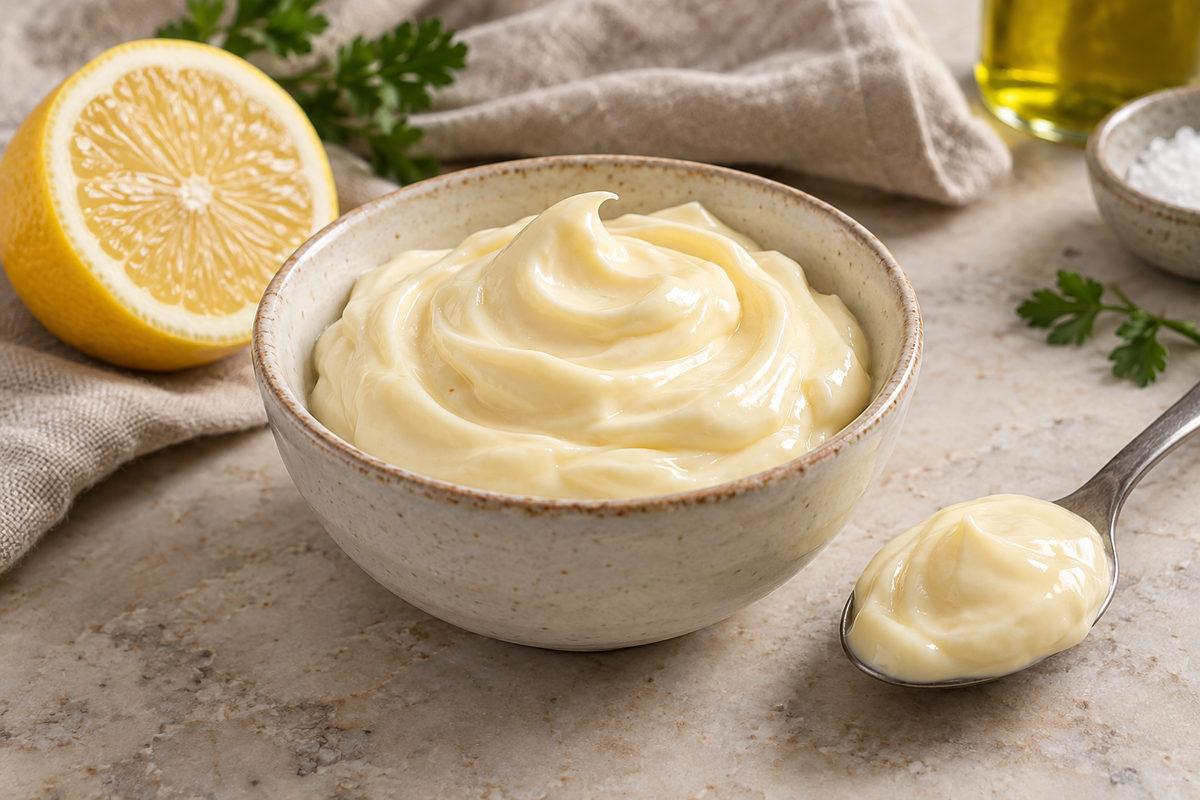

A good jar of mayonnaise is useful. A small batch you can season exactly the way you like is even more useful: brighter for a tomato sandwich, a little sharper for potato salad, or plain enough to become tomorrow's dressing.
To make mayonnaise with an immersion blender, put a pasteurized whole egg, lemon juice, Dijon, and salt in a narrow, flat-bottomed container, then add oil. Start with the blending head resting over the yolk. Hold it still until a thick emulsion develops, then lift slowly to incorporate the remaining oil. The blending can take roughly 60 seconds; allow about five minutes for the whole recipe.
The important detail is not a special setting. It is the relationship between the container, the blade, and that first small pool of egg.
Choose the container before you crack the egg
Use a tall, food-safe blending beaker with a flat bottom and an internal diameter only slightly wider than the blender's bell-shaped blade guard. The head must move freely, but it should not sit in the middle of a broad pool. Check the fit with the appliance unplugged.
There is no universal jar diameter: blender heads differ. What matters is that the egg-and-lemon mixture reaches the blades when the head rests at the bottom. A container can be tall and still be too wide. Avoid a shallow mixing bowl for this particular all-at-once method. Serious Eats' method explains why this close fit matters.
Choose enough capacity for the finished batch plus working room—roughly a 2-cup beaker is a practical starting point, provided its shape fits your blender. Do not force the head into a drinking glass or use chipped glass. A lidded storage jar can wait until the blending is finished.
Immersion blender mayonnaise recipe
Yield: about 1¼ cups, or 20 tablespoons
Total time: about 5 minutes, including roughly 30–60 seconds of blending
Equipment: immersion blender with blending arm, narrow blending-safe beaker, measuring spoons, and a clean lidded container.
Ingredients
- 1 large commercially pasteurized in-shell whole egg
- 1 tablespoon fresh lemon juice
- 1 teaspoon Dijon mustard
- ¼ teaspoon fine salt, plus more to taste
- 1 cup (240 ml) neutral oil, such as canola or sunflower oil
Choose an egg labeled pasteurized; “organic,” “cage-free,” and “farm fresh” do not mean the same thing. This is an uncooked recipe. The FDA recommends pasteurized eggs or egg products for foods served with raw or undercooked egg. This specific formula uses a whole shell egg, not an unspecified volume of egg substitute.
Neutral oil lets the lemon and mustard stay in balance. Extra-virgin olive oil brings a stronger taste and can become unpleasantly bitter in blender mayonnaise; save it for another preparation if you want a mild first batch. Do not reduce the oil dramatically and expect the same thick texture. KitchenAid's mayonnaise guide discusses oil choices and substitutions.

The approximately 60-second blending method
- Prepare a clean workspace. Wash your hands and clean the beaker, blending arm, and utensils. Assemble the appliance according to its manual. Keep the motor housing dry.
- Build the base. Crack the pasteurized egg into the beaker. Add the lemon juice, Dijon, and salt. Pour the oil over them and allow the layers to settle briefly without stirring.
- Position before switching on. Lower the blending head to the flat bottom, centered over the yolk. The blade area needs contact with the egg mixture. Stabilize the beaker on a dry, nonslip surface.
- Start and stay still. Blend at a steady, sufficiently high speed, following your model's operating instructions. Do not pump the head up and down. Watch for a pale, thick layer spreading around the bottom.
- Bring in the remaining oil. Once that base is established, raise the head gradually through the mixture. Keep its openings below the surface as the oil is incorporated. Stop when the mayonnaise looks uniform and creamy, usually within about a minute of blending. Observe the appliance's continuous-run limit.
- Finish and chill. Switch off before lifting out the head. Taste with a clean spoon, adjust salt, and transfer to a clean covered container. Refrigerate promptly and label the preparation date.
Use the texture as your cue, not a stopwatch. Different head designs and ingredient temperatures can change the timing. Inspired Taste also demonstrates this bottom-up immersion-blending approach. If the mixture is still loose and oily, stop and check the setup instead of running the motor indefinitely.

Use the blending arm—not the whisk—for this method
If you have the Fresko H9 immersion blender set, attach its blending arm for the recipe above. Its variable-speed trigger lets you adjust speed while keeping the head in place. Check the beaker fit yourself; included accessories are not a guarantee that every small batch has the necessary depth.
The whisk is useful for aerated mixtures such as whipped cream and egg whites. It can also be used in a different mayonnaise technique with oil added gradually, but it does not recreate this blade-at-the-bottom, oil-on-top setup. For more on keeping the head submerged, see how to use an immersion blender without splatter.
Why immersion blender mayo fails—and what to do
A broken emulsion is a texture problem. It is not automatically a food-safety problem, but rescuing the texture cannot make mishandled ingredients safe.
| What you see | What to check | Next step |
|---|---|---|
| Thin, oily mixture from the start | Beaker too wide or egg mixture below the blades | Stop. Choose a better-fitting vessel and use the fresh-egg recovery below. |
| Thick bottom with oil above it | The first emulsion is working; upper oil remains | Raise the head gradually while keeping the openings submerged. |
| Mixture separates after an early lift | Too much oil reached the blades before the base formed | Restart an emulsion in a clean beaker, then feed in the broken mixture slowly. |
| Uniform but too thick to spread | No visible separate oil; emulsion is intact | Stir in drinking water ½ teaspoon at a time until it suits your use. |
| Foamy or splattered mayonnaise | Blade openings broke the surface | Stop, lower the head, and avoid further unnecessary blending. |
Recover a freshly broken batch
Put one fresh, commercially pasteurized whole egg in a clean, narrow beaker. Add a spoonful of the broken mixture and position the head over the egg, making sure the liquid reaches the blades. Start blending, then incorporate the rest very slowly—small additions first, followed by a thin stream once it thickens. This creates a new emulsion instead of repeatedly churning the failed one. KitchenAid describes a related fresh-yolk recovery technique; whichever method you use, add the broken mixture gradually.
The repaired batch will be larger and may need seasoning. Only attempt this immediately with safely handled ingredients; adding an egg does not restart the storage clock.
Homemade mayonnaise storage and egg safety
Keep homemade mayonnaise covered at 40°F (4°C) or below and use it within four days. This follows USDA guidance for homemade mayonnaise made with pasteurized eggs. Make a smaller batch another day instead of planning on several weeks of storage. Freezing is not recommended because the emulsion can separate.
Keep serving portions small and return the main container to the refrigerator. Discard mayonnaise left unrefrigerated for more than two hours, or one hour when the temperature is above 90°F (32°C), following FDA egg-handling guidance. Use clean utensils and do not rely on smell to judge safety.
Lemon juice supplies flavor; this recipe is not a validated acidification or preservation process. Neither added acid nor vacuum sealing makes it shelf-stable. Pasteurization reduces the raw-egg risk but does not replace refrigeration or clean handling.
Quick answers
Is an “emulsion blender” a different appliance?
For this recipe, the tool is an immersion blender, also called a hand or stick blender. “Emulsion” describes the mixture you are making, not an attachment you need to buy.
Can I make it without mustard?
Other mayonnaise formulas omit mustard, but keep it in this first batch: it adds flavor and helps the emulsion. For a mustard allergy, choose a separately developed mustard-free recipe rather than assuming a direct substitution.
Can I make a half batch?
Not reliably with the same container. Reducing the starting liquid may put it below the blades. Make this whole-egg batch in a suitable vessel and share or use it within the refrigerated storage window.
What should I make with the finished mayo?
Start with a tomato sandwich or a spoonful alongside roasted potatoes. For a quick dip, stir a little hot sauce into a serving portion. Explore the Fresko immersion blender recipe collection when you are ready for the next project.
Aktie:
12 Immersion Blender Recipes for Soups, Sauces, and More
Sous Vide Egg Bites: Make-Ahead Breakfast Guide