

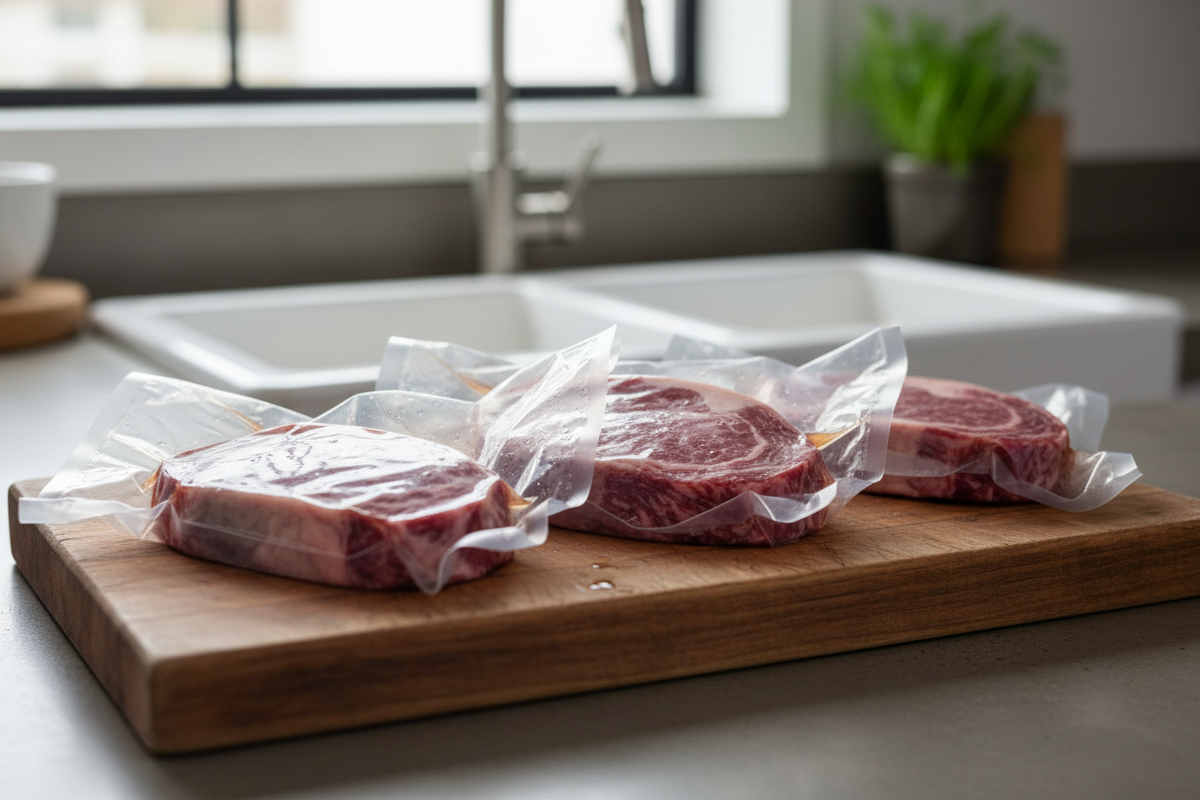
 How long does vacuum sealed meat last? Whether you're stocking a chest freezer with bulk beef, preserving a deer harvest, or meal-prepping for the week, the answer depends on the food and its storage conditions. Vacuum packaging helps protect freezer quality, but it does not sterilize meat or provide a universal refrigerator extension. Below you'll find food-specific storage guidance and practical tips for meat storage.
Quick answer: For meat vacuum sealed at home and kept at 40°F (4°C) or below, use 1–2 days for raw poultry, ground meat, and raw sausage; 3–5 days for raw beef, pork, veal, and lamb steaks, chops, and roasts; and 3–4 days for cooked leftovers. Vacuum sealing does not reset these limits. Freezer times describe quality: food that was safe when frozen and stays continuously at 0°F (−18°C) or below remains safe indefinitely. FoodSafety.gov provides food-specific guidance.
Vacuum Sealed Meat Shelf Life at a Glance
| Storage condition | Raw meat | Cooked leftovers | Raw venison |
|---|---|---|---|
| Home refrigerator, 40°F or below | 1–2 days for poultry/ground meat/raw sausage; 3–5 days for whole red-meat cuts | 3–4 days | 2–3 days for fresh venison cuts; freeze promptly |
| Freezer, 0°F or below: quality guide | Whole red-meat cuts: 4–12 months; ground meat: 3–4 months; whole poultry: 12 months; poultry pieces: 9 months | 2–6 months | 9–12 months for properly wrapped venison cuts |
| Does home vacuum packing add refrigerator days? | No separate extended limit used here | No: not 2 weeks | No: do not use a 5–7 day vacuum-storage promise |
| Sources | FoodSafety.gov | FoodSafety.gov | Penn State Extension |
How Long Does Vacuum Sealed Meat Last? (Full Storage Chart)
| Meat and packaging condition | Refrigerator: 40°F or below | Freezer: 0°F or below, best quality | Source |
|---|---|---|---|
| Raw beef steaks and roasts; home packed | 3–5 days | 4–12 months | FoodSafety.gov |
| Raw ground beef; home packed | 1–2 days | 3–4 months | FoodSafety.gov |
| Raw chicken, whole or pieces; home packed | 1–2 days | Whole: 12 months; pieces: 9 months | FoodSafety.gov |
| Raw pork chops and roasts; home packed | 3–5 days | 4–12 months | FoodSafety.gov |
| Raw fatty fish, such as salmon; home packed | Use within 2 days after purchase or freeze | 2–3 months | FoodSafety.gov seafood handling; FoodSafety.gov |
| Raw lean fish, such as cod; home packed | Use within 2 days after purchase or freeze | 6–8 months for cod | FoodSafety.gov seafood handling; FoodSafety.gov |
| Raw lamb steaks, chops, and roasts; home packed | 3–5 days | 4–12 months | FoodSafety.gov |
| Fresh raw venison cuts; home packed | 2–3 days | 9–12 months for properly wrapped cuts | Penn State Extension |
| Raw sausage made from poultry, pork, or beef; home packed | 1–2 days | 1–2 months | FoodSafety.gov |
| Cooked meat or poultry leftovers; home packed | 3–4 days | 2–6 months | FoodSafety.gov |
| Opened lunch meat or deli-sliced meat; also if resealed at home | 3–5 days | 1–2 months | FoodSafety.gov |
| Commercial luncheon meat, unopened | 2 weeks | 1–2 months | FoodSafety.gov |
| Fully cooked ham, vacuum-sealed at plant, unopened | 2 weeks or manufacturer use-by date | 1–2 months | FoodSafety.gov |
Vacuum-packed fish needs a thawing precaution: For fish labeled to stay frozen until use, remove it from the vacuum packaging before refrigerator thawing; do not simply thaw it in the intact sealed bag. Follow the manufacturer's directions. This distinction is specified in FDA Food Code 2026, section 3-501.13(E).
Does Vacuum Sealing Meat Move the Needle?
 Vacuum sealing can help protect meat against air exposure and moisture loss during storage. It is especially useful for portioning freezer meals. It does not remove every trace of oxygen or make the following benefits absolute:
- It reduces air exposure: Vacuum packaging removes much of the air, but some harmful bacteria can grow in low-oxygen conditions. Keep perishable meat cold and follow time limits. USDA explains reduced-oxygen risks.
- It helps protect flavor: Good packaging helps limit oxidation and moisture loss. Color is not a safety test: vacuum-packed beef can be purple or burgundy without being spoiled. USDA color guidance.
- It helps reduce freezer burn: Tight, suitable packaging limits air contact and moisture loss, but damaged bags and poor temperature control can still reduce quality. USDA packaging advice.
|
⚠ Important Safety Note
Vacuum sealing does NOT kill anaerobic bacteria such as Clostridium botulinum.
Perishable raw or cooked vacuum-packed meat must be refrigerated at 40°F or below or frozen at 0°F or below. USDA reduced-oxygen food guidance.
Never store vacuum sealed raw meat at room temperature.
|
How Long Will Vacuum Sealed Meat Last in the Refrigerator?
 For home-packed meat, follow the food-specific refrigerator limits: raw poultry, ground meat, and raw sausage 1–2 days; whole beef, pork, lamb, and veal cuts 3–5 days; cooked meat leftovers 3–4 days. Opened lunch meat is 3–5 days. A longer window for a particular unopened commercial product does not apply to home-resealed portions.
Key factors for refrigerator shelf life:
- Freshness at sealing: Seal promptly after purchase or processing while the meat is cold and safe. Sealing does not erase earlier refrigerated time.
- Seal integrity: A failed seal does not start a new storage clock. Use the original time and temperature history; discard perishable food if that history cannot be established.
- Temperature: Keep refrigerated food at 40°F or below. Refrigerate perishable food within 2 hours, or within 1 hour when the surrounding temperature is above 90°F. USDA handling guidance.
- Meat type: Raw poultry, ground meat, whole red-meat cuts, and cooked leftovers have different refrigerator limits. Match the category in the chart.
How Long Can Vacuum Sealed Meat Last Before It Goes Bad?
- Unexpectedly swollen or leaking packaging: Do not taste the contents to investigate; discard suspect perishable meat.
- Broken or compromised seal: Do not add a fresh 1–2 days. Account for all earlier refrigerator time. If a bag tears while food stays safely frozen, USDA says it can be overwrapped or rewrapped.
-
Off or sour odor: Any unusual smell is a discard signal.
-
Slimy or sticky surface: Bacterial biofilm — do not rinse and cook. Discard entirely.
- Color changes: Color alone does not establish spoilage or safety. Discard meat with mold, slime, off odors, or unsafe handling history; do not try to make spoiled food safe by cooking it.
|
🚫 Never Rely on Smell Alone
Dangerous pathogens like Salmonella and E. coli produce no detectable odor.
Always follow the time guidelines in the chart above, regardless of appearance or smell.
When in doubt, throw it out — USDA food safety guidance.
|
How Long Does Meat Last in Vacuum Seal Bags?
How Long Does Vacuum Sealed Food Last?
| Food group retained from the original guide | How to choose a storage limit |
|---|---|
| Raw meat | Use the meat-specific limits above; do not apply a vacuum-sealing multiplier. FoodSafety.gov |
| Cooked meals | Most home-cooked meat leftovers: 3–4 days refrigerated; freezing quality depends on the dish. FoodSafety.gov |
| Hard cheese | Check the exact cheese and whether the package is opened. Do not use a blanket 4–8 month refrigerator claim. FoodKeeper lookup |
| Blanched vegetables | Follow the vegetable-specific freezing preparation and storage advice; do not assume years of quality for every vegetable. USDA freezing guidance |
| Fruits | Choose guidance for the exact fruit and preparation; a vacuum seal is not a universal refrigerator extension. FoodKeeper lookup |
| Dry rice and nuts | Follow the food-specific package and storage instructions. These categories do not share a single shelf life. FoodKeeper lookup |
How Long Does Vacuum Sealed Deer Meat Last?

| Venison form | Refrigerator / freezer planning | Source and scope |
|---|---|---|
| Fresh raw steaks and roasts | Use fresh cuts within 2–3 refrigerated days; properly wrapped cuts have a 9–12 month freezer quality guide. | Penn State Extension; not a vacuum-specific extension |
| Ground venison | Freeze promptly if not cooking soon. Do not transfer the whole-cut freezer-quality estimate to every grind or mixture. | Follow the processor’s specific handling instructions; general venison guidance |
| Raw venison sausage | Use the recipe or processor’s product-specific guidance, especially when other meat is added; do not assume 1–2 years of quality. | For pork/beef/poultry sausage, FoodSafety.gov lists 1–2 days refrigerated and 1–2 months frozen. |
| Cooked venison leftovers | Use within 3–4 refrigerated days. | USDA leftover handling |
Best practices for vacuum sealed venison:
- Chill promptly: Follow safe field-dressing, transport, and processing advice for local conditions. Do not interpret “process within 24 hours” as permission to leave the carcass warm. Clemson Extension wild-game guidance.
- Trim for quality: Remove damaged tissue and unwanted fat or connective tissue during preparation. Trimming is not a safety treatment and does not grant extra refrigerated days.
- Inspect the seal: Use a second heat seal only if the machine and bag instructions allow it. Check for wrinkles, liquid, and punctures.
- Freeze flat before stacking: Leave room around packages so they freeze promptly; stack them after they are solid. Avoid a fixed 12–24 hour promise for every package.
- Label with cut and date: Include the processing or purchase date and freeze date. This prevents mystery packages and helps you rotate older portions first.
 Vacuum Sealed Meat Storage Mistakes to Avoid
- Temperature fluctuations: Each freeze-thaw cycle damages meat cell walls, causing texture degradation even inside a vacuum seal. Set your freezer to 0°F and minimize door-opening.
- Refreezing thawed meat unnecessarily: Meat thawed in the refrigerator can be refrozen if handled safely and still within its food-specific refrigerated storage window; quality may decline. Cook meat thawed in cold water or the microwave before refreezing. Portion meat before sealing so you only thaw what you need.
- Sealing with moisture near the seal area: Wipe the inside of the bag near the opening before sealing. Moisture can interfere with a reliable seal.
- Using low-quality bags: Choose compatible freezer bags and rolls, and inspect for punctures and poor seams. Do not treat a bag grade as a fixed storage-life guarantee.
- Sealing warm or hot meat: Refrigerate cooked meat promptly in shallow portions; hot food may go directly into the refrigerator. Once chilled, package it according to the machine instructions. Do not leave cooked meat on the counter to cool. USDA cooling guidance.
- Not labeling: Without a date and contents label, it is harder to track storage windows and avoid unnecessary food waste.
Frequently Asked Questions
How long does vacuum sealed meat last in the fridge?
How long will vacuum sealed meat last in the freezer?
How long can vacuum sealed meat last before it goes bad?
How long does meat last in vacuum seal bags?
How long does vacuum sealed food last?
How long does vacuum sealed deer meat last?
Final Thoughts
- Raw meat: 1–2 refrigerated days for poultry, ground meat, and raw sausage; 3–5 for whole red-meat cuts.
- Cooked leftovers: 3–4 days refrigerated; freeze promptly for longer storage.
- Deer / venison: Follow safe game handling and food-specific guidance; do not rely on a vacuum-sealing extension.
- Other foods: Match advice to the exact food and preparation rather than applying a universal multiplier.
- Bag quality matters: Use suitable bags, protect them from damage, and inspect each seal.
- Cold storage is essential: Vacuum packaging is not sterilization; sealing does not restart a food-safety clock.
Food safety note: These are general home-storage guidelines, not product shelf-life testing. Follow specific package instructions and do not use appearance or smell as proof of safety. Refrigerate perishable food at 40°F or below; freeze at 0°F or below.
Share:
Mother’s Day Gift Ideas: Thoughtful Kitchen Upgrades Every Mom Will Love
How to Use a Vacuum Sealer: Step-by-Step (Beginner-Friendly)