

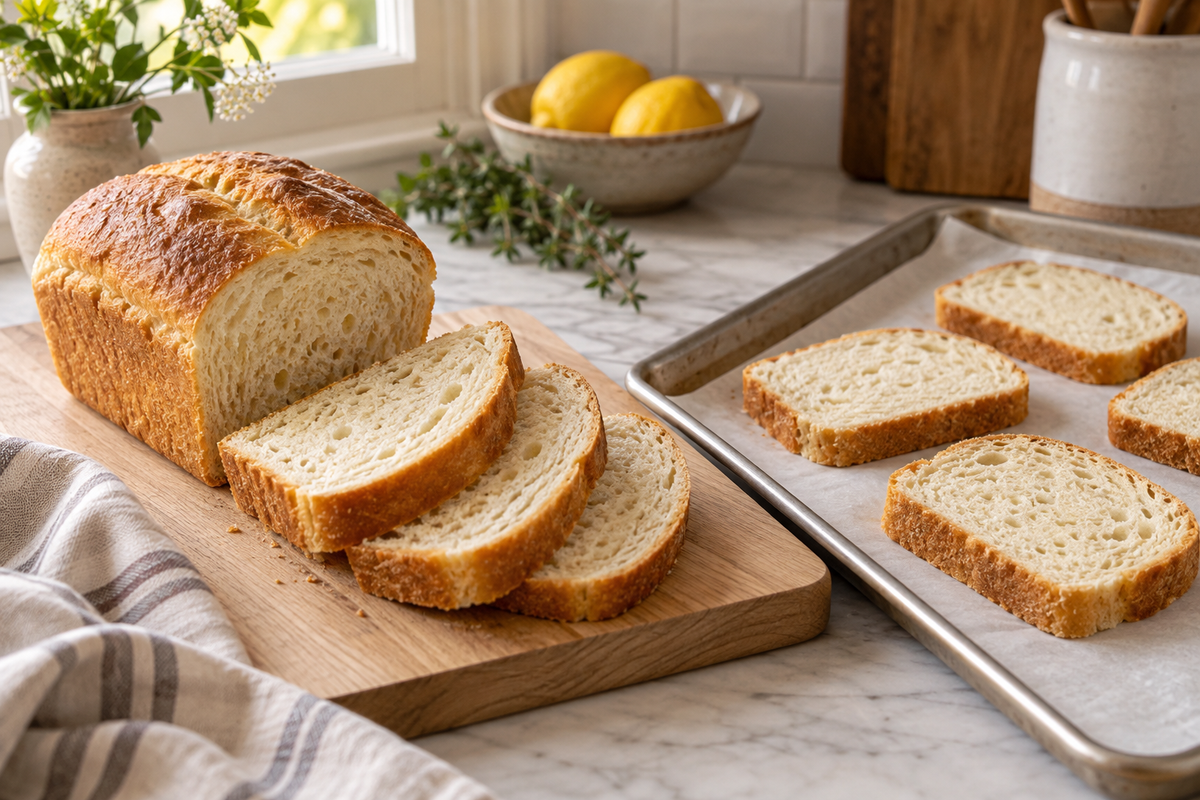
Quick answer: Yes, you can vacuum seal bread, but soft loaves can flatten as a bag tightens. For freezer storage, cool the bread, portion it, and freeze it firm before sealing gently. Use manual vacuum control or a compatible rigid container when shape matters. Vacuum packaging does not make bread shelf-stable.
A squashed loaf may still become toast, but it is not the sandwich bread you meant to save. The useful question is not how tightly you can seal it. It is how much air you can remove while keeping the crumb and crust in a condition you will enjoy.
This guide covers plain, fully baked bread, including sandwich slices, sourdough, rolls, and bagels. Filled sandwiches and breads with perishable fillings need their own refrigeration and food-safety rules.
Choose the method around the bread
A flexible bag presses against its contents as air is removed. Bread's airy structure can collapse under that pressure. A firm crust does not necessarily protect the soft center, and a gentle setting cannot guarantee an unchanged loaf.
For very delicate bread, a compatible rigid vacuum container avoids the bag squeezing directly against the surface. Check the container's usable dimensions: a stated capacity in liters does not tell you whether your loaf will fit without bending.
| Bread or situation | Practical starting point | Watch for |
|---|---|---|
| Soft sandwich slices | Freeze individual slices firm, then package in small portions with controlled vacuum. | Edges curling or slices compressing together. |
| Whole sourdough or crusty loaf | Portion first if you will not use the whole loaf together; freeze firm before bagging. | Sharp crust ridges stressing the film, or the center flattening. |
| Bagels and sturdy rolls | Split or portion before freezing if that suits how you serve them. | Tight packing deforming the cut surfaces. |
| Brioche or airy dinner rolls | Favor a correctly sized rigid container when presentation is important. | A lid pressing on the tops; container storage permissions. |
| Bread for the next meal | Ordinary suitable bread packaging may be enough; vacuum sealing is optional. | Spending time and packaging on bread you will use immediately. |
These are handling choices, not a tested ranking of bread varieties. Start with a small portion rather than risking a whole fresh batch.
How to vacuum seal bread without crushing it: a freeze-first workflow
- Cool plain bread completely. Do not bag a warm loaf. Let steam escape before packaging so you are not trapping condensation against the crumb. Perishable fillings are outside this workflow; do not leave those foods out while waiting for bread to cool.
- Choose portions you will actually use. Slice a sandwich loaf before freezing, or divide it into meal-size sections. A two-slice pack is easier to use than repeatedly opening and resealing a whole loaf.
- Freeze until firm. Arrange slices or rolls without stacking them into a heavy pile. A thin slice and a large loaf will not firm up at the same rate, so use their condition rather than a universal number of minutes. Package promptly once firm.
- Use the right packaging. Choose compatible heat-seal vacuum bags for a countertop sealer, or the appropriate valve bags for a handheld system. Keep crumbs and moisture away from seams, zippers, and valves. Leave the clearance specified by the machine and bag instructions.
- Remove air cautiously. Use the model-specific controls below and watch the bread, not just the bag. Stop if the loaf begins to lose height or the slices fold. Do not chase the tightest-looking package.
- Check, label, and freeze. Inspect the closure and film for gaps or damage. Label the bread type, portion count, and freezing date, then return it to the freezer. Avoid placing heavy packages on top.
Pre-freezing is a shape-protection step, not sterilization. It also does not make excessive vacuum harmless. For exceptionally airy bread, choose a rigid container or ordinary freezer packaging instead of forcing a bag method to work.
New V8 Pulse Vac and HV9 SOFT are different controls
Both systems offer an alternative to treating delicate bread like a firm piece of meat. Their controls and packaging are different, however. Match the instructions to the model printed on your machine.
New V8: you control the vacuum duration
The New V8 automatic vacuum sealer has a manual sequence for delicate foods. The U.S. manual instructs you to select MANUAL with the MODE button before inserting the bag. Secure the opening in the bag-mouth clamp and close the lid. Hold PULSE VAC to remove air, release it at the desired level, then press MANUAL SEAL.
For bread, watch for the first visible compression and release promptly. More suction is not automatically a better result. This is the New V8 procedure; do not assume an earlier V8 model has the same buttons or sequence.

HV9: SOFT is a gentler automatic mode
The FRESKO HV9 handheld vacuum sealer set uses valve bags and compatible glass containers. Its U.S. manual specifically identifies SOFT for delicate foods such as bread.
For a valve bag, stay below its maximum fill line, close the zipper fully with the sealing clip, and lay it flat with the valve upward. Place the nozzle over the valve and start SOFT. The unit stops automatically; the manual also says pressing any button stops operation. Watch for deformation rather than assuming the automatic endpoint suits every loaf.
Container distinction: the HV9 manual specifies FIRM for its glass vacuum containers, with the lid tightly closed and the nozzle connected to the lid valve. Do not carry the bag's SOFT instructions over to the container. Check the supplied container's temperature and freezer-use instructions separately.
| Control | What you control | Bread-related limit |
|---|---|---|
| New V8 Pulse Vac | Vacuum duration by holding and releasing; a separate manual sealing step. | Requires observation and compatible heat-seal bags. |
| HV9 SOFT | A gentler automatic bag cycle, with a manual stop option. | Not a pulse function and not a no-crush guarantee. |
| HV9 glass-container workflow | FIRM mode through the container valve. | Rigid walls protect against bag squeeze; the bread must fit without pressure from the lid. |

When the package does not look right
| What you see | What to change |
|---|---|
| Bread flattens while vacuuming | Stop. Next time, freeze it firmer, remove less air, or use a suitable rigid container. |
| Crumbs across the closure | Clean and dry the sealing area or zipper before trying again. |
| A bag becomes loose again | Check the seam, valve, zipper, and film for damage. Repackage in compatible intact packaging rather than repeatedly running the pump. |
| A crust ridge strains the bag | Reposition the portion or choose a suitable container; do not pull the film tighter over the sharp point. |
| The crust loses its crispness | Plan to refresh the bread after storage. Airtight packaging does not preserve a just-baked crust indefinitely. |
Storage, thawing, and realistic expectations
For longer storage, freezing is the practical direction for plain bread. King Arthur Baking's bread-storage guidance favors freezing in usable portions and refreshing slices as needed. Keep the freezer at 0°F (-18°C) or below, consistent with USDA freezing guidance.
Open the tight vacuum package while the bread is still firm, then transfer the portion to ordinary food-safe covering for thawing. This gives the crumb space as it softens. Remove all packaging before toasting or warming. A filled sandwich is different: follow its perishable-ingredient handling and thawing instructions.
There is no single extra shelf life to promise for all vacuum-sealed bread. Ingredients, freshness at packing, temperature, packaging, and how often the package is opened all matter. Vacuum sealing does not reverse staling or make moldy bread usable. USDA advises discarding moldy bread and baked goods, rather than trimming away the visible patch.
Frequently asked questions
Can you vacuum seal fresh bread without freezing it first?
Sometimes, using careful vacuum control or a suitable rigid container. Very soft bread can still collapse. Freezing first is a useful option when the bread is headed for freezer storage anyway.
Are whole loaves better than slices for vacuum sealing?
Neither is automatically better. Choose a whole loaf when you will serve it together; choose slices or smaller sections when you want individual portions. Both still need protection from compression.
Can I use the bread's original supermarket bag?
Do not assume it is compatible with a vacuum sealer's air channels, heat seal, or valve connection. Transfer bread to packaging approved for your exact system.
Choose for your routine: compare vacuum sealers by their control method and packaging, then follow the instructions supplied with your exact model. The FRESKO product manuals page includes the New V8 guide; FRESKO product support can help confirm the correct manual or accessory.
Aktie:
Are Vacuum Sealer Bags Universal? A Bag-and-Machine Compatibility Guide