

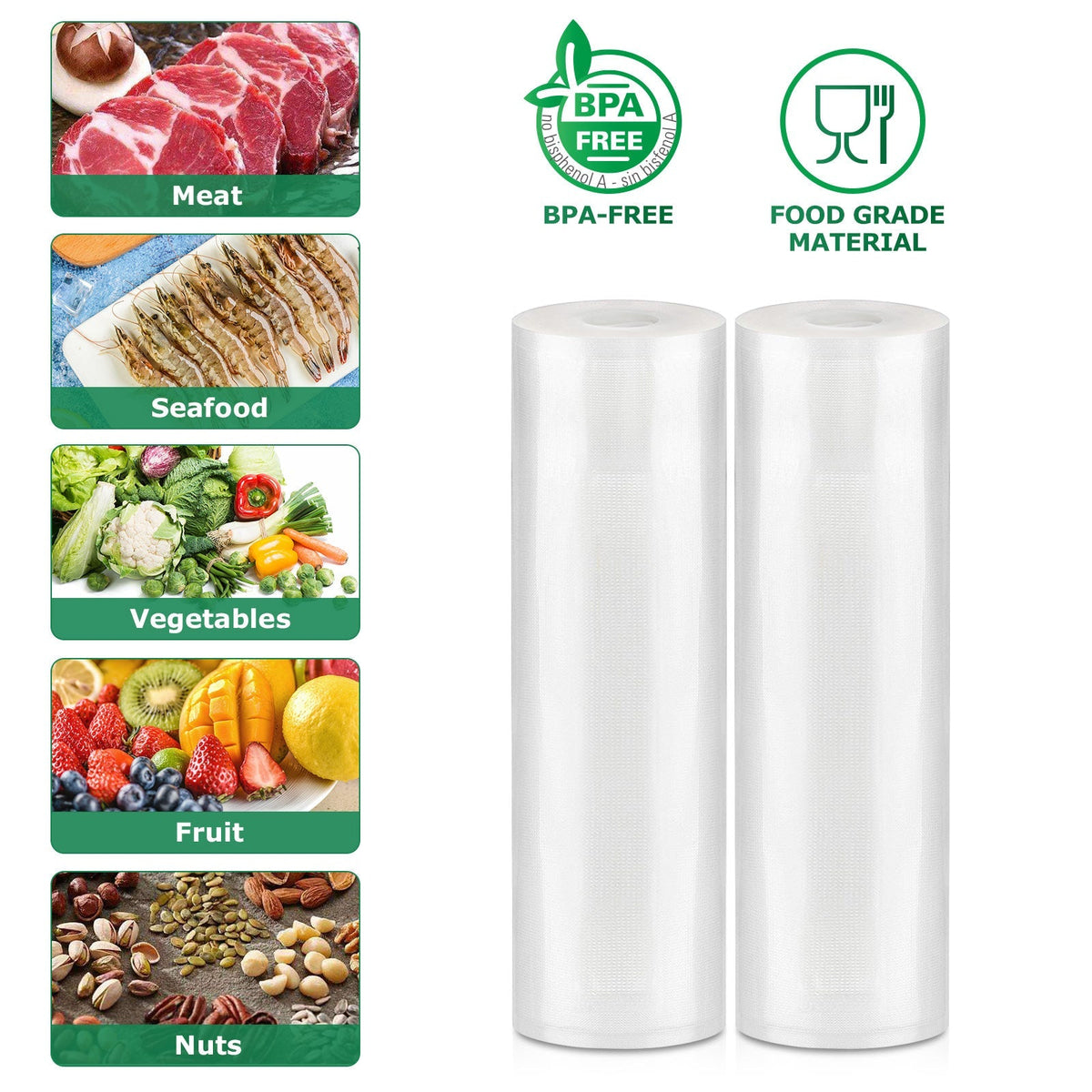
A bargain box of bags is only a bargain if your machine can remove the air and close the package reliably. The confusing part is that “vacuum sealer bag” can describe several different systems, not one interchangeable product.
Are vacuum sealer bags universal? No. Many embossed heat-seal bags work across compatible external suction machines, but smooth chamber pouches and valve-equipped zipper bags belong to different systems. Match the bag’s air-removal design, opening width, sealing requirements, and intended food use to your exact machine before buying a larger supply.
This guide focuses on compatibility: which bag belongs with which machine, and what to check before loading food. It is a documentation-based guide, not a claim that we tested every brand combination.
Match the bag to the vacuum system first
Start with where the air leaves the package. Does the machine pull through an open bag edge, evacuate a chamber around the bag, or connect to a valve? These are different jobs, even when the finished food looks similarly packed.
| Bag type | Usual matching system | What still needs checking |
|---|---|---|
| Embossed or channel-textured heat-seal bag | Standard external suction / edge sealer | Approved film, opening width, loading position, and seal settings |
| Smooth chamber pouch | Chamber vacuum sealer | Pouch and filled-food fit inside the chamber; compatible sealing requirements |
| Reusable zipper bag with a vacuum valve | Matching handheld pump or approved accessory connection | Valve connection, zipper closure, food-use limits, and cleaning instructions |
| Ordinary sandwich or freezer zipper bag | Not automatically a machine-vacuum bag | Do not assume it can be evacuated or heat-sealed by your appliance |
For example, Anova’s chamber pouch specifications expressly exclude edge sealers. FoodSaver’s zipper-bag guidance likewise distinguishes its handheld system from bags that need a heat seal. The machine category matters more than a familiar brand name.
Why embossed bags work differently from smooth pouches
On a conventional edge sealer, the food stays outside the machine while the bag opening sits in the vacuum channel. Texture inside a compatible bag provides routes for air to escape as the walls draw together. Without those routes, a smooth pouch can flatten near the opening while air remains around the food.
A chamber machine removes air from the space around the package as well as from inside it. Its pouches do not need the same internal channel pattern. That difference explains why inexpensive chamber pouches are not a straightforward substitute for external-sealer bags.
Do not try to solve a mismatch by inserting an improvised straw or strip of plastic. Choose packaging approved for the system. Specialty nozzle machines are another category; their instructions, not a general edge-sealer rule, determine the correct bag.
Five checks before you buy replacement bags
- Identify the exact model. Check its manual for bag type and any restrictions. An accessory port does not turn every bag into a compatible accessory.
- Measure the opening width. The entire opening must fit within the machine’s usable sealing span. Do not confuse the thickness of the finished seal line with the maximum bag width. A “5 mm seal,” for example, does not describe the opening size it accepts.
- Check length and usable space. Leave the loading allowance required by the manual. A chamber pouch must also fit inside the chamber with its contents. For rolls, check storage-compartment fit separately from sealing compatibility; a bulky roll may need to be stored outside the machine.
- Confirm the film and intended use. “BPA-free,” “freezer-safe,” and “sous-vide-safe” answer different questions. None alone proves machine compatibility or permission for every cooking method. Check the specified material and thickness; thicker is not automatically compatible with the same seal settings. Look for instructions for the specific bag, including temperature and time limits where applicable.
- Resolve uncertainty before buying in bulk. Ask the machine or bag manufacturer to confirm the model pairing. Once approved, start with a small pack and check the finished seals during normal use. One successful seal is not evidence that an unsupported material is suitable.
Cross-brand recommendations are not identical. Weston lists several compatible heat-seal brands for a specific bag SKU. In contrast, FoodSaver’s own guidance recommends its bags for its units and warns that other sealing bars may be too hot or too cool. A third-party “universal” label does not override your machine’s instructions.
Which FRESKO bags belong with which setup?
The vacuum sealer bags collection describes compatibility with major brands that support standard external vacuum sealing. Read that as a system boundary, not a promise that the bags work with every chamber, handheld, or specialty machine.
FRESKO precut vacuum sealer bags come in 6-by-10-inch and 8-by-12-inch options. Verify the selected size against your machine and the portion you want to pack. Precut describes the ready-made format; it is not a separate vacuum technology.
The FRESKO HV9 handheld vacuum sealer set uses reusable valve-equipped bags and compatible glass containers. Its pump is placed over the valve. Ordinary open-ended heat-seal bags are not replacements for those valve bags, and another brand’s valve is not automatically an HV9 match.
New V8 offers heat sealing plus a separate accessory-vacuum function. Use the correct connection for each task; do not put a valve bag in the heat-seal path merely because the appliance also supports accessories. Consult the exact model in FRESKO product manuals.
Once compatibility is settled, our rolls versus precut bags comparison covers the separate choice between custom sizing and faster portioning.

A bag will not vacuum or hold its seal: what to check
| What you notice | Check before blaming the bag brand |
|---|---|
| Pump runs, little air leaves | Correct bag system, opening position, sufficient headspace, and an intact bag |
| Seal is wrinkled, weak, or incomplete | A clean, dry, flat sealing area and the approved film/settings combination |
| Package loosens after sealing | Punctures, damaged seams, or contamination at the closure; for valve bags, zipper and valve condition too |
The New V8 manual identifies incorrect loading, overfilling, punctures, and moisture near the sealing area as possible causes. Follow its troubleshooting sequence instead of repeatedly running a failing package. A stronger vacuum cannot repair a hole. Stop using visibly damaged bags.
A tight package also does not prove the food is safe. USDA guidance on vacuum-packed meat requires perishable meat and poultry to remain refrigerated at 40°F or below, or frozen at 0°F or below. Vacuum packaging is not room-temperature preservation.
Common compatibility questions
Can you use any vacuum sealer bags with any machine?
No. Start with the system in the matrix, then confirm the precise bag and model. Matching width alone is not enough: the machine must be able to remove air through the bag’s design and close it as intended.
Can you use any bags in a vacuum sealer if they melt closed?
No. Making a heat seal is not the same as evacuating air or establishing suitability for food storage. Never treat a melted seam on an ordinary plastic bag as approval for vacuum packaging.
Are reusable vacuum bags automatically suitable for the freezer or sous vide?
No. Check the exact product. FoodSaver, for example, publishes separate instructions for its reusable zipper-bag range. Do not transfer another product’s cooking, freezing, or washing permissions to your own bags just because both have valves.
The takeaway: shop by system first, dimensions second, and intended use third. That order is more useful than the word “universal” on a package—and leaves fewer incompatible bags in the kitchen drawer.
Aktie:
How to Clean a Vacuum Sealer: Seal Bar, Vacuum Channel, and Gaskets