

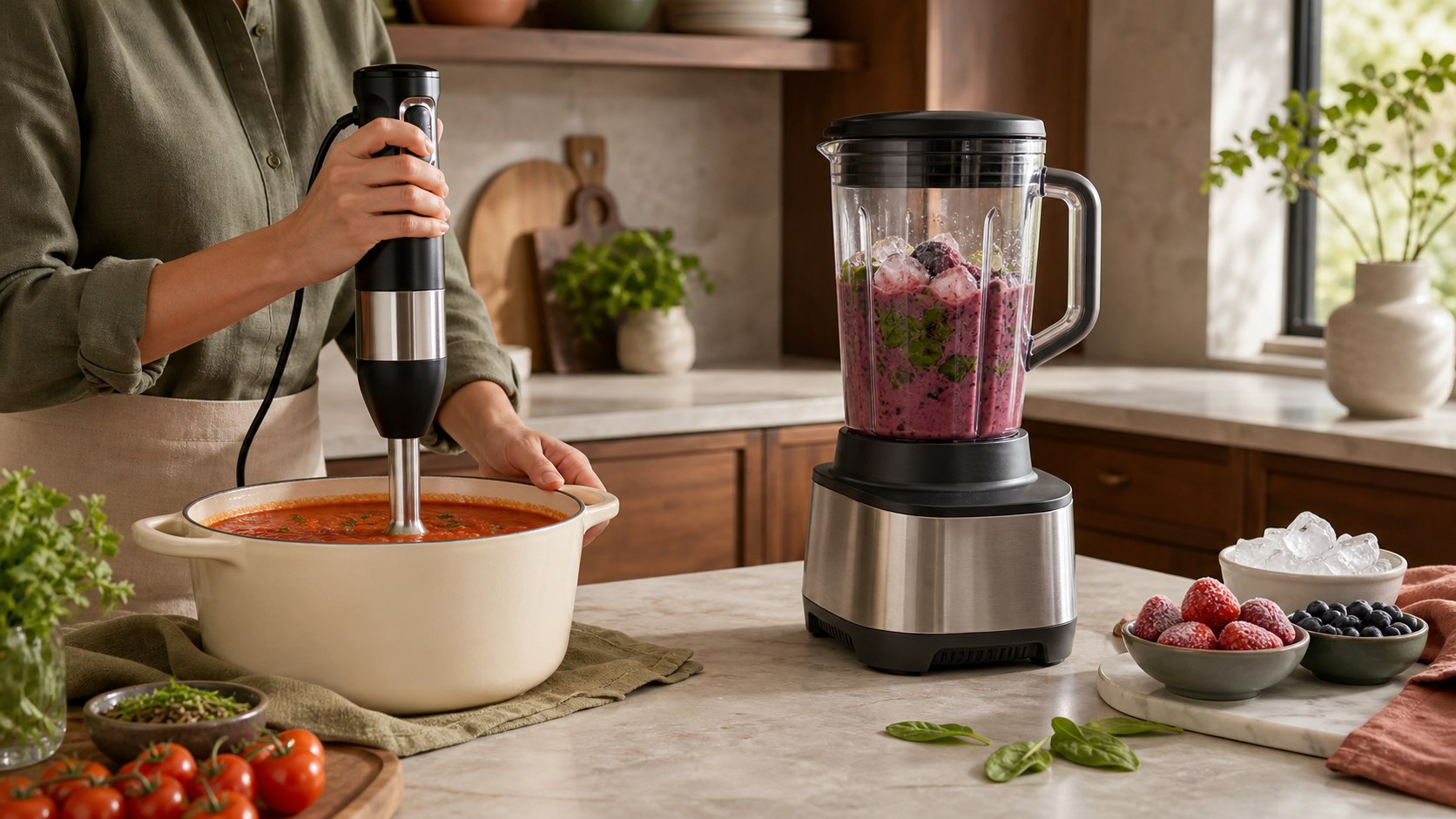

Choosing an immersion blender vs blender is less about which appliance is “better” and more about what you make on a normal Tuesday. Both puree and emulsify, but they work in different containers and solve different kitchen problems.
Quick verdict: Choose an immersion blender if you mostly make soups, sauces, mayonnaise, baby food, or other small-to-medium batches and value fast cleanup and compact storage. Choose a countertop blender if frozen-fruit smoothies, crushed ice, nut butter, ultra-smooth textures, or large pitcher batches dominate your routine. If you cook often and make icy drinks often, the two tools complement each other.
Immersion Blender vs Blender: Key Differences
| Factor | Immersion blender | Countertop blender |
|---|---|---|
| How it works | Handheld blade blends in your pot, bowl, jar, or beaker | Blade spins in a dedicated pitcher on a motor base |
| Best for | Hot soup, sauce, dressing, puree, small batches | Smoothies, ice, frozen drinks, large or very smooth batches |
| Texture | Rustic to smooth; easy to stop at your preferred consistency | Usually the silkiest result on fibrous or frozen ingredients |
| Capacity | Flexible, limited mainly by pot depth and shaft length | Limited by pitcher size and maximum-fill line |
| Cleanup | Usually one detachable shaft | Pitcher, lid, and often a removable cap or blade assembly |
| Storage | Fits in a drawer or narrow cabinet | Needs counter or cabinet footprint |
| Hands-free operation | No; you hold and guide it | Yes, after the lid is secured |
What Is an Immersion Blender?
An immersion blender—also called a hand blender or stick blender—puts a small blade and protective bell at the end of a handheld shaft. You lower the bell into food and move it through the mixture. Because food stays in its cooking vessel, there is less transferring, less splashing between containers, and fewer dishes.
That design makes an immersion blender especially natural for creamy vegetable soup, pan sauce, gravy, applesauce, pesto, hummus, whipped cream, and a quick vinaigrette. Models with a whisk, beaker, or chopper attachment stretch beyond pureeing. If you want a deeper primer, read what an immersion blender is and when to use one.
What Is a Countertop Blender?
A countertop blender uses a fixed pitcher and a larger motor base. Its jar shape creates a vortex that repeatedly pulls ingredients toward the blades. That controlled circulation, combined with higher power on many models, is why a countertop blender usually wins with ice, frozen fruit, fibrous greens, nuts, and very smooth drinks.
The tradeoff is transfer and footprint. A pitcher needs a workable minimum volume, occupies more storage space, and adds parts to wash. For cooks who use it every morning, those costs may be trivial; for someone making one cup of soup or dressing, they can feel disproportionate.
The Six-Task Blender Scorecard
Here is the decision table most shoppers actually need. Scores reflect typical home models; always follow your appliance manual.
| Kitchen task | Immersion blender | Countertop blender | Short verdict |
|---|---|---|---|
| Hot soup | 5/5 | 4/5 | Immersion wins for safe, convenient in-pot blending; a vented full-size jar can be smoother. |
| Mayonnaise or vinaigrette | 5/5 | 3/5 | The narrow beaker and close blade contact favor small emulsions. |
| Soft-fruit smoothie | 3/5 | 5/5 | Either works, but the pitcher usually produces a more uniform drink. |
| Ice or frozen drink | 1/5 | 5/5 | A purpose-rated countertop blender is the clear choice. |
| Large family batch | 4/5 | 5/5 | Immersion handles a stockpot; countertop wins when a large pitcher can circulate the recipe. |
| Whisking or small chopping | 5/5 with attachments | 2/5 | A multi-attachment hand blender can cover more prep roles. |

Head-to-Head: Where Each Tool Wins
Soup and hot food: immersion blender
Blending directly in the pot eliminates ladling hot liquid into a pitcher. That is faster and reduces transfer risk. Keep the blade guard below the surface before starting, use a tall pot, and begin slowly. A high-performance countertop blender can produce an exceptionally silky bisque, but only use a full-size model approved for hot liquids with a vented lid—never a sealed personal-blender cup.
Smoothies, ice, and frozen fruit: countertop blender
A traditional blender’s jar geometry and power are built for a recirculating vortex. If your breakfast routinely includes frozen mango, kale stems, ice, seeds, or thick smoothie bowls, the countertop appliance is the more dependable choice. An immersion blender can handle a soft banana-protein shake in a tall beaker, but that does not make it an ice crusher.
Small batches and emulsions: immersion blender
For half a cup of dressing or a single batch of mayonnaise, a large pitcher may not pull ingredients into its blades. A narrow immersion beaker keeps oil and egg close to the blade, which makes emulsifying efficient. The same advantage applies to baby food, a cup of sauce, or a small bowl of bean dip.
Ultra-smooth texture: countertop blender
Fibrous greens, berry seeds, nuts, and frozen pieces usually become finer in a capable countertop blender. An immersion blender gives you more tactile control and can create a pleasing rustic texture, but it may require longer blending to approach the same smoothness.
Cleanup and storage: immersion blender
Detach and rinse the shaft, and you are often done. A stick blender also disappears into a drawer—an important advantage in apartments and kitchens with limited counter space. That convenience matters because the appliance you can grab and clean quickly is the one you are more likely to use.
Hands-free blending: countertop blender
After the lid is locked and the correct program is chosen, a countertop blender can run without being held. An immersion blender always needs active control, which is useful for texture but less convenient during a long blend.
Which Blender Should You Buy?
- Soup-first home cook: Choose an immersion blender.
- Daily frozen-smoothie drinker: Choose a countertop blender.
- Small kitchen or dorm: Choose an immersion blender, provided your recipes are not ice-heavy.
- Family meal prepper: Choose based on the batch: stockpot soups favor immersion; pitcher smoothies favor countertop.
- Sauce, dip, and mayonnaise fan: Choose an immersion blender with a beaker.
- Frozen cocktails and nut butter: Choose a high-power countertop blender rated for those jobs.
- Cook who wants one compact prep system: Consider a multi-attachment immersion blender.
Common Mistakes When Comparing Blenders
- Buying by wattage alone. Blade geometry, guard design, speed control, jar shape, and how power is delivered matter as much as the number on the box.
- Assuming every immersion blender crushes ice. Only process hard or frozen ingredients when the manufacturer specifically allows it.
- Using the wrong container. A vessel that is too wide or shallow encourages splatter. Use a tall beaker or keep food deep enough to cover the blade guard.
- Starting at full speed. Begin low, keep the bell submerged, and increase speed as a vortex forms. Our guide to using an immersion blender without splatter explains the technique.
- Overfilling a countertop pitcher. Respect maximum-fill lines, especially with hot ingredients.
- Ignoring cleanup and storage. A theoretically stronger appliance offers little value if it stays in the back of a cabinet.
Fresko Immersion Blender Options
If your scorecard points to an immersion blender, the Fresko H7 Variable-Speed Immersion Blender is a streamlined choice for everyday soups, sauces, dressings, and purees. If you want one motor handle to cover more prep, the Fresko H9 4-in-1 Variable-Speed Immersion Blender Set adds a broader attachment system for blending, whisking, and small-batch prep. Explore the full Fresko hand blender collection to compare the current configurations.
Frequently Asked Questions
Can an immersion blender replace a regular blender?
It can replace a countertop blender for soups, sauces, purees, dressings, mayonnaise, baby food, and many soft-ingredient drinks. It is not a full replacement if you regularly crush ice, blend large amounts of frozen fruit, make nut butter, or demand an ultra-smooth pitcher texture.
Is a hand blender the same as an immersion blender?
Yes. “Hand blender,” “stick blender,” and “immersion blender” generally describe the same handheld appliance. Do not confuse it with a hand mixer, which uses beaters for batters, doughs, and whipping.
Which is better for soup: an immersion blender or blender?
An immersion blender is usually better for convenience because it purees soup in the cooking pot. A hot-liquid-rated countertop blender may create a finer texture, but it requires careful transfer and a vented lid.
Can you make smoothies with an immersion blender?
Yes, especially with soft fruit, yogurt, milk, and protein powder in a tall beaker. For ice, large frozen pieces, fibrous greens, or thick smoothie bowls, a countertop blender is usually better.
Which blender is easier to clean?
An immersion blender is typically easier: detach and wash the blade shaft while the food stays in its original vessel. A countertop blender adds a pitcher and lid, although many jars can self-clean with warm water and a drop of dish soap.
Is an immersion blender safer for hot liquids?
It avoids transferring hot liquid, which can reduce one major risk. You still need to keep the blade guard submerged, start low, avoid overfilling the pot, and unplug the unit before touching the blade. With a countertop blender, use only a hot-liquid-rated, vented pitcher.
Do I need both types of blender?
Not necessarily. Own both when you frequently cook soups and sauces and make ice-heavy smoothies or frozen drinks. Otherwise, choose the tool that wins your two or three most common tasks.
The Bottom Line
For cooks, the immersion blender usually wins on flexibility, in-pot convenience, storage, and cleanup. For drink makers, the countertop blender wins on ice, frozen ingredients, circulation, and silky texture. Use the six-task scorecard—not a spec-sheet arms race—to choose the appliance that fits your kitchen.
Aktie:
Sous Vide Pork Tenderloin: Juicy Results Every Time
How to Prevent Freezer Burn: Causes, Fixes & Storage Guide