

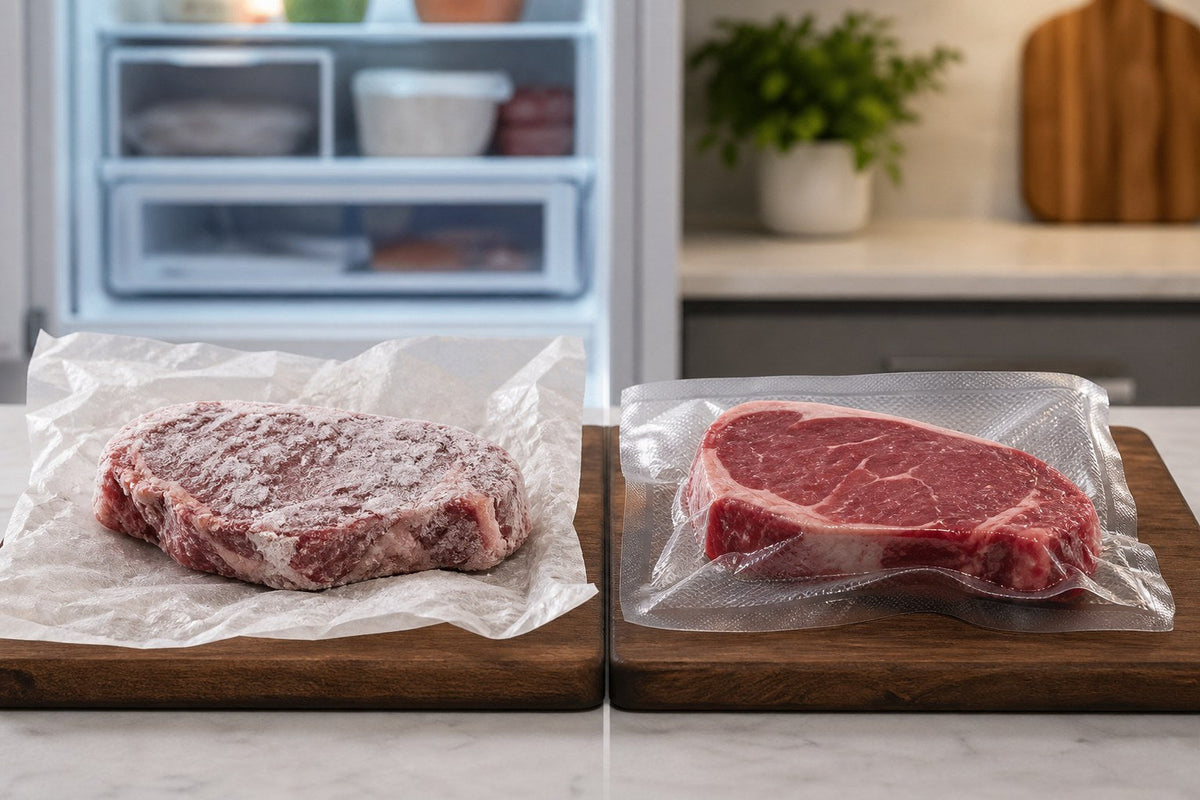
Quick answer: To prevent freezer burn, minimize the air touching food, use moisture- and vapor-resistant freezer packaging, keep the freezer at 0°F (-18°C) or below, freeze portions quickly, and label them so they are used on time. A vacuum sealer is especially effective because it removes the air pocket that drives dehydration and oxidation—but the bag still needs a clean, complete seal.
Freezer burn is frustrating because the food often looked perfect when it went in. Weeks later, a steak has pale leather-like edges, vegetables are frosted and shriveled, or ice cream has a gritty cap. The problem is not “too much cold.” It is moisture leaving the food after cold, dry air reaches the surface.

What Is Freezer Burn?
Freezer burn is surface dehydration. Water in frozen food can move from ice directly into vapor—a process called sublimation—then collect elsewhere as frost. The exposed area dries out and may oxidize, creating pale, gray-brown, tough, or flavorless patches.
According to the USDA, freezer burn is a quality issue, not a food-safety issue. Food kept continuously frozen at 0°F remains safe, although quality declines over time. That does not excuse separate signs of spoilage or temperature abuse: if food thawed above safe temperatures, the package is leaking or swollen, or you do not know how it was handled, freezer burn is not the only question.
Why Freezer Burn Happens: Cause-and-Fix Table
| Cause | What it does | What you may see | Best fix |
|---|---|---|---|
| Air trapped in the package | Speeds moisture loss and oxidation | Dry pale edges; frost inside the bag | Remove air and use close-fitting freezer packaging |
| Weak, wrinkled, or dirty seal | Lets dry freezer air enter over time | Localized burn near the opening | Clean the seal zone and make a second seal |
| Thin or non-freezer packaging | Allows water vapor and air to pass through | Widespread drying after long storage | Use freezer-grade bags, wrap, or containers |
| Warm freezer or temperature swings | Encourages thaw-refreeze cycles and large ice crystals | Heavy surface frost; damaged texture | Hold 0°F or below and limit door-open time |
| Warm or steamy food packed too soon | Adds condensation and warms nearby items | Ice buildup and clumped portions | Cool food promptly and safely before packing |
| Too much time or repeated refreezing | Adds more opportunity for moisture migration | Gradual flavor and texture loss | Portion, date, rotate, and avoid unnecessary thawing |
How to Prevent Freezer Burn in Five Steps
1. Cool, portion, and prepare the food
Freeze food while it is still at good quality. Divide meat, leftovers, and produce into the amount you will use at one time so a large package does not have to be thawed and refrozen. Cool cooked food promptly in shallow containers in the refrigerator; do not leave perishables on the counter for hours. Blanch vegetables that require it, then dry them well. Pre-freeze very soft, wet, or delicate foods until firm so a vacuum sealer does not crush them or pull liquid into the seal.
2. Choose packaging that fits the food
Use material designed for freezing: heavy freezer bags, freezer paper plus an outer barrier, rigid freezer-safe containers, or vacuum sealer bags. Ordinary store wrap is often permeable to air, so the USDA recommends overwrapping it for longer storage. Match the package to the portion; an oversized bag or container leaves an avoidable air pocket.
If bag sizing is the problem, use Fresko's vacuum sealer bag size guide. Precut bags are fast for repeat portions, while cut-to-length rolls fit roasts, racks, and unusual shapes with less empty material.
3. Remove air and create a clean seal
Press freezer wrap directly against the food, push air from a zipper bag, or vacuum seal. Before sealing, leave three to four inches of clean bag above the food. Fold the rim back while loading, then unfold and wipe the inside completely dry. The finished line should be straight, continuous, and free from grease, crumbs, wrinkles, or moisture. Add a second seal above the first for long storage or juicy food.
For soups and marinades, freeze them solid before vacuum sealing or use pulse control. The objective is not maximum suction at any cost; it is removing air without contaminating the seal.
4. Freeze fast, flat, and at 0°F
Set an appliance thermometer where you can read it and keep the freezer at 0°F (-18°C) or lower. Place new packages in a single layer with space for cold air to circulate, then stack them after they are solid. USDA guidance notes that faster freezing makes smaller ice crystals and protects texture. Avoid the freezer door for long-term items because it experiences the largest temperature swings.
5. Label, rotate, and check
Write the food, portion, and freeze date on every package. Store older food where it is easy to reach and use a first-in, first-out routine. Check vacuum bags the next day: if one has loosened, reseal it before surface damage starts. Use the vacuum-sealed meat storage chart for quality windows by cut rather than treating “frozen” as a permanent holding plan.

Five-Step Freezer-Burn Prevention Checklist
- Prepare: cool cooked food safely; blanch and dry suitable vegetables.
- Portion: package only what you will thaw and use together.
- Protect: choose close-fitting, moisture- and vapor-resistant freezer packaging.
- Seal and freeze: remove air, inspect the seal, and freeze flat at 0°F or below.
- Rotate: label the date, use older packages first, and recheck seals.
Does Vacuum Sealing Prevent Freezer Burn?
Vacuum sealing greatly reduces freezer-burn risk because it removes most of the air around the food and limits the space into which moisture can migrate. USDA Food and Nutrition Service guidance describes vacuum-sealed produce as much less likely to become freezer burned because less oxygen is present.
It is not magic. A puncture, wet seal, unsuitable bag, or unstable freezer can still damage the food. Bones may need a small protective patch, and high-moisture foods need enough headspace to keep liquid out of the sealing channel. If your current machine leaves visible air, overheats during batch work, or produces narrow inconsistent seals, a wider heating strip and automatic moisture detection can improve consistency. The Fresko New V8 Advanced Vacuum Sealer is designed for repeated freezer prep and automatically adjusts for dry or moist food.
Can You Fix Freezer-Burned Food?
You cannot put lost moisture back into damaged cells, but mild freezer burn does not always mean dinner is lost.
- Meat and fish: trim dry patches before or after cooking. Use the remainder in chili, soup, tacos, curry, or another moist dish.
- Vegetables: use them in soup, sauce, casseroles, or purées where a crisp texture is not expected.
- Fruit: blend it into smoothies, compote, or baking.
- Bread: toast it or use it for breadcrumbs, croutons, or strata.
- Ice cream: scrape away the icy top layer if the flavor underneath is still acceptable.
Discard food if you suspect unsafe thawing, a prolonged power outage, cross-contamination, or spoilage. Never taste food to determine whether it is safe.

Common Mistakes That Make Freezer Burn Worse
- Freezing meat for months in thin supermarket film without an outer barrier
- Leaving a large headspace in a container or an oversized bag
- Sealing across juice, oil, crumbs, or a folded bag edge
- Putting steaming food directly beside already frozen packages
- Stacking many warm packages before their centers freeze
- Storing high-value food in the freezer door
- Thawing a family-size package repeatedly instead of freezing portions
- Assuming vacuum sealing replaces freezing, refrigeration, or safe thawing
Frequently Asked Questions
What is the best way to prevent freezer burn?
Use close-fitting, airtight freezer packaging; remove as much air as practical; keep the freezer at 0°F or below; freeze food quickly; and label it for timely use. Vacuum sealing combines the first two steps efficiently.
Is freezer burn safe to eat?
USDA guidance says freezer burn itself does not make food unsafe. It creates dry, tough, or flavorless areas. Food must still have remained safely frozen and show no separate signs of spoilage or temperature abuse.
Why does food get freezer burn in a sealed bag?
The bag may contain trapped air, have a tiny puncture, use material that is not vapor-resistant, or have a wrinkled or contaminated heat seal. Temperature fluctuations and very long storage can compound the problem.
Does aluminum foil prevent freezer burn?
Heavy-duty foil can be an effective outer barrier when wrapped tightly, but sharp folds can tear and it is hard to see the food. For longer storage, combine a close inner wrap with heavy foil or another airtight freezer layer.
Can freezer burn be reversed?
No. The lost moisture and damaged texture cannot be fully restored. You can trim affected areas or use mildly burned food in moist recipes that make the quality loss less noticeable.
Does a colder freezer prevent freezer burn?
A stable freezer at 0°F or below supports quality and safety. Simply turning an already stable freezer far colder does not compensate for air leaks, poor packaging, or repeated door opening.
How long before food gets freezer burn?
There is no universal countdown. Initial food quality, fat and moisture content, packaging barrier, trapped air, seal integrity, freezer stability, and storage time all matter. A weak package may show damage in weeks; a well-sealed package can protect quality much longer.
The Bottom Line
If you remember only one principle, remember this: air is the main pathway to freezer burn. Prepare food properly, match the package to the portion, remove air, make a clean seal, freeze at 0°F, and rotate what you store. That five-step habit protects texture and flavor far better than simply pushing another loose bag to the back of the freezer.
Build a more reliable freezer routine: compare Fresko freezer-grade vacuum bags and rolls, or see the broader benefits of vacuum sealing food.
Food-safety sources: USDA FSIS Freezing and Food Safety, USDA FSIS Freezer Packaging Guidance, and USDA FNS Vacuum-Sealing Guidance. Follow current government advice and product instructions.
Aktie:
Immersion Blender vs Blender: Which One Fits Your Kitchen?
Sous Vide Pork Chops: Temperature, Timing and Finishing