

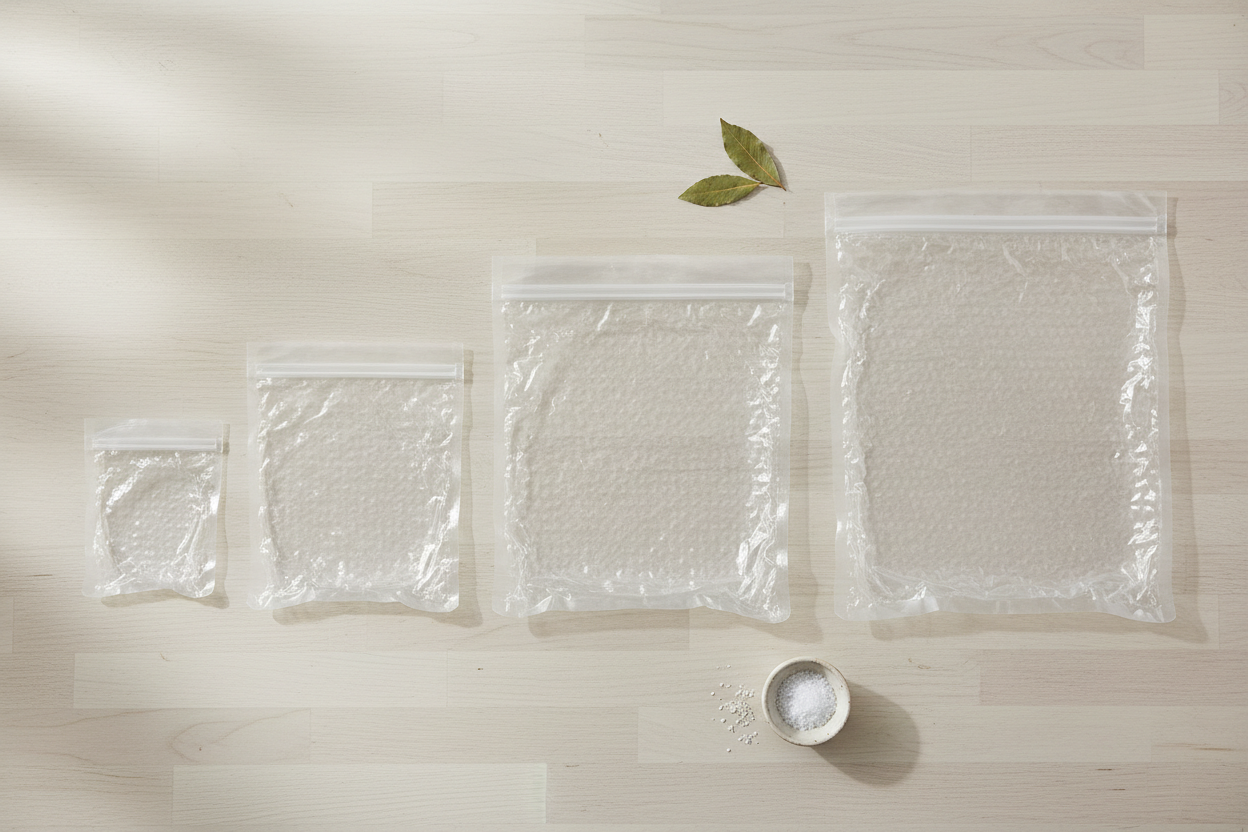

Standing in front of a wall of vacuum sealer bags — or scrolling through a dozen listings online — it's easy to just grab whatever size looks about right. But the wrong bag size is one of the most common reasons people end up with wasted plastic, weak seals, or freezer-burned food. A bag that's too big wastes material and leaves too much air pocket space; a bag that's too small won't seal cleanly around the food at all.
This guide breaks down the standard vacuum sealer bag sizes, how to measure what you actually need, and which size makes sense for different foods — from a single chicken breast to a whole holiday roast.
Quick Answer
Vacuum sealer bags generally come in four size ranges: small (pint, roughly 6" x 10"), medium (quart, roughly 8" x 12"), large (gallon, roughly 11" x 20"), and jumbo or roll-cut (11" x 20" and up). As a rule of thumb, measure your food, add 3–4 inches of extra bag length for the seal, and round up to the nearest standard size rather than down.
Why Bag Size Actually Matters
• Too much empty space means more air to remove, which weakens the seal over time and speeds up freezer burn in the empty pocket.
• A bag that's too tight won't leave enough material for a clean seal, and can burst or peel open during sealing or freezing.
• Oversized bags waste money — you're paying for plastic you don't need on every single seal.
• The right size also makes stacking and organizing your freezer or pantry much easier.
Standard Vacuum Sealer Bag Sizes Explained
Sizing isn't perfectly standardized across brands, but most vacuum sealer bags fall into one of these general categories:
|
Size |
Typical Dimensions |
Best For |
|
Pint / Small |
6" x 10" |
Snacks, herbs, small portions of nuts or spices |
|
Quart / Small-Medium |
8" x 12" |
Single steaks, chicken breasts, burger patties |
|
Gallon / Medium-Large |
11" x 16" |
Family-size meat portions, multiple chicken breasts, fish fillets |
|
Large / Jumbo |
11" x 20" or bigger |
Whole roasts, bulk meal prep, large batches of soup or bulk produce |
|
Rolls (custom-cut) |
8", 11", or wider, cut to length |
Odd-shaped or oversized items like whole fish, ribs, or bread loaves |

How to Measure What You Need
1. Lay the food flat and measure its length, width, and height at the widest points.
2. Add roughly 3–4 inches to the length for the seal itself, plus enough width so the bag isn't stretched tight around the food.
3. For odd shapes (racks of ribs, whole fish, loaves of bread), round up to the next standard size or use a cut-to-length roll instead.
4. If you're batch-freezing multiple portions in one household, size up slightly so food isn't packed in so tightly that it freezes unevenly.
Rolls vs. Pre-Cut Bags: Which Gives You More Size Flexibility?
Pre-cut bags are convenient and consistent, but they lock you into fixed dimensions. Bag rolls — where you cut and seal one end yourself — are worth having on hand if you regularly deal with oddly shaped or oversized items, since you can customize the length to the food instead of the other way around. Many people keep a couple of pre-cut sizes for everyday portions and one roll on hand for the occasional large or unusual cut.

Size Guide by Food Type
|
Food |
Recommended Bag Size |
Notes |
|
Chicken breasts (2-4 pieces) |
Quart / 8" x 12" |
Leave 3 inches of empty space above the food for a clean seal |
|
Ground beef (1 lb portions) |
Quart or Gallon |
Flatten into a thin layer before sealing to speed up thawing |
|
Whole roast or brisket |
Large / Jumbo or roll-cut |
Measure the item first and add at least 4 inches on each side |
|
Fish fillets |
Quart or Gallon |
Bag flat and freeze on a tray first to avoid crushing delicate fillets |
|
Soups and sauces (liquid) |
Quart or Gallon, freeze first |
Pre-freeze liquid in a dish, then transfer to the bag to avoid seal failure |
|
Coffee beans, snacks, nuts |
Pint / Small |
Smaller bags reduce air pocket size and keep contents fresher longer |
|
Bulk vegetables |
Gallon or Large |
Blanch first, then portion into meal-size amounts before sealing |
|
Sous vide single-serve meals |
Quart |
Leave enough slack for the bag to move freely in the water bath |
Common Mistakes
Mistake #1: Sizing the bag too close to the food
Without enough extra length above the food, there isn't enough clean, dry material left for the sealer to bond, and the seal is more likely to fail.
Mistake #2: Using one size for everything
A single "go-to" bag size might work most of the time, but it usually means wasting large bags on small items or forcing bulky cuts into bags that are too small.
Mistake #3: Not accounting for liquid or expansion
Soups, sauces, and some produce expand slightly as they freeze. Sizing too tightly for liquids can strain the seal and cause leaks.
Expert Tips
At Fresko, we recommend keeping at least two sizes on hand at all times — a small/medium size for everyday portions like chicken breasts or snack bags, and a large size for batch cooking or bulk buys. If you meal-prep regularly, portioning into the smallest practical size actually saves more food long-term, since you're only opening and thawing what you need instead of a large bag all at once.
Recommended Tools
Pairing the right bag size with a vacuum sealer that has strong, consistent suction makes the biggest difference in seal quality — especially on larger bags, where there's more air to pull and more surface area for the seal to hold. Fresko offers both small and large vacuum seal bags sized for everyday portions and bulk storage, so you're not stuck rounding up or down.
FAQ
What size vacuum sealer bag do I need for chicken breasts?
A quart-size bag (roughly 8" x 12") comfortably fits two to four chicken breasts with enough room left for a clean seal.
Can I cut a large vacuum sealer bag down to a smaller size?
Yes. Bag rolls are designed to be cut to length, and even pre-made large bags can be trimmed down and resealed on one end if needed.
Is it better to size up or size down when I'm not sure?
Size up slightly. A little extra bag length is a minor waste of material, but a bag that's too small can fail to seal properly or burst under vacuum pressure.
Do larger vacuum sealer bags need a stronger vacuum sealer?
Larger bags have more surface area and air volume to remove, so a machine with strong, consistent suction will seal them more reliably than a lower-powered model.
What's the best bag size for meal prepping?
Quart-size bags are the most versatile for single-serving or family-size meal prep portions, since they minimize wasted space without being too small for most meals.
Are gallon-size vacuum seal bags too big for everyday use?
Not necessarily — gallon bags work well for bulk meat purchases, multiple portions bagged together, or larger produce batches, but they're less efficient for single-serving items.
Conclusion
The right vacuum sealer bag size comes down to matching the bag to the food, not the other way around. Measure first, size up when in doubt, and keep a couple of different sizes on hand so you're never stretching a bag too thin or wasting material on something small. If you're also wondering whether you can reuse a bag once it's empty, check out our guide on reusing vacuum sealer bags, and browse Fresko's small and large vacuum seal bags to find the right fit for your kitchen.
Share:
Can You Reuse Vacuum Sealer Bags? What You Need to Know
Do You Need a Vacuum Sealer for Sous Vide? (2026 Guide)