

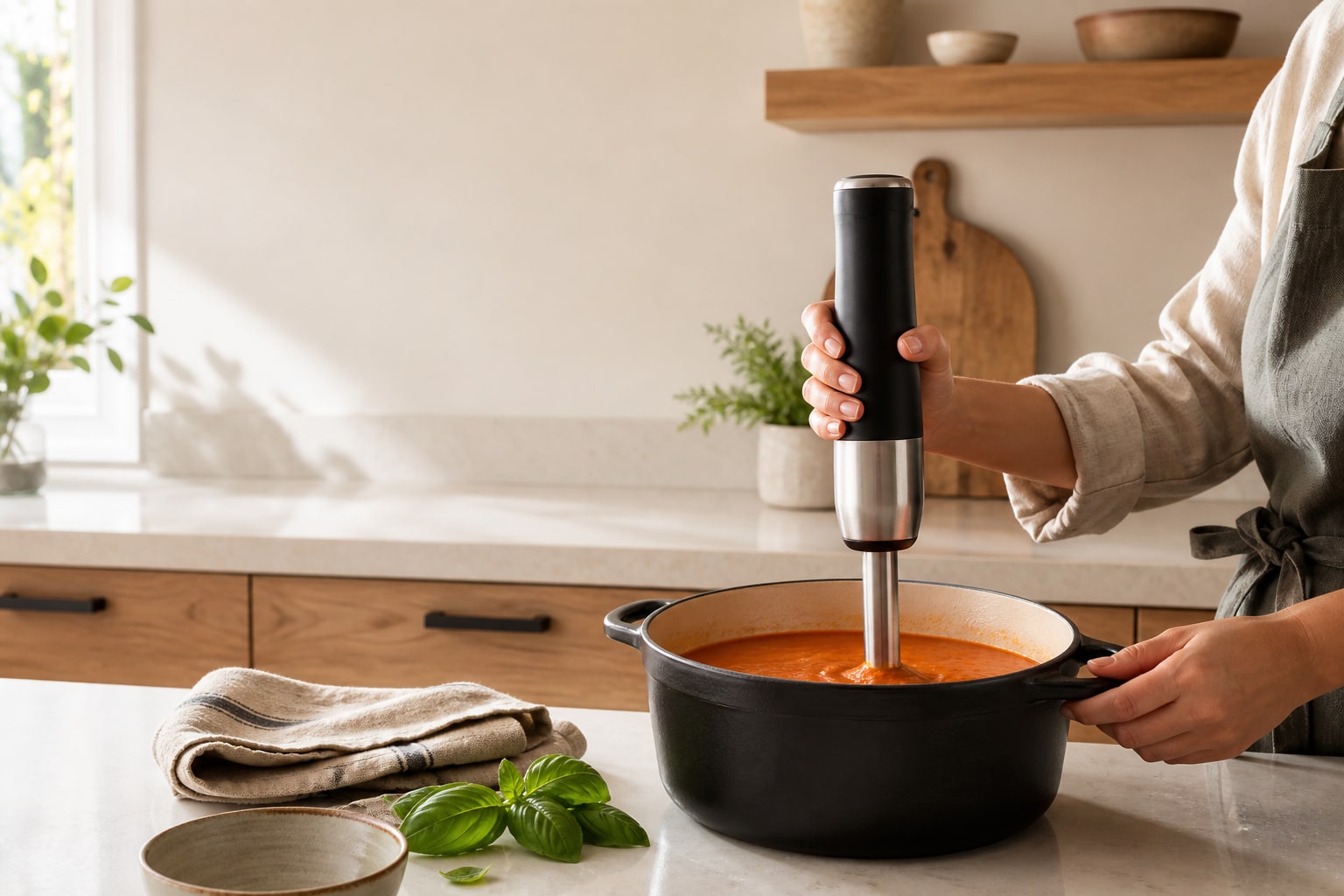
It looks simple: a motorized handle, a slim metal shaft, and a small blade at the bottom. Yet this compact tool can turn a pot of roasted vegetables into soup, build mayonnaise in a jar, or make one smoothie without dirtying a full-size blender. So, what is an immersion blender, exactly—and is it worth giving one drawer space?
The real advantage is not that it replaces every appliance. It is that it handles liquid-forward, small-batch jobs quickly, with less transferring and cleanup. Below, we will break down how it works, what every part does, the tasks it handles well, and who actually needs one.
How Does an Immersion Blender Work?
Pressing the power button or speed trigger starts a motor inside the handle. That motor turns a drive shaft, which spins the blade under the bell-shaped guard at the bottom. The blade pulls nearby food and liquid into a small circulation pattern, cuts it, and pushes it back out. Moving the blender slowly through the mixture repeats that cycle until you reach the texture you want.
Unlike a countertop blender, an immersion blender does not need its own pitcher. The cooking pot, mixing bowl, or tall beaker becomes the blending vessel. That is why it is especially convenient for hot soups and quick sauces: there is no heavy pot to pour and no blender jar to scrape clean.
Immersion Blender Parts, Explained

- Motor housing: The top section contains the motor and forms the handle. Keep this part out of food and water.
- Power or speed control: A button, dial, or pressure-sensitive trigger starts the blade and may let you adjust speed.
- Coupling: This connection transfers power from the motor to the removable shaft or accessory.
- Blending shaft: The long, narrow section reaches into deep pots and cups while keeping the motor above the food.
- Blade guard (or bell): The housing around the blade directs food flow and helps limit splatter. Some guards are designed to reduce scratching on cookware.
- Blade: A small stainless steel blade performs the pureeing, blending, and emulsifying.
Many models add a tall blending beaker. More versatile sets may include a whisk for cream and eggs or a mini chopper for herbs, nuts, and onions. Attachments expand the tool's range, but the blending arm remains its defining feature.
What Is an Immersion Blender Used For?
An immersion blender is at its best when there is enough liquid to move ingredients around the blade. It can leave soup rustic, make it completely smooth, or build a stable emulsion in seconds. Here are the jobs that justify its spot in many kitchens.
| Use | Why it works | Best setup |
|---|---|---|
| Soups and vegetable purees | Blend directly in the pot and stop at chunky or silky. | Blending arm |
| Mayonnaise and dressings | Fast blade action disperses oil into tiny droplets. | Tall narrow beaker |
| Sauces and gravies | Smooth small lumps without transferring the pan. | Deep saucepan |
| Single-serve smoothies | Efficient for soft fruit, yogurt, protein powder, and liquid. | Tall beaker |
| Baby food | Lets you control texture in a small batch. | Narrow container |
| Whipped cream and eggs | A whisk attachment incorporates air more effectively than the blade. | Whisk accessory |
| Pesto, salsa, and chopped herbs | A mini chopper handles drier, chunkier ingredients. | Chopper accessory |

For one real-world example, use the blending arm to make basil pesto for our sous vide lemon chicken recipe.
Benefits of an Immersion Blender
- Less transferring: Blend where you cook, which is particularly useful for a large pot of soup.
- Fast cleanup: Detach and wash the blending shaft instead of cleaning a large pitcher and lid.
- Better small batches: A narrow beaker keeps a one-cup sauce close to the blade.
- Texture control: Short pulses can preserve some texture; longer blending creates a finer puree.
- Compact storage: The slim tool takes much less space than a countertop appliance.
What an Immersion Blender Does Not Do Well
A hand blender is usually less powerful and less contained than a full-size blender. It is not the first choice for crushing a pitcher of hard ice, pulverizing dry spices, grinding coffee, kneading dough, or producing an ultra-smooth smoothie from lots of frozen fruit. It also cannot slice or shred vegetables unless a compatible processor attachment is included.
Mashed potatoes are another common trap. The fast blade can release too much starch and turn potatoes gluey. A masher or ricer gives a fluffier result. And while the blade can chop soft ingredients, it needs enough liquid—or the correct chopper bowl—to circulate food safely and evenly.
Immersion Blender vs. Blender, Food Processor, and Hand Mixer
| Tool | Best for | Main tradeoff |
|---|---|---|
| Immersion blender | Soup, puree, sauces, emulsions, small smoothies | Less power and containment |
| Countertop blender | Ice, frozen drinks, large ultra-smooth batches | Requires transferring and more storage |
| Food processor | Chopping, shredding, slicing, dough, dry mixtures | Larger bowl and more parts to wash |
| Hand mixer | Beating batter, whipping cream, mixing cookie dough | Does not puree or emulsify like a blade |
In short: choose an immersion blender when the food is already in a pot or tall container and you want to make it smoother. Choose the other tools when you need heavy ice crushing, precise slicing, or traditional beating.
Who Needs an Immersion Blender?
You are likely to use one often if you make soup, sauces, dressings, baby food, or single servings; cook in a small kitchen; or dislike moving hot food between vessels. It is also a practical second blender for people who already own a countertop model but want quicker everyday cleanup.
You may not need one if you rarely cook liquid-based recipes, mainly blend frozen drinks, or already rely on a full-size blender and do not mind washing it. The most honest answer to “do I need an immersion blender?” is: yes, if in-pot blending or small-batch convenience solves a weekly problem; otherwise, it is optional.
How to Use an Immersion Blender Safely
- Choose a deep vessel. A tall beaker or deep pot keeps ingredients around the blade and reduces splatter.
- For hot food, stop the heat first. Move the pot off the active burner and let violently boiling liquid settle.
- Submerge before starting. Put the blade guard fully below the surface, but never immerse the motor housing or the shaft connection.
- Start low and move slowly. Hold the tool mostly upright and gently sweep or tilt it through the mixture. Avoid lifting the running blade above the surface.
- Stop before lifting. Release the trigger, wait for the blade to stop, then remove the blender.
- Unplug before cleaning or changing attachments. Wash the detachable parts according to the model instructions; wipe the motor body only.

Common Immersion Blender Mistakes
Using a container that is too wide
If a small amount of food cannot cover the blade, it will splash or blend unevenly. Switch to a tall, narrow beaker.
Running continuously at full speed
Start low, pulse, and check texture. Long uninterrupted runs can overprocess food and heat the motor. Follow your model's duty-cycle guidance.
Forcing hard or dry ingredients through the blade
Cut solid ingredients into smaller pieces and add enough liquid. Use a chopper accessory for drier mixtures, and never use an attachment for a job its manual excludes.
Choosing a Fresko Hand Blender
Once you know what you want to make, the choice becomes straightforward. Fresko's current hand blenders use a variable-speed trigger, a 300W motor, a detachable stainless steel blending shaft, and titanium-coated stainless steel blades.
| Model | Best for | Included setup |
|---|---|---|
| Fresko H7 | Simple in-pot blending and compact storage | Detachable blending arm with anti-scratch design |
| Fresko H9 | Blending plus whipping and chopping | 4-in-1 set with blending arm, 24-oz beaker, whisk, and chopper |
Ready to compare the full lineup? Browse the Fresko hand blender collection and choose the attachments that match the way you cook.
Immersion Blender FAQs
Are a hand blender, stick blender, and immersion blender the same?
Yes. In everyday kitchen use, all three names describe the same handheld appliance with a motorized blade on the end of a shaft.
Is a hand mixer the same as an immersion blender?
No. A hand mixer uses beaters to whip or mix batters; an immersion blender uses a blade to puree and emulsify.
Can you use an immersion blender in hot soup?
Usually, but follow the appliance manual. Remove the pot from active heat, let vigorous boiling settle, keep the blade guard submerged, and never immerse the motor housing.
Can you make smoothies with an immersion blender?
Yes—especially single servings made with liquid, yogurt, soft fruit, or protein powder. A full-size blender is better for large batches and a lot of hard frozen fruit or ice.
Can you use an immersion blender for mashed potatoes?
You can, but it is usually not recommended. Fast blades overwork potato starch and can create a gluey texture. Use a potato masher or ricer instead.
Can an immersion blender crush ice?
Some models can handle a small amount of ice when the manual allows it, but a countertop blender designed for ice is the safer, more effective choice.
How do you clean an immersion blender?
Unplug it, detach the blending shaft, and wash the removable parts as directed. Never submerge the motor housing; wipe it with a damp cloth.
Is an immersion blender worth it?
It is worth it if you regularly make soup, sauces, dressings, purees, or small smoothies and value fast cleanup. If you mainly crush ice or make large frozen drinks, prioritize a countertop blender.
The Bottom Line
An immersion blender is a compact, practical specialist: it brings the blade to the food, blends directly in your container, and makes liquid-forward recipes easier to manage. It will not replace every countertop appliance, but for soup, sauce, dressing, puree, and small-batch work, it can become the blender you reach for most.
Aktie:
Best Vacuum Sealer for Food in 2026: Tested Buying Guide
How to Use an Immersion Blender Without Splatter