

A tight bag tells you the seal is holding. It does not tell you how many safe refrigerator days are left. To answer how long does meat last vacuum sealed, first identify the meat, whether it is raw or cooked, and who packed it. Then check the temperature history.
Quick answer: For fresh meat vacuum sealed at home, use the normal refrigerated storage limits at 40°F (4°C) or below: 1–2 days for raw poultry, ground meat, and raw sausage; 3–5 days for raw beef, pork, veal, or lamb steaks, chops, and roasts; and 3–4 days for cooked leftovers. Do not add days because you removed the air. Food that was safe when frozen and remains continuously at 0°F (−18°C) or below can stay safe indefinitely; freezer month ranges describe quality. Source: FoodSafety.gov.
Home-storage chart · Commercial unopened packages · Freezer quality · Packing and thawing · Common questions
Vacuum-sealed meat storage chart: home-packed food
Use these limits for ordinary home storage, including meat you repackage with a countertop vacuum sealer. They assume prompt refrigeration, good handling, and an uninterrupted cold chain. They are not a shelf-life study of Fresko equipment. A package with an unknown handling history cannot be cleared by a chart.
| Food and condition | Refrigerator: 40°F or below | Freezer: 0°F or below, best quality | Source |
|---|---|---|---|
| Raw beef, pork, veal, or lamb steaks, chops, and roasts | 3–5 days | 4–12 months | FoodSafety.gov: fresh red meat |
| Raw ground beef, pork, lamb, veal, or poultry | 1–2 days | 3–4 months | FoodSafety.gov: ground meat |
| Raw chicken or turkey, whole | 1–2 days | 12 months | FoodSafety.gov: fresh poultry |
| Raw chicken or turkey, pieces | 1–2 days | 9 months | FoodSafety.gov: fresh poultry |
| Raw sausage made from chicken, turkey, pork, or beef | 1–2 days | 1–2 months | FoodSafety.gov: raw sausage |
| Cooked meat or poultry leftovers | 3–4 days | 2–6 months | FoodSafety.gov: leftovers |
| Cooked meat soup or stew | 3–4 days | 2–3 months | FoodSafety.gov: soups and stews |
| Deli-sliced or opened packaged lunch meat, including portions resealed at home | 3–5 days | 1–2 months | FoodSafety.gov: opened luncheon meat |
Sealing does not restart the clock. Count the time already spent refrigerated before repacking. If the plan changes and you cannot use the meat within its window, freeze it promptly while it is still safe—not after an extra week in a vacuum bag. Refrigerate cooked leftovers promptly; do not leave dinner on the counter until it feels completely cold.
For other cuts, fish, and wild game, see the food-specific sections in our meat storage reference. Product-specific guidance may differ, so match the food and packaging condition rather than borrowing a convenient number.
Why unopened commercial packages are different
A manufacturer's unopened package is not equivalent to a bag you seal after cooking dinner. Processing, ingredients, hygiene controls, and packaging specifications can all affect the labeled storage instructions. There is no single extended refrigerator limit for every commercially vacuum-packed meat.
| Exact product condition | Refrigerator: 40°F or below | Freezer quality guide | Source and limit |
|---|---|---|---|
| Fully cooked ham, vacuum-sealed at the plant, unopened | 2 weeks or the manufacturer's use-by date | 1–2 months | FoodSafety.gov: this specific ham category; not home-cooked meat |
| Commercial packaged luncheon meat, unopened | 2 weeks | 1–2 months | FoodSafety.gov: unopened luncheon meat; opened packages use the chart above |
| Commercial hot dogs, unopened | 2 weeks | 1–2 months | FoodSafety.gov: unopened hot dogs; after opening, refrigerate for 1 week |
| Other commercially vacuum-packed raw or cooked meat | No universal extension: follow the exact product's refrigerated-storage and manufacturer use-by instructions | Follow product guidance; do not assume a years-long quality guarantee | USDA: vacuum-packaged meat |
Check whether the label says keep refrigerated, keep frozen, or gives instructions after opening. A sell-by date is not permission to hold repacked meat for extra days. USDA also explains that most U.S. date labels describe quality rather than acting as safety guarantees. Safe handling still matters before and after the printed date. Read USDA's explanation of food product dating.
How long does vacuum-sealed meat last in the freezer?
Separate two questions: Is it safe? and Will I enjoy eating it? Continuous storage at 0°F or below prevents microbial growth, but freezing does not reliably destroy all pathogens or undo unsafe handling before freezing. Once thawed, the meat needs normal refrigerated handling again. USDA's freezing guidance makes this distinction.
For quality, start with the food-specific month ranges in the chart. Vacuum packaging can help protect against moisture loss and freezer burn, but neither the equipment nor a tight-looking bag promises that every cut will taste fresh after two or three years. Fat content, initial quality, package damage, and temperature swings all matter.
Freezer burn itself is a quality defect, not proof of food poisoning. For safely handled food kept frozen, dry patches can be trimmed; extensive damage may make the meat not worth serving. A torn bag found while the food is still continuously frozen can be rewrapped. A thawed package with an uncertain temperature history is a different problem.

Pack, label, freeze, and thaw with a plan
- Keep preparation cold. Work in small batches and return unused portions to the refrigerator. Refrigerate perishable food within 2 hours, or within 1 hour when the surrounding temperature is above 90°F.
- Cool cooked food promptly. Divide a large roast or batch of stew into smaller portions and shallow containers. Hot food can go directly into the refrigerator; do not wait on the counter for it to cool. Vacuum pack chilled portions for the intended storage method. USDA leftovers guidance explains rapid cooling.
- Match the bag to the machine. Keep the sealing area clean and dry, avoid wrinkles, and check for a continuous seal. Follow your model's instructions for headspace and moist food. For loading and sealing, use our vacuum sealer beginner's guide; use the government-backed limits on this page for storage times.
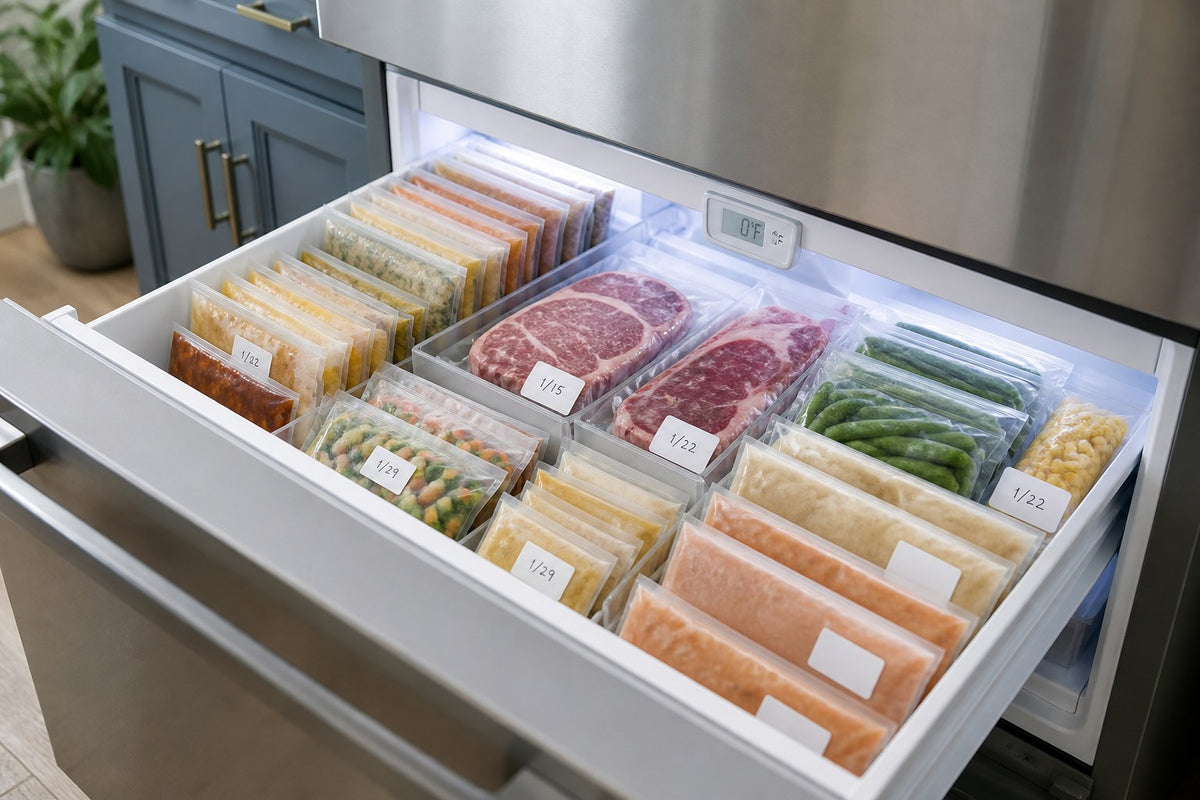
- Label more than the sealing date. Note the cut, raw or cooked status, purchase or cooking date, and freeze date. Freeze portions in a single layer before stacking, then use older packages first.
- Thaw safely. Thaw meat in the refrigerator, in a leakproof bag in cold water changed every 30 minutes, or in the microwave. Cook immediately after cold-water or microwave thawing. Never thaw meat on the countertop. Source: USDA.
For bulk-buying routines, compare the current Fresko vacuum sealer range and choose the model and bags that suit your portions. The useful benefit is organized, well-protected food—not an exemption from refrigerator safety rules.
Common questions
Can vacuum-sealed cooked meat stay refrigerated for two weeks?
Not as a general rule for home-cooked leftovers. Use 3–4 days at 40°F or below. The two-week figure belongs to specific commercial categories, such as unopened fully cooked ham vacuum-sealed at a plant, not all cooked meat.
Does opening and resealing the bag give me a fresh storage window?
No. Repacking does not erase the earlier storage time. Keep the original purchase or cooking date and account for the full handling history.
Is a vacuum-packed steak safe if it has turned purple?
Purple or burgundy beef can be normal when oxygen is absent. Color alone cannot establish safety. USDA explains this normal color change. Discard meat with spoilage signs or an unsafe time-temperature history; never taste it to check.
Can I refreeze meat that thawed in the refrigerator?
Yes, if it has been handled safely and remains within its appropriate refrigerated storage window, although quality may decline. Cook meat thawed in cold water or the microwave before refreezing. Follow the package instructions for commercially prepared products.
The practical rule: refrigerate for the food-specific window, freeze early when plans change, and use vacuum sealing to protect quality. A tidy freezer and a reliable date label do more for meal planning than an unsupported shelf-life promise.
Partager:
How to Prevent Freezer Burn: A Practical Storage Checklist
What Is Freezer Burn? Signs, Causes and Food Quality