

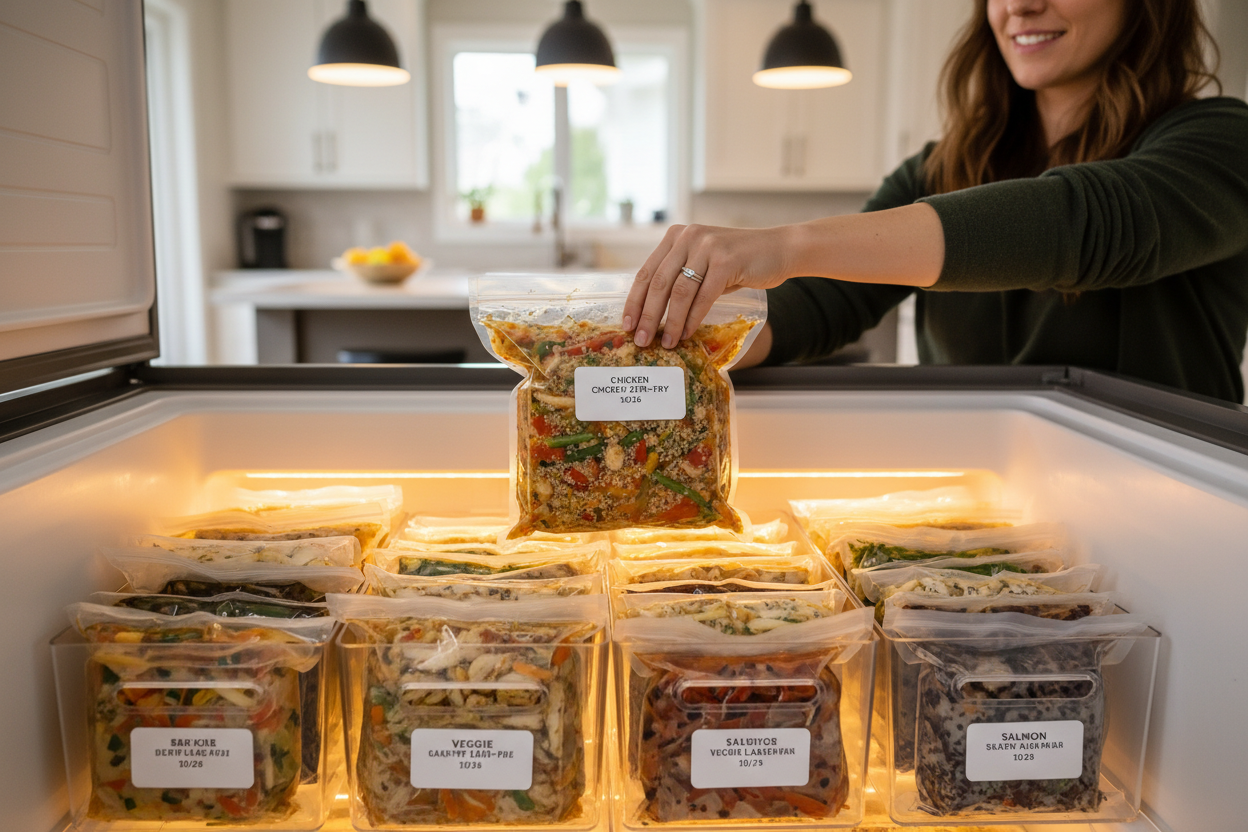

Réponse rapide : La brûlure de congélation est une déshydratation, pas une détérioration. Elle se produit lorsque l'humidité à la surface des aliments congelés s'échappe dans l'air sous forme de vapeur (un processus appelé sublimation), laissant derrière elle des taches sèches, gris-blanc. Elle est causée par le contact de l'air — par un emballage lâche, des variations de température ou un stockage prolongé — et bien qu'elle rende les aliments plus durs, plus secs et plus fades, elle ne les rend pas dangereux à manger. La solution est presque toujours la même : éliminer l'air avant de congeler.
Si vous avez déjà sorti un sac de poulet ou un pot de crème glacée du congélateur pour le trouver couvert de taches blanches givrées, vous avez rencontré la brûlure de congélation. C'est l'une des raisons les plus courantes — et les plus mal comprises — pour lesquelles de bons aliments finissent à la poubelle. Ci-dessous, nous verrons exactement ce que c'est, ce qui la cause, comment la repérer sur différents aliments, si elle est réellement sûre à manger, et les méthodes qui l'arrêtent véritablement.

Qu'est-ce que la brûlure de congélation ?
La brûlure de congélation est la formation de taches sèches, coriaces et décolorées sur les aliments congelés après que l'humidité s'est échappée de leur surface. Elle apparaît sous forme de taches brun-gris sur la viande, de taches blanches crayeuses sur les légumes, ou de cristaux de glace granuleux sur la crème glacée et les produits de boulangerie.
Ce n'est pas de la moisissure, et elle n'est pas causée par un congélateur « trop froid ». C'est simplement une perte d'humidité. Une fois que l'eau quitte la surface de l'aliment, elle ne peut plus revenir — c'est pourquoi la brûlure de congélation modifie la texture et la saveur de manière permanente, même si elle ne rend pas les aliments dangereux.
Qu'est-ce qui cause la brûlure de congélation ?
La brûlure de congélation se produit par un processus appelé sublimation : l'eau contenue dans les aliments congelés se transforme directement de glace en vapeur sans jamais devenir liquide. Cette vapeur s'échappe dans l'air ambiant, et ce faisant, elle prive la surface de l'aliment de son humidité et se redépose souvent sous forme de cristaux de glace à l'intérieur de l'emballage.
Trois conditions accélèrent ce processus :
- Exposition à l'air. Toute poche d'air piégée contre les aliments donne à l'humidité un endroit où aller. Plus il y a d'air, plus la sublimation est rapide.
- Fluctuation de la température. Chaque fois qu'une porte de congélateur s'ouvre, ou qu'un congélateur fonctionne à une température supérieure à 0 °F (-18 °C), les aliments décongèlent et recongèlent partiellement — et chaque cycle attire plus d'humidité à la surface.
- Durée. Même les aliments bien emballés finiront par subir une brûlure de congélation. Chaque aliment a une durée de conservation réaliste au congélateur, et plus il reste longtemps, plus il perd de l'humidité.
Un emballage lâche ou non hermétique est le multiplicateur derrière ces trois facteurs — c'est la raison pour laquelle deux coupes de viande identiques peuvent congeler de manière complètement différente selon la façon dont elles ont été emballées.

Comment savoir si quelque chose est brûlé par le congélateur
Les signes de brûlure de congélation varient un peu selon le type d'aliment, mais le motif est constant : sécheresse, décoloration et cristaux de glace concentrés à la surface plutôt que dans tout l'aliment.
- Sur la viande et le poulet : taches gris-brun ou blanches, texture coriace ou dure sur les bords, et cristaux de glace visibles à l'intérieur de l'emballage.
- Sur le poisson et les crevettes : décoloration terne, blanc crayeux ou opaque, texture sèche ou fibreuse au lieu de l'aspect ferme et brillant habituel.
- Sur les légumes : taches ratatinées et sèches ou surface légèrement givrée et terne, parfois avec une texture pâteuse une fois décongelés.
- Sur la crème glacée : gros cristaux de glace granuleux à la surface et une texture granuleuse au lieu d'une crème lisse.
- Sur le pain et les produits de boulangerie : texture sèche et rassis et petits cristaux de glace à l'intérieur du sac.
Si vous n'êtes pas sûr de savoir si ce que vous regardez est une brûlure de congélation ou simplement du givre normal, l'indice est l'emplacement et la texture : la brûlure de congélation est sèche et décolorée sur l'aliment lui-même, pas seulement une couche de givre sur l'emballage.

Brûlure de congélation vs engelure vs cristaux de glace : quelle est la différence ?
Ces termes sont utilisés de manière interchangeable, mais ils ne sont pas tout à fait la même chose.
| Terme | Ce que c'est réellement | Où ça apparaît |
|---|---|---|
| Brûlure de congélation | Déshydratation de la surface de l'aliment par sublimation | Directement sur la viande, les produits, les produits de boulangerie, la crème glacée |
| « Engelure » sur les aliments | Terme informel utilisé par les gens pour la brûlure de congélation — pas un terme distinct en science alimentaire | Identique à la brûlure de congélation |
| Cristaux de glace | Humidité gelée qui s'est échappée de l'aliment et a recongelé à proximité | À l'intérieur de l'emballage, à la surface de l'aliment, ou sur les parois du congélateur |
Dans le langage courant, « engelure » sur les aliments et brûlure de congélation décrivent la même chose. Les cristaux de glace sont généralement un symptôme de la même perte d'humidité sous-jacente, bien qu'une petite quantité de formation de cristaux de glace soit normale dans tout congélateur et ne signifie pas automatiquement que l'aliment est ruiné.
Les aliments brûlés par le congélateur sont-ils sûrs à manger ?
Oui. Selon l'USDA, la brûlure de congélation est un problème de qualité, pas un problème de sécurité alimentaire. Les aliments brûlés par le congélateur ne vous rendront pas malade et n'indiquent pas de croissance bactérienne ou de détérioration — il s'agit simplement d'une perte d'humidité.
Ceci étant dit, quelques questions courantes se posent à ce sujet :
La brûlure de congélation peut-elle vous rendre malade ? Non. La brûlure de congélation en elle-même ne provoque pas de maladies d'origine alimentaire. L'aliment est toujours sûr tant qu'il a été congelé correctement et qu'il est resté à une température sûre pendant toute la durée.
Les aliments brûlés ou endommagés par le congélateur sont-ils dangereux ou nocifs ? Non — « dangereux » et « nocifs » renvoient tous deux à un risque pour la sécurité alimentaire, et la brûlure de congélation n'en présente aucun. L'inconvénient réside entièrement dans la qualité gustative : une texture plus sèche, une bouchée plus dure et une saveur plus fade.
Peut-on manger des crevettes, du poulet ou de la crème glacée brûlés par le congélateur ? Oui. Tous sont sûrs à manger une fois cuits correctement (ou, pour la crème glacée, simplement décongelés à la température de service). Les crevettes et le poisson ont tendance à montrer les effets de la brûlure de congélation sur la texture de la manière la plus spectaculaire, donc si la partie brûlée est petite, la retirer avant la cuisson donne généralement le meilleur résultat.
Est-il sûr de manger des saucisses ou d'autres viandes transformées brûlées par le congélateur ou « givrées » ? Oui, la même règle s'applique — la brûlure de congélation sur les saucisses, les hot-dogs ou d'autres viandes transformées affecte la texture et le goût, pas la sécurité, à condition que le produit ait été stocké à une température de congélation sûre tout au long.
La seule mise en garde à signaler : la brûlure de congélation est un signal de qualité, pas de sécurité, mais il est tout de même utile de vérifier que l'aliment a été congelé et stocké correctement au départ (c'est-à-dire qu'il n'est pas resté à l'air libre et décongelé pendant des heures avant d'être recongelé). C'est une question de sécurité alimentaire distincte de la brûlure de congélation elle-même.
Pourquoi la brûlure de congélation est-elle « mauvaise » si elle n'est pas dangereuse ?
Il est important d'éviter la brûlure de congélation car elle dégrade tout ce qui rend les aliments agréables à manger :
- Texture — la viande devient plus dure et filandreuse ; les légumes deviennent pâteux ou caoutchouteux ; la crème glacée devient glacée et granuleuse au lieu d'être lisse.
- Saveur — la déshydratation concentre certaines saveurs tout en en atténuant d'autres, et une exposition prolongée à l'air permet l'oxydation, ce qui peut créer des notes désagréables, légèrement rances dans les aliments plus gras.
- Valeur — la brûlure de congélation est l'une des sources les plus courantes (et les plus évitables) de gaspillage alimentaire. Si vous achetez en vrac ou préparez vos repas pour économiser de l'argent, la brûlure de congélation annule discrètement ces économies.

Comment prévenir la brûlure de congélation : méthodes qui fonctionnent réellement
Chaque méthode de prévention se résume à un seul levier : réduire l'exposition des aliments à l'air. Voici comment se comparent les options courantes.
| Méthode | Élimination de l'air | Durée de vie typique au congélateur avant brûlure | Risque de brûlure de congélation |
|---|---|---|---|
| Sac de congélation (air expulsé à la main) | Partiel | 1 à 3 mois | Élevé |
| Papier aluminium / film alimentaire seul | Minimal | 2 à 4 semaines | Très élevé |
| Récipient rigide avec couvercle | Partiel (des poches d'air subsistent) | 1 à 2 mois | Moyen |
| Papier boucher + sac de congélation (double emballage) | Bon | 2 à 4 mois | Moyen-faible |
| Scellage sous vide | Quasi-total | 6 à 12 mois et plus | Très faible |
1. Retirez le plus d'air possible avant de congeler
C'est le facteur le plus important. Une machine sous vide retire presque tout l'air autour des aliments avant de les sceller, ce qui ralentit directement la sublimation — prolongeant souvent la durée de vie au congélateur de plusieurs fois par rapport à un sac standard. Si vous n'avez pas de machine sous vide, la méthode par déplacement d'eau (abaisser un sac à fermeture éclair dans l'eau pour que la pression chasse l'air avant de le sceller) est une alternative raisonnable et peu coûteuse pour un stockage à court terme.
2. Maintenez votre congélateur à 0°F (-18°C) ou en dessous
Même les aliments parfaitement emballés subiront plus rapidement des brûlures de congélation dans un congélateur chaud ou fluctuant. Un simple thermomètre de congélateur élimine les incertitudes, et éviter de trop remplir l'étagère de la porte (qui subit les plus grandes variations de température) aide à maintenir la cohérence.
3. Refroidissez les aliments avant de les congeler
Mettre des aliments chauds directement au congélateur augmente la température autour d'eux, provoquant la décongélation partielle et la recongélation des articles voisins — accélérant la perte d'humidité pour tout ce qui se trouve à proximité. Laissez les aliments refroidir à température ambiante, ou réfrigérez-les brièvement, avant de les congeler.
4. Portionnez avant de congeler
Ouvrir un emballage, en retirer une partie et recongeler le reste introduit de l'air frais à chaque fois. Sceller les aliments en portions individuelles, de taille repas, signifie que vous n'ouvrez que ce que vous êtes sur le point d'utiliser. (combien de temps les différents aliments se conservent au congélateur)
5. Doublez l'emballage pour un stockage plus long
Pour les articles que vous prévoyez de conserver plus de quelques mois, une couche intérieure (film plastique ou papier boucher pressé directement contre les aliments) plus une couche extérieure hermétique (un sac sous vide ou un sac de congélation épais) offre une protection supplémentaire contre les fuites d'air lentes.
6. Étiquetez et faites tourner (premier entré, premier sorti)
Le risque de brûlure de congélation augmente plus les aliments restent longtemps, peu importe leur emballage. Étiquetez tout avec la date de congélation et utilisez les articles plus anciens en premier.
Brûlure de congélation sur des aliments spécifiques

Poulet et autres viandes. Recherchez une décoloration gris-brun et une texture sèche et coriace concentrée sur les bords. Comme la viande a une forte teneur en humidité, elle est particulièrement sujette à la sublimation — la mise sous vide avant la congélation est la solution la plus efficace, et c'est aussi le moyen le plus simple de sceller sous vide le poulet avant de le congeler en un coup d'œil avant la cuisson.

Crevettes et poissons. Les fruits de mer sont encore plus sensibles à l'humidité que la viande rouge, et leur texture souffre rapidement une fois la déshydratation commencée — les crevettes en particulier peuvent devenir caoutchouteuses ou farineuses. Les crevettes brûlées par le congélateur sont toujours comestibles une fois cuites ; si seule la surface est affectée, rincer et couper les parties les plus sèches avant la cuisson aide. Sceller les crevettes et le poisson immédiatement après l'achat (plutôt qu'après un ou deux jours au réfrigérateur) donne les meilleurs résultats, car les fruits de mer commencent à perdre leur qualité dès qu'ils sont hors de l'eau.

Glace. Oui, la crème glacée subit des brûlures de congélation — elles apparaissent sous forme de plaques glacées et granuleuses à la surface plutôt que la texture lisse initiale. Elle est toujours bonne à manger ; les cristaux de glace ne sont que de l'eau qui s'est séparée du mélange. Presser un film plastique directement contre la surface avant de fermer le couvercle ralentit ce processus, et garder le carton à l'arrière du congélateur (loin de la porte) aide aussi.
Légumes. Les légumes crus congelés sans blanchiment préalable ont tendance à brûler plus rapidement au congélateur et à devenir mous une fois décongelés, car les enzymes qui les décomposent sont toujours actives. Un blanchiment rapide (ébullition brève, puis bain de glace) avant la congélation ralentit considérablement ce processus et aide les légumes à conserver leur couleur, leur texture et leurs nutriments plus longtemps.
Pain et pâtisseries. Le pain sèche rapidement au congélateur sans un joint hermétique, devenant rassis et friable. La mise sous vide du pain tranché en portions utilisables le garde mou beaucoup plus longtemps qu'un sac à pain standard.
Soupes, sauces et autres liquides. Les liquides se dilatent en congelant, alors laissez environ un demi-pouce d'espace libre dans n'importe quel récipient — sinon le joint peut se fissurer. Une fois congelé, le transfert du liquide dans un récipient plus ajusté ou scellé sous vide élimine la poche d'air restante et ralentit la formation de cristaux de glace supplémentaires.
Comment se débarrasser de la brûlure de congélation (ou de son goût)
La brûlure de congélation elle-même ne peut pas être inversée — une fois que l'humidité a quitté les aliments, ce changement de texture est permanent. Mais vous pouvez minimiser son impact :
- Coupez-la. Pour la viande, le poisson et les légumes fermes, couper la partie la plus sèche et la plus décolorée avant la cuisson élimine la majeure partie de la mauvaise texture et du mauvais goût, laissant le reste parfaitement utilisable.
- Cuisinez autour. Les méthodes de cuisson à la chaleur humide — braiser, mijoter, faire mijoter dans une sauce — réhydratent mieux les portions plus dures et brûlées par le congélateur que les méthodes à chaleur sèche comme le gril ou le rôtissage, qui ont tendance à rendre la sécheresse plus perceptible.
- Masquez les cas légers. Une marinade, une saumure ou une sauce relevée peut compenser une légère perte de saveur, en particulier sur la viande et la volaille.
- Quand il faut abandonner. Si la brûlure de congélation couvre la majeure partie de l'article et que la texture est significativement affectée, c'est toujours techniquement sûr — mais à ce stade, c'est un jugement à porter sur la question de savoir si cela vaut la peine d'être mangé ou de le remplacer.
FAQ
Qu'est-ce que la brûlure de congélation, en une phrase ? La brûlure de congélation est la déshydratation de la surface des aliments congelés causée par l'échappement de l'humidité dans l'air, laissant derrière elle des zones sèches, décolorées, parfois couvertes de cristaux de glace.
Comment savoir si quelque chose est brûlé par le congélateur ? Recherchez une décoloration sèche, grisâtre ou blanche à la surface des aliments, une texture plus dure ou coriace, et des cristaux de glace visibles sur ou autour des aliments — et pas seulement du givre à l'extérieur de l'emballage.
Comment savoir si le poulet est brûlé par le congélateur ? Vérifiez la présence de taches gris-blanc ou ternes à la surface et d'une texture sèche et coriace sur les bords. Si c'est mineur, coupez la zone affectée avant la cuisson ; le reste du poulet est bon.
La brûlure de congélation rend-elle malade ou est-elle dangereuse ? Non. La brûlure de congélation est un changement de qualité, pas un risque pour la sécurité. Elle ne causera pas de maladie — elle affecte juste la texture et le goût.
Peut-on manger des aliments brûlés par le congélateur ? Oui, les aliments brûlés par le congélateur sont sans danger. Coupez les portions gravement affectées si vous voulez la meilleure texture, ou utilisez une méthode de cuisson (comme le braisage) qui aide à compenser la sécheresse.
Comment prévenir ou éviter les brûlures de congélation ? Retirez le plus d'air possible avant de congeler (la mise sous vide est la méthode la plus efficace), maintenez votre congélateur à 0°F ou en dessous, refroidissez les aliments avant de les congeler et utilisez les articles dans un délai raisonnable.
Comment se débarrasser du goût de brûlure de congélation ? Vous ne pouvez pas l'inverser complètement, mais couper les parties les plus sèches et utiliser des méthodes de cuisson à chaleur humide (ragoûts, braisés, sauces) réduit considérablement sa perceptibilité.
La brûlure de congélation est-elle la même chose que les engelures sur les aliments ? "Engelure" est juste le nom informel que les gens utilisent pour la brûlure de congélation — ils désignent le même processus de déshydratation.

En résumé
La brûlure de congélation n'est pas aléatoire et n'est pas dangereuse — c'est le résultat prévisible de l'exposition à l'air, des variations de température et du temps. Elle affecte la texture et la saveur, pas la sécurité, ce qui signifie que les aliments de votre congélateur couverts de givre sont toujours parfaitement comestibles. La véritable solution est la prévention : couper l'accès des aliments à l'air est ce qui arrête réellement la sublimation à la source, et c'est exactement ce qu'une bonne machine sous vide est conçue pour faire.
Si vous en avez assez de couper les bords brûlés par le congélateur de bons aliments, une machine sous vide comme la Fresko AutoMax V2, V6 ou V8 retire l'air beaucoup plus efficacement qu'un sac à fermeture éclair ou un récipient — c'est pourquoi les aliments scellés sous vide durent régulièrement 3 à 5 fois plus longtemps au congélateur avant que la qualité ne commence à baisser. Associez-la aux sacs et rouleaux sous vide sans BPA de Fresko, portionnez vos aliments avant de les congeler et étiquetez tout avec la date — trois habitudes qui résolvent la plupart des problèmes de brûlure de congélation pour de bon.
Partager:
Comment sceller sous vide des bocaux Mason pour des aliments secs plus frais
Saveurs de la Coupe du Monde : un tour du monde du barbecue que vous pouvez faire mariner en quelques minutes