

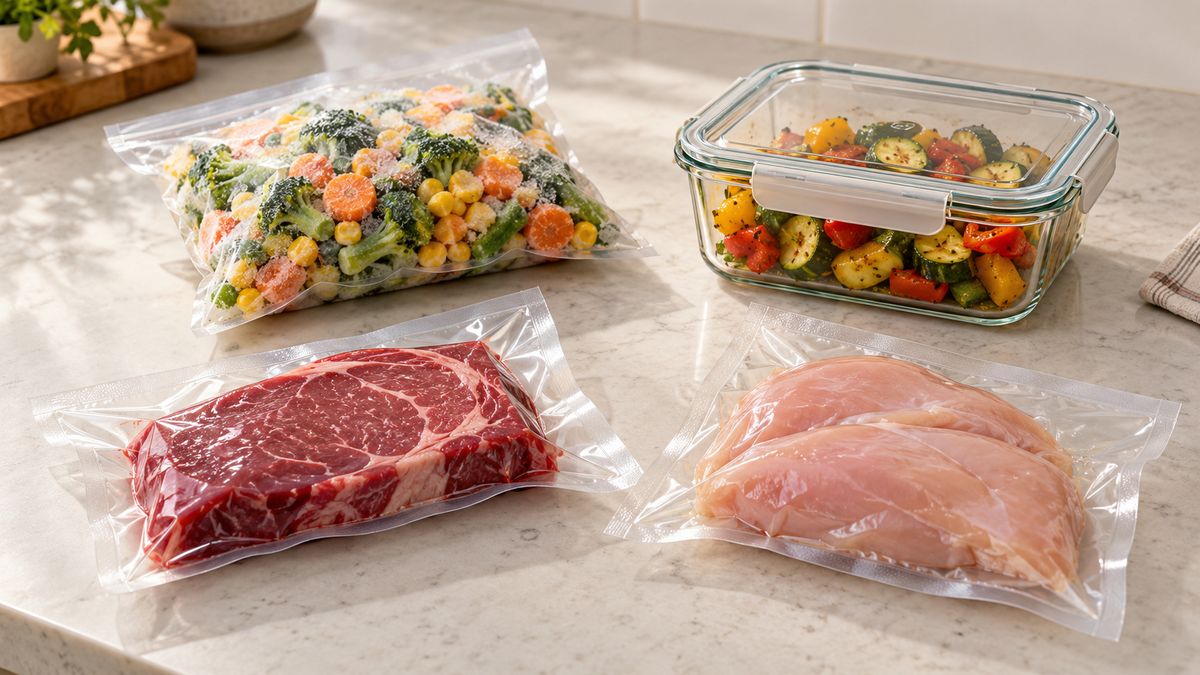
Quick answer: For meat portions and freezer meals in heat-sealed bags, start with a countertop vacuum sealer. Shortlist the FRESKO V6 if you frequently make custom-length bags, or the New V8 if moisture detection and a removable drip tray are priorities. Consider the V2 for a straightforward automatic sealing setup, and the HV9 for compatible reusable valve bags and containers.
The best vacuum sealer for food depends on what you package, how often you seal it, and whether you want to cut open a sealed bag or reopen a container. A household freezing individual steaks has different needs from someone storing everyday leftovers or preparing large batches of soup.
This guide compares documented features and packaging options, with FRESKO models as examples. Recommendations are based on those features and their intended uses, rather than hands-on comparative performance tests.

Compare FRESKO Vacuum Sealers by Your Main Task
Start with the job you want the machine to handle most often.
| Your main task | Model to consider | Features that support the choice | What to consider before buying |
|---|---|---|---|
| Everyday heat-sealed portions, especially when you prefer precut bags | FRESKO V2 Easy Auto | Automatic vacuum and sealing, Pulse Vac, Extended Seal and an accessory port | If you regularly make bags from rolls, consider whether integrated roll storage and cutting would be useful |
| Regular freezer preparation with different portion sizes | FRESKO V6 Roll & Cut | Built-in roll storage and cutter, separate vacuum-and-seal and seal-only areas, and pulse control | Making a bag from a roll still requires cutting it and sealing one end before filling |
| Mixed meat and freezer portions, with moisture handling and cleanup as priorities | FRESKO New V8 | Automatic moisture detection, Pulse Vac, roll storage, cutter and a removable drip tray | Moisture detection does not mean free-flowing liquids can be vacuumed directly into the machine |
| Frequently opened food containers and reusable valve bags | FRESKO HV9 Handheld Vacuum Sealer Set | Cordless operation, SOFT and FIRM modes, and compatible reusable bags and glass containers | It uses a valve-based system rather than heat-sealing ordinary open-ended rolls |
New V8 and the older V8 are different product listings. Use the specifications and instructions for the exact model you are considering.
Choosing a Vacuum Sealer for Meat
When comparing vacuum sealers for meat, focus on the portions you actually prepare. A bag for two chicken breasts presents a different sizing and handling task from a large roast or a bone-in cut.
Three features deserve particular attention:
- Bag fit: Check that the machine supports a bag wide enough for your food, with the opening clearance required by its instructions.
- Vacuum control: Manual control gives you a way to manage the vacuum process as food compresses or moisture moves toward the opening.
- Cleanup access: Meat preparation makes access to the sealing area and moisture collection tray especially relevant.
The New V8 is worth shortlisting when moisture detection, Pulse Vac and a removable drip tray are priorities. These features address control and cleanup; they do not establish that it outperforms every other model when sealing meat.
If your main task is preparing differently sized bags for steaks, chops and roasts, the V6’s integrated roll storage and cutter may be the more relevant reason to choose it.
Packaging matters as much as machine selection. Keep the sealing area clean, avoid wrinkles, and inspect bags for damage around sharp bones. A stronger vacuum cannot repair a puncture or compensate for an unsuitable bag.
Keep Food Safety Separate from Packaging Performance
Vacuum sealing does not make perishable meat safe to store at room temperature or give every food the same storage life. Keep refrigerated foods at 40°F or below and frozen foods at 0°F or below, following food-specific storage guidance and package directions. USDA’s refrigeration guidance and freezing guidance explain these requirements.
Choosing a Vacuum Sealer for Freezer Storage
For freezer preparation, look beyond the pump. Consider how easily you can make suitable bags, arrange portions, inspect seals and label each package.
Precut bags are convenient when you regularly prepare similar portions. Rolls let you adjust bag length for different foods, but require an extra cutting and sealing step.
The V6 is a useful option for households that frequently make custom-length freezer bags. Its integrated storage and cutter keep the roll and cutting tool together, while its separate sealing area supports making the closed end of a bag. The product listing specifies support for bags and rolls up to 11 inches wide; still check that the filled bag suits your portion and leaves enough room for sealing.
For occasional freezer portions, a simpler setup with suitable precut bags may be sufficient. Buying more features makes sense when they remove a step you regularly find inconvenient.
Use packaging intended for the machine and for freezer storage. Label portions with their contents and packing date, and inspect the closure before putting them away. Protective packaging helps maintain frozen food quality, but no machine can guarantee protection when a bag leaks or becomes damaged.
Choosing a Vacuum Sealer for Everyday Home Use
Think about what happens after you seal the food.
If you usually pack portions once and open them when needed, a heat-sealed bag is a practical format. If you repeatedly open the same container, a compatible reusable system may fit your habits better.
Consider the V2 when you want automatic heat sealing with manual vacuum control available. It is a reasonable starting point for users who mainly work with precut bags and do not make integrated roll handling a priority.
Consider the HV9 when you prefer reusable valve bags and containers. Its cordless design supports moving between compatible packages, and its SOFT and FIRM modes provide different vacuum settings. For foods with more liquid, the HV9 product guidance directs users toward its glass vacuum containers rather than vacuuming liquids directly in a bag.
Before choosing either format, account for the space needed to operate it, store its packaging, and clean everything afterward. A machine that fits your kitchen routine is more useful than a feature you rarely use.

What to Look for in a Vacuum Sealer for Heavy Use
If you regularly portion bulk purchases or prepare many meals at once, evaluate the complete process: cutting bags, filling them, sealing, observing required pauses and cleaning up.
Useful comparison points include:
- Supported bag widths and materials.
- Instructions for repeated cycles and cooling.
- Access to the sealing strip and vacuum channel.
- Roll storage and cutting convenience.
- Replacement packaging and serviceable parts.
Built-in cutters and removable trays can simplify preparation or cleanup. Those features alone do not prove that a machine can run continuously or handle a commercial workload.
For example, the V6 product page describes overheating protection that pauses operation and returns the machine to standby after cooling. That is a protection feature, not a reason to ignore operating intervals. Follow the instructions for the exact model rather than planning a batch around an unsupported “bags per minute” claim.
If your workload requires long, repeated sealing sessions, confirm the permitted operating cycle with the manufacturer before purchasing.

Match the Packaging System to the Food
The machine and its packaging must work together.
Countertop edge sealers remove air through the bag opening. They generally use textured vacuum bags or rolls designed to provide air channels.
Handheld systems draw air through a compatible valve. The pump, valve, bag or container lid must fit together.
Chamber sealers remove air from the surrounding chamber as well as the pouch. This makes suitable chamber models worth considering for frequent liquid packaging, although the entire filled pouch must fit inside. Anova’s explanation of chamber sealing describes how this differs from edge sealing.
Compare ongoing costs as well as the appliance price. Consider the cost per usable portion, the bag sizes you actually need, and the cleaning and replacement requirements of reusable items. Check each item’s instructions before assuming it can be reused, heated or washed in a dishwasher.
Frequently Asked Buying Questions
Which vacuum sealer is best for meat and freezer meals?
Start with a countertop model that supports your portion sizes and preferred packaging. Compare the V6 when custom bag preparation is your main priority, and the New V8 when moisture detection and tray cleanup matter more. The better choice depends on those tasks rather than a single suction specification.
Can I vacuum seal soup with a moist-food setting?
A moist-food setting is not permission to draw free-flowing soup into an edge sealer. The New V8 manual recommends freezing liquid foods in portions before transferring the frozen portions to vacuum bags.
If you frequently package liquids and want to avoid that preparation step, investigate a chamber machine designed for the task. Follow its temperature, fill-level and capacity instructions.
Do I need an expensive machine for occasional use?
Not necessarily. Pay for features that solve a recurring problem. Integrated roll storage is more useful when you make bags frequently; it may offer less value if you mainly use precut sizes. Include replacement packaging in your budget before comparing the total cost.
Will any vacuum bag work with my machine?
No. Confirm the bag format, material and width, along with any valve or accessory connection. Textured edge-sealing bags, chamber pouches and handheld valve bags serve different systems. Buy a compatible format before committing to a large supply.
Before You Buy
Choose your most common food and portion size, then decide how you want to package it. Use that decision to narrow the model list.
Before ordering, confirm:
- The exact model and its supported packaging.
- Whether it fits your portions and available workspace.
- Its cleaning, repeated-cycle and cooling requirements.
- The cost of replacement bags, rolls or containers.
- Current warranty and return terms for your seller.
Explore the FRESKO vacuum sealer collection and review the matching product manual to choose a setup that fits the way you prepare and store food.
Share:
Steakhouse Perfection at Home! 🥩 Sous Vide Steak with Herb Butter (Secret to a Perfect Cook)
How to Protect Your Food Before the Storm Hits