

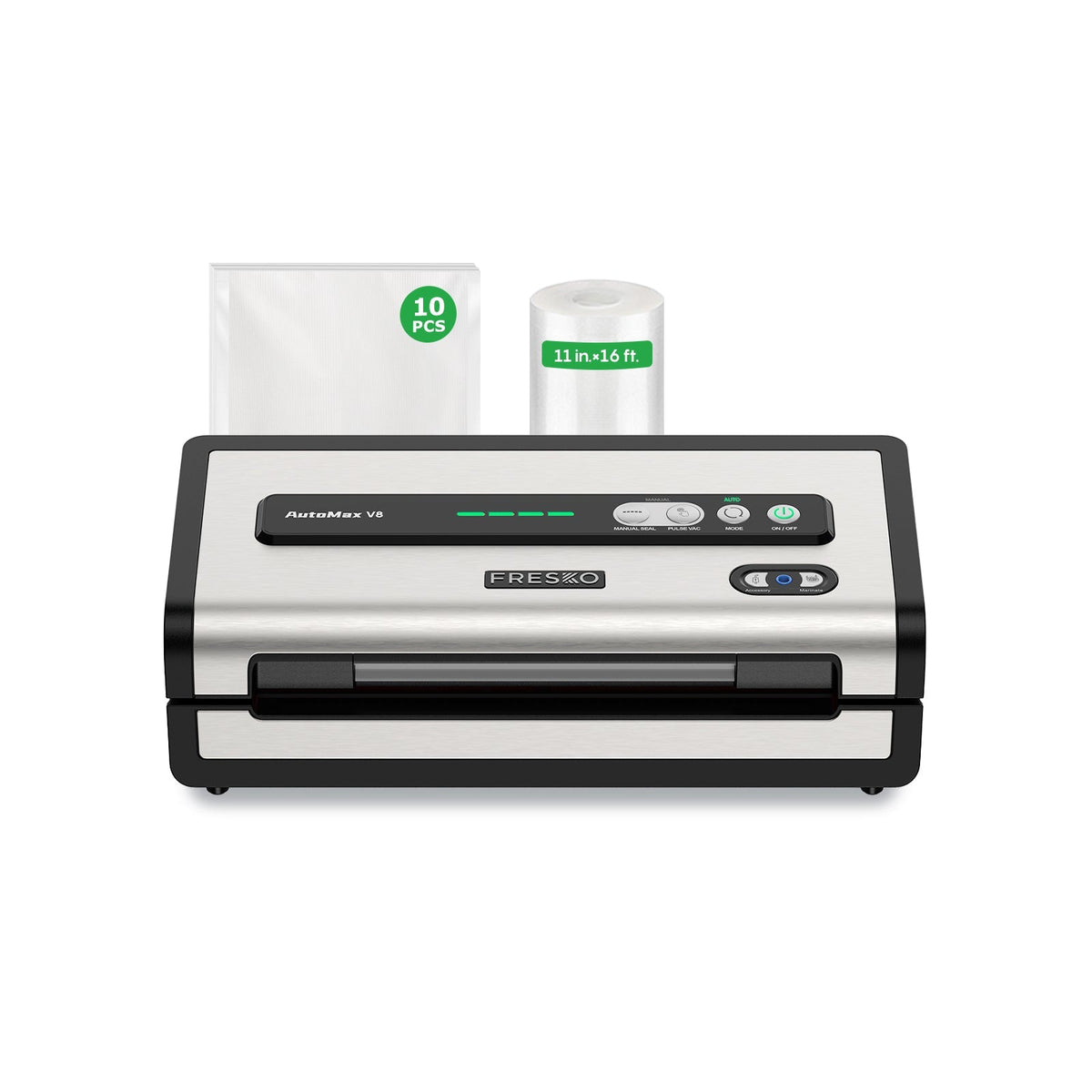
Quick answer: The best vacuum sealer for food is the one that fits your usual packaging job. Choose an edge sealer for heat-sealed freezer portions, a handheld system for compatible valve bags and containers, or a chamber machine for frequent liquid packaging. Compare control, usable capacity, cleanup, and ongoing packaging costs before choosing a model.
A freezer full of neatly labeled portions is useful. A complicated appliance that stays in its box is not. Start with the food you actually buy, the portions you freeze, and how often you open them again. Those details tell you more than a single suction rating or a “best overall” badge.
This is a manufacturer-documentation-based buying guide, not a hands-on product test or an independent ranking. FRESKO examples illustrate different workflows; no one machine is the right fit for every kitchen.
First, choose the right type of vacuum sealer
| Type | A useful starting point for | Trade-off to check |
|---|---|---|
| Countertop edge sealer | Meat portions, freezer meals, and custom-length heat-sealed bags | Food and liquid sit outside the machine. Check bag texture, width, and moisture precautions. |
| Handheld valve system | Compatible reusable bags and rigid containers you open regularly | The pump, valve, lid, and bag must work together. It is not a heat-sealing substitute for ordinary open-ended rolls. |
| Chamber sealer | Frequent liquid packaging where the selected machine permits it | The loaded pouch must fit inside the chamber. Check chamber dimensions, fill limits, and care requirements. |
An edge sealer draws air from the bag opening. A chamber machine reduces pressure around the entire pouch, which changes how it handles liquids. Anova’s explanation of chamber sealing describes this distinction. A chamber machine is not automatically the better purchase: a large roast that fits an edge-sealer bag may not fit a small chamber.
Compare features by the problem they solve
Manual control versus automatic convenience
Automation can make repetitive portions easier. Manual vacuum control gives you another option when food starts compressing before an automatic cycle finishes. Neither feature replaces watching delicate food. If bread and soft baked goods are a regular part of your routine, also consider a compatible rigid container rather than expecting a bag to preserve every shape.
Seal design versus bag preparation
A heat seal has to keep the package closed after the pump stops. Compare the manufacturer’s seal design, supported film, and sealing controls, but do not treat a wider strip as a guarantee against leaks. Wrinkles, crumbs, moisture, punctures, and an unsuitable bag can still cause trouble. A visible, accessible sealing area is worth looking for.
Moist-food settings versus free-flowing liquid
A moist-food setting is not blanket permission to vacuum soup directly into an edge sealer. Read the actual instruction manual. The New V8 manual recommends pre-freezing liquid foods in portions before bagging them. Our freeze-first workflow for soups and sauces explains the preparation. If that extra step does not fit your cooking, investigate a suitable container system or a chamber machine instead.
Published power versus your batch size
Pump figures can help describe a machine, but they do not tell you how long it takes to cut bags, fill portions, align openings, or clean up. Check any required pauses between cycles and what happens when the machine overheats. A speed claim with no bag size or test conditions is not a useful basis for planning a large batch.
What matters for meat and freezer storage?
When choosing a vacuum sealer for freezing meat, start with portion size. Will the bag hold your usual roast or several chicken pieces while leaving the clearance required by the manual? Can you arrange a flat opening without squeezing juices toward the machine? A wider bag is useful only if the machine supports its width and material.
For freezer prep, prioritize a packaging system you can label, inspect, and organize consistently. Look at both seal access and puncture risk around sharp bones. More suction does not fix a damaged bag. Keep replacement packaging available so you are not tempted to freeze a questionable seal.
Food-safety boundary: Vacuum packaging does not sterilize food, reset its storage clock, or replace refrigeration and freezing. USDA advises keeping perishable vacuum-packed foods refrigerated at or below 40°F or frozen at 0°F. Follow food-specific storage limits and package directions—not a blanket claim that meat keeps for weeks. See USDA’s vacuum-packaging safety guidance.
Which FRESKO features fit your kitchen?
The models below serve different priorities. The feature descriptions come from current US product information; the “consider it when” column is editorial guidance, not a performance-test result. New V8 and the older V8 are separate listings—check the exact model before comparing specifications.
| Model | Confirmed features relevant to buying | Consider it when… |
|---|---|---|
| FRESKO V2 Easy Auto Vacuum Sealer | Automatic vacuum and seal; Pulse Vac; Extended Seal; accessory port | You want a countertop heat-sealing workflow without making integrated roll storage your priority. |
| FRESKO V6 Roll & Cut Vacuum Sealer | Built-in roll storage and cutter; separate vacuum-and-seal and seal-only zones; pulse control | You often make custom-length bags and want the roll and cutter together. |
| FRESKO New V8 vacuum sealer | Automatic moisture detection; Pulse Vac; roll storage and cutter; removable drip tray | You want automatic heat sealing plus manual control and an organized bag-prep station. |
| FRESKO HV9 handheld vacuum sealer set | Cordless valve-based system; SOFT and FIRM modes; reusable bags and glass containers | You prefer compatible containers and valve bags rather than cutting and heat-sealing rolls. |
Do not confuse New V8 Pulse Vac with HV9 SOFT. Pulse Vac provides manual vacuum control; HV9 SOFT is the handheld system’s gentler mode. They belong to different machines and packaging systems. Neither is a promise that every delicate food will remain unchanged.

Budget for the packaging and cleanup, too
The purchase price is only the starting point. Estimate how many portions you package each month, the bag sizes you use, and whether the included accessories match those portions. Compare replacement bag costs per usable portion rather than comparing only the price of a roll or box.
- Rolls: Flexible lengths can suit mixed portions, but making each bag takes a cutting and sealing step.
- Precut bags: Convenient for repeated sizes; an oversized bag can use more material than the portion needs.
- Reusable systems: Budget for compatible bags, lids, and containers, plus cleaning and drying time. Reuse permission depends on the item and its instructions.
- Maintenance: Check access to the vacuum channel and drip tray, gasket care, and whether replacement parts are available. Removable does not automatically mean dishwasher-safe.
Measure your storage space and the working area needed with the lid open and a filled bag in front. Check current warranty and return terms for the exact product and seller; do not assume every FRESKO model has identical coverage.
A five-question buying checklist
- What will I package most often: freezer meat, everyday leftovers, delicate food, or liquids?
- Do I want heat-sealed bags, reusable valve bags, rigid containers, or a combination?
- Will the supported bag size or chamber hold my actual portions?
- Can I comfortably store, operate, clean, and maintain the machine?
- Does the complete cost—including replacement packaging—fit my routine?
Frequently asked buying questions
Which food vacuum sealer is the best for home use?
For regular freezer portions, start by comparing countertop edge sealers. For frequently reopened containers, consider a compatible handheld system. The best food vacuum sealer for home use is the one whose packaging, controls, and cleanup you will use consistently—not necessarily the model with the largest pump figure.
Do I need the most expensive model?
No. Pay for a feature when it removes a recurring inconvenience. Built-in roll storage matters more if you make bags often; it matters less if you mainly use precut sizes. Frequent liquid packaging may justify a different type of machine rather than a more elaborate edge sealer.
Can I buy any replacement bag?
No. Match the bag format, material, width, and valve connection to the selected machine. Standard edge-sealing bags, smooth chamber pouches, and valve bags are different systems. Confirm compatibility before buying a bulk supply.
Ready to narrow the shortlist? Compare the current vacuum sealers, then read the exact model’s product manual before purchasing. Choose the workflow first; choose the model second.
Share:
Steakhouse Perfection at Home! 🥩 Sous Vide Steak with Herb Butter (Secret to a Perfect Cook)
How to Protect Your Food Before the Storm Hits