

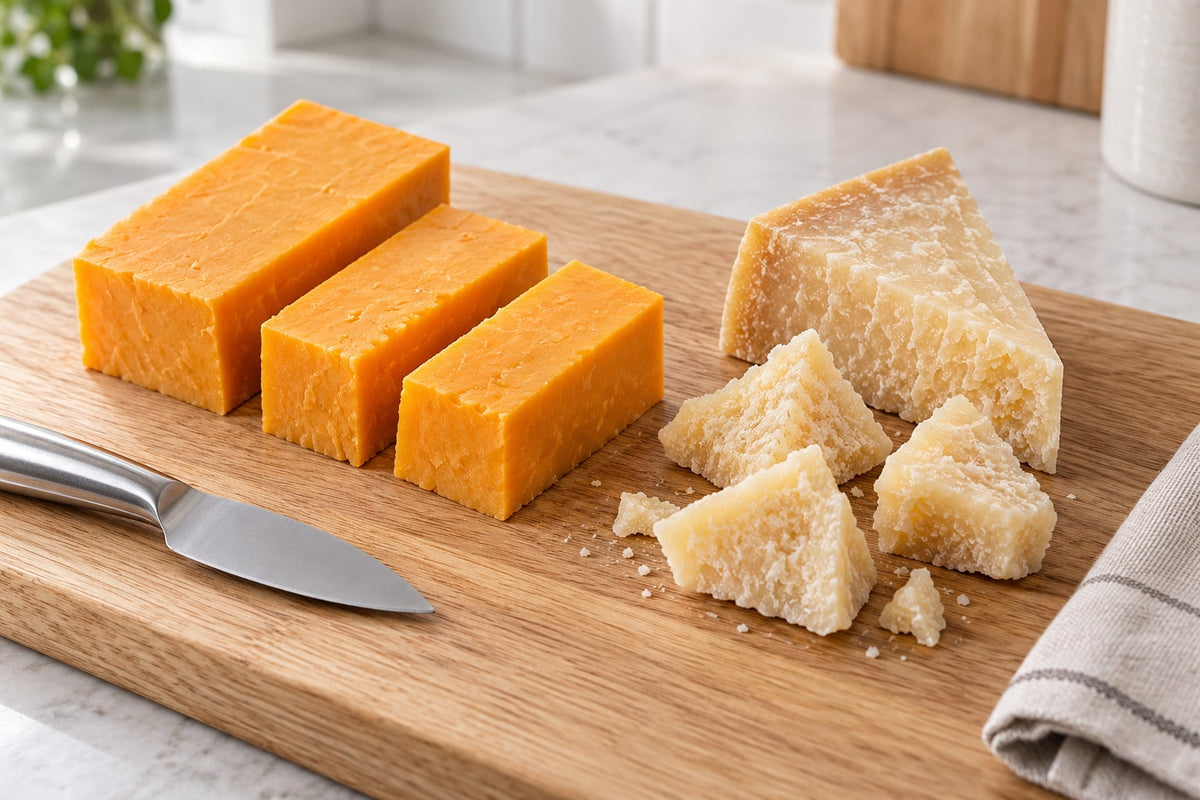
A big block of cheese is a useful grocery buy until the cut end dries out, the package gets crowded, or nobody remembers when it was opened. Vacuum packaging can make suitable hard-cheese portions easier to organize. The important choice, though, comes before you switch on the sealer: what kind of cheese are you storing?
Can you vacuum seal cheese? Yes, suitable hard cheeses can be vacuum packaged for refrigerated portion storage. Follow the cheese maker’s guidance, choose a bag or rigid container for the portion, and keep it cold. Vacuum sealing is not suitable for every cheese, and resealing does not restart its storage life.
Start with the cheese, not the vacuum setting
This guide covers household portioning of commercially made hard cheese, not home cheesemaking or aging cheese under vacuum. A plain block of Cheddar or Parmesan is a more appropriate starting point than a soft, moist cheese. Check the maker’s storage directions before changing its packaging.
For fresh, soft, brined, blue, and bloomy-rind cheeses, keep the recommended packaging and storage method unless you have specific instructions for that cheese. A softer vacuum setting is not a food-safety exception. University of Guelph’s cheese packaging guidance, for example, favors oxygen-permeable wrapping for surface-ripened soft cheese.
| Cheese or situation | Practical package choice | Important boundary |
|---|---|---|
| Suitable hard-cheese block, portioned for later | Compatible vacuum bag for compact storage | Follow the cheese maker’s directions; refrigerate after packing. |
| Suitable hard cheese cut into pieces | Compatible rigid container when shape protection matters | Rigid walls prevent bag compression; they do not make an unsuitable cheese safe to vacuum pack. |
| Fresh mozzarella, ricotta, cream cheese, or cheese in brine | Original or manufacturer-recommended refrigerated packaging | Do not apply the hard-cheese vacuum method to these foods. |
| Brie, Camembert, blue, or other specialty-rind cheese | Wrapping and storage specified by its producer | Do not assume every rind or cheese benefits from reduced oxygen. |
| Unopened commercial package | Leave intact when practical | Keep the original label and storage instructions. |
Choose the package for the portion
A bag makes sense when you want a compact, individually packed block. Choose enough room for the cheese without crowding the closure or valve. Avoid forcing a sharp corner against the film, and use a clean, undamaged bag intended for your sealer.
A rigid container is useful when you want suitable hard-cheese pieces to retain their arrangement or be easier to lift out. It takes more refrigerator space, but the walls do not pull inward around the food. Removing air from a container still creates a reduced-oxygen environment; glass is not a workaround for the cheese-type restrictions above.
Already own a different machine? Match the packaging to its system. A handheld pump works through a compatible valve; a countertop heat sealer uses the bag type specified in its manual. Compare FRESKO vacuum sealers if you are choosing a system, rather than assuming one bag works with every machine.
How to vacuum seal cheese in an HV9 valve bag
Work with cold cheese, clean hands, a clean knife, and a clean preparation surface. Take out only what you need to portion, and return the packed cheese to the refrigerator promptly.
- Keep the original information. Note the cheese type, original opening date, and applicable package instructions before discarding any outer wrapper.
- Fill below the bag’s maximum line. Keep cheese clear of the closure and air valve. Do not overfill to squeeze one more piece inside.
- Close the entire zipper with the sealing clip. Check for crumbs or cheese residue that could interrupt the closure.
- Lay the bag flat with its valve facing up. Keep the valve unobstructed and accessible; do not position cheese directly underneath it.
- Position HV9 over the valve and start the cycle. Follow the manual’s mode guidance for the food and package. The pump stops automatically at its target vacuum. SOFT is gentler, but it does not make soft cheese suitable for this method.
- Check, label, and refrigerate. Inspect the closure and bag for damage or returning air. Do not repeatedly run the pump to compensate for an obvious leak.
How to use the HV9 glass container
For suitable hard-cheese portions, start with a clean container and lid. Keep cheese and crumbs away from the sealing surfaces, close the lid securely, and place the pump over the valve. Use FIRM mode for the glass container, as specified for HV9, and allow the automatic cycle to finish.
Set the lid’s date marker to the vacuum-packing date, add the separate opening-date label described below, and refrigerate. When accessing the cheese, use the lid’s release valve before opening. Remove a portion with clean utensils and follow the same preparation and sealing checks before packing the remainder again.
These instructions are specific to HV9 and its compatible accessories. They do not describe a heat-sealed bag, a canning jar, or a pressure-canning process.
Use the date dial without losing the original opening date

The date dial answers “When did I vacuum pack this container?” It does not answer “How long is this cheese safe?” Keep both the packing event and the food’s earlier history visible.
- On the dial: the vacuum-packing date.
- On a separate label: cheese name, original opening date, and relevant storage or use instructions.
- After repacking: retain the original opening date rather than replacing it with today’s date.
For example, cheese opened Monday and repacked Wednesday was still opened Monday. Treat resealing as a packaging step, not a fresh start. Keep older portions easy to find and avoid combining cheese from different packages if that would make its history unclear.
Refrigeration, cleaning, and when not to reseal
Keep the home-portioned cheese in this guide refrigerated at 40°F or below, following USDA refrigerator guidance. Utah State University Extension explains that vacuum packaging does not replace refrigeration or freezing. Follow the cheese label and applicable opened-package guidance; there is no universal extra number of days to add because you used HV9.
Before reusing a bag, follow its cleaning instructions and inspect the closure and valve. The HV9 manual calls for removing the valve and cleaning the inside after moist-food use. Do not reuse a damaged bag. Keep the pump out of water and wipe its exterior with a damp cloth; do not treat it like the removable accessories.
Never use vacuum sealing to rescue questionable cheese. USDA advises discarding moldy soft cheese and moldy shredded, sliced, or crumbled cheese; hard blocks have different handling rules. Consult its mold guidance rather than simply cleaning the package and resealing.
Frequently asked questions
Does vacuum-sealed cheese need to be refrigerated?
Keep the cheese portioned using this guide refrigerated. Vacuum packaging is not a way to convert refrigerated cheese into a shelf-stable food. Follow the original label for commercially packaged products.
Can I vacuum seal cheese after every use?
Suitable cheese can be repackaged according to the food and equipment instructions, using clean, sound packaging. Each opening adds handling, so portioning first may be simpler. Keep the original opening date.
Does SOFT mode mean I can seal soft cheese?
No. The mode name describes gentler vacuum control, not a food category or safety approval. Cheese suitability must be established separately.
Will vacuum sealing stop all mold or spoilage?
No. A tight-looking package is not proof of food safety. Correct temperature, clean handling, appropriate cheese selection, and storage history still matter.
Image note: The cover is an AI-generated editorial illustration. Product images are official FRESKO images.
Share:
Will an Immersion Blender Scratch Your Pot? What a Guard Can—and Cannot—Do