

You're making soup tonight, but Sunday prep means onions, slaw, and a pile of vegetables. Can one small appliance do all of it? The useful question in an immersion blender vs food processor comparison is not which has more power. It is what you want the food to look like when you stop.
Quick answer: Choose an immersion blender for smoothing soup and sauces directly in their container. Choose a mini chopper for small amounts of chopped ingredients. Choose a full-size food processor with the appropriate discs when you need slices or shreds; dough requires a model and attachment approved for it. A hand blender's chopping bowl does not automatically provide those processor functions.
This is a task-based comparison using current manufacturer information, not a side-by-side appliance test.
Quick task choice
Start with your most frequent job, then check the attachment—not just the appliance name. This table separates the standard blending arm from the Fresko H9's mini chopper and a full-size processor.
| Kitchen task | Immersion blending arm | H9 mini chopper | Full-size food processor |
|---|---|---|---|
| Smooth soup in the pot | Good fit; follow hot-food instructions | Not an in-pot tool | Requires transfer; follow temperature and liquid limits |
| Blend a small sauce | Good fit in a suitably narrow vessel | Check the attachment's permitted uses | Possible with the correct blade and enough mixture to reach it |
| Chop herbs, nuts, onion, or garlic | Not the first choice for a loose, dry chop | Listed small-batch uses | Multipurpose blade; useful for larger batches |
| Slice cucumbers or shred cabbage | No | No slicing or shredding function documented | Yes, with the appropriate disc |
| Knead bread or pizza dough | No | Not a documented H9 function | Only if the model, blade, and recipe quantity are approved |
The distinction is supported by KitchenAid's processor accessory guide: chopping uses a multipurpose blade, slicing and shredding use discs, and kneading uses a dough blade on the covered model. Those accessories are not interchangeable promises.
Blending arm vs chopper vs processor
The blending arm brings the blade to the food
The narrow shaft goes into your pot or beaker. It makes sense when you want a mixture smoother without moving it into another appliance. It does not have a feed tube or a slicing disc. For the broader tool overview, see what an immersion blender is and what its parts do.
The H9 mini chopper is a separate attachment
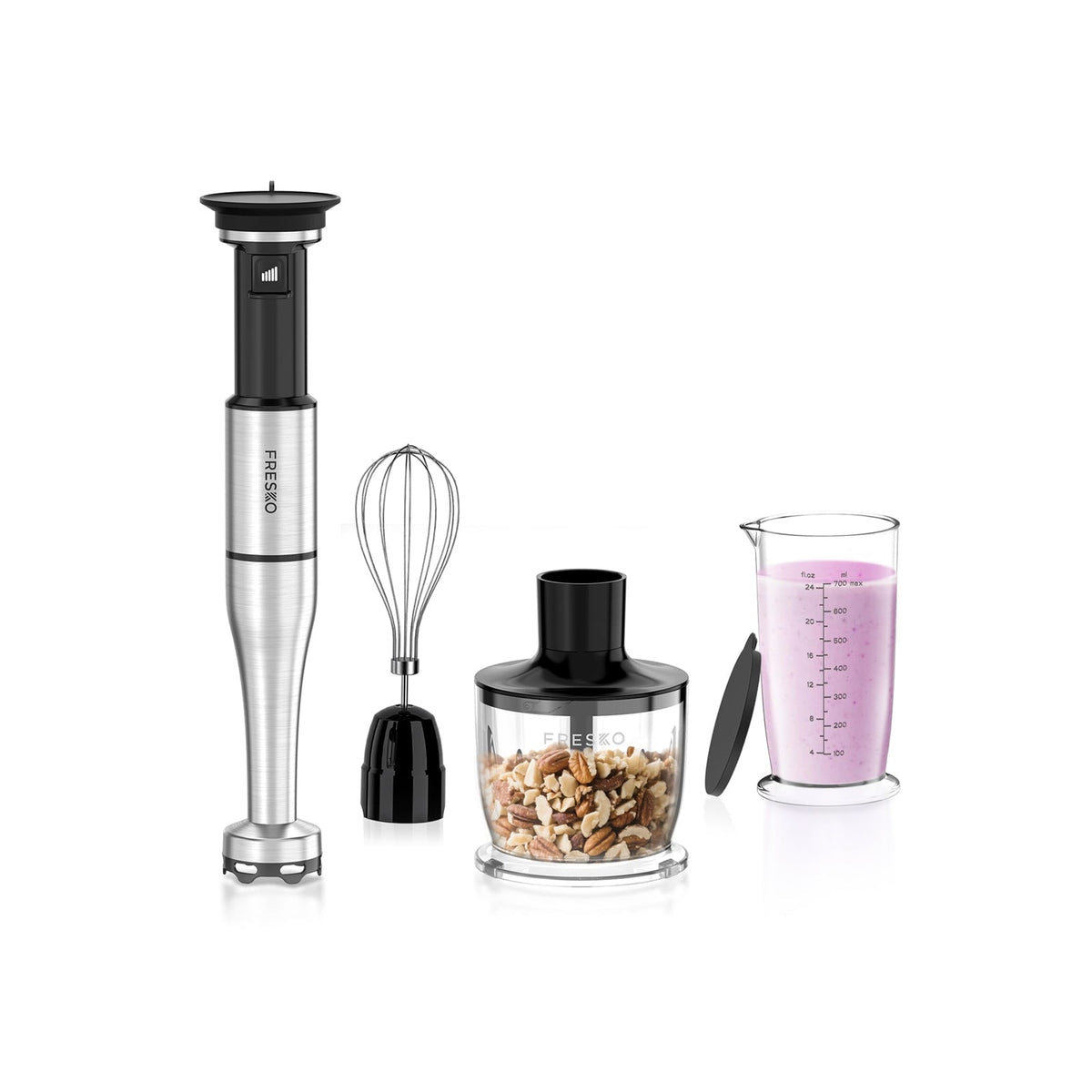
The chopper contains food in its own bowl and uses the H9 motor handle to drive its blade. Fresko lists herbs, nuts, onions, and garlic among its small-batch jobs. The H9 set also includes a whisk and beaker. That makes it useful across several prep steps, but does not turn the chopper into a full-size slicing, shredding, or dough-making processor.

A full-size processor offers different cutting attachments
A processor works in a dedicated bowl. Depending on the model, its feed tube and discs let you make repeated slices or shreds rather than an irregular chop. Check the box contents: some functions require separately sold accessories, and a larger bowl alone does not establish dough capability. KitchenAid's chopper-versus-processor guide explains this attachment distinction.
Puree, chop and slice
Puree: decide where the food should stay
For cooked vegetable soup, an immersion arm lets you work in the pot. For a thicker mixture that a processor's manual allows, the work bowl may fit your process better. Neither label promises the same result for every recipe. Think about liquid, batch size, and whether ingredients can reach the blade.
If you mainly want to make smoothies or frozen drinks, use our separate immersion blender vs countertop blender comparison to choose the right blending setup.
Chop: stop while you still like the texture
A little chopped onion for dinner and a large vegetable-prep session create different demands. A mini chopper can suit the first; a larger processor may reduce repeated loading for the second. Cut ingredients to the size the manual specifies, use short pulses when appropriate, and check before continuing. More processing can mean a finer result, not a better one. KitchenAid's food-chopper instructions describe this prep-and-pulse approach.
Slice or shred: look for the disc
If the goal is cucumber rounds or cabbage ribbons, a chopping blade is the wrong substitute. Buy the function explicitly: a compatible slicing or shredding disc, the right feed arrangement, and instructions covering your ingredient. Do not buy the H9 expecting it to do either job. For one occasional salad, a knife or hand grater may be all you need.
Capacity and cleanup
Compare the batch you actually make, not the largest number on a carton. A processor bowl's stated capacity is not permission to fill it to the rim with liquid. The manual's working limits come first. An immersion blender also has limits: the food must cover the working end, while the motor and connection stay out of the mixture. More pot volume does not mean unlimited reach or run time.
The H7-P listing specifies a 700 ml beaker; that does not tell you the H9 chopper's usable capacity. Check the selected attachment's markings and instructions rather than transferring measurements between products.
For cleanup, count the food-contact pieces you used. A blending arm used in your existing pot can mean fewer extra dishes. A chopper adds its bowl, lid, and blade; a processor may add a feed tube, pusher, and disc. Unplug before disassembly, keep the motor dry, and follow each part's washing instructions. Detachable does not automatically mean dishwasher-safe. See KitchenAid's cleaning guidance for the same model-specific distinction.
Choose a set
Picture your next three meals. If the repeated job is smoothing a pot of soup or a small sauce, start with the blending arm. If it is chopping small amounts as well, a set with a mini chopper can earn its space. If it is slicing, shredding, or approved dough work, prioritize a processor equipped for those jobs.
- H7: Fresko's streamlined hand-blender option, centered on the detachable blending arm.
- H7-P: the hand-blender-and-beaker configuration; its US listing specifies a 700 ml beaker.
- H9: the broader set with blending arm, whisk, mini chopper, and beaker. It is the relevant option when you want blending plus documented small-chopping uses.
These packages are different; do not assume an H7 or H7-P includes the H9's whisk and chopper. Current US configurations are listed on the Fresko hand blender collection.
Choose for the job you repeat. If in-pot blending and compact, small-batch prep fit your kitchen, view the Fresko H9 set and its included attachments. If uniform slices are your priority, keep a properly equipped food processor on your list.
Share:
Sous Vide Egg Bites: Make-Ahead Breakfast Guide
How to Clean an Immersion Blender: Blade Guard, Attachments, and Storage