

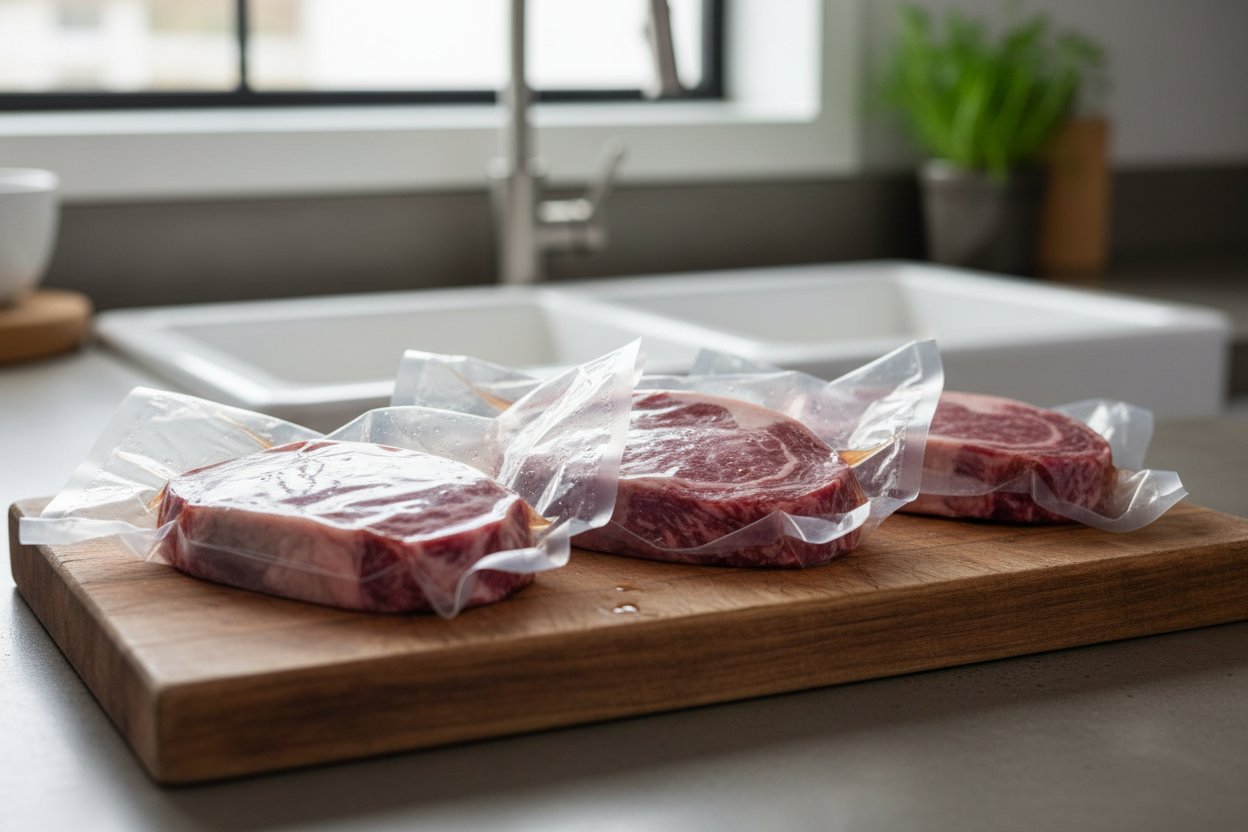
 How long does vacuum sealed meat last? Whether you're stocking a chest freezer with bulk beef, preserving a deer harvest, or meal-prepping for the week, this is one of the most important questions in meat storage and food preservation. According to USDA food safety guidelines, vacuum sealing is one of the most effective methods available for extending meat shelf life, eliminating freezer burn, and reducing food waste. Below you'll find a complete vacuum sealed meat storage chart, science-backed shelf life data, and practical tips for every meat type.
|
✅ Quick Answer
Raw Whole Cuts (Steaks, Chops, Poultry): Lasts 3–5 days in the refrigerator and 1–3 years in the freezer.
Ground Meats & Raw Sausage: Lasts 1–2 days in the fridge and up to 1 year frozen.
Cooked Meats: Lasts up to 2 weeks refrigerated and 2–3 years frozen.
Wild Game (Deer/Venison): Lasts 5–7 days refrigerated and 2–3 years frozen—provided all fat and silver skin are fully removed before sealing.
|
Vacuum Sealed Meat Shelf Life at a Glance
Use this quick-reference chart for instant comparisons before diving into the full breakdown by meat type.
|
Storage Method
|
Raw Meat
|
Cooked Meat
|
Deer / Venison
|
|
Refrigerator (vacuum sealed)
|
3–5 days
|
Up to 2 weeks
|
5–7 days
|
|
Freezer (vacuum sealed)
|
1–3 years
|
2–3 years
|
2–3 years
|
|
Freezer (no vacuum seal)
|
4–12 months
|
2–3 months
|
6–12 months
|
|
Refrigerator (no vacuum seal)
|
1–3 days
|
3–4 days
|
3–5 days
|
Source: USDA FSIS Food Product Dating; FoodSafety.gov FoodKeeper App.
How Long Does Vacuum Sealed Meat Last? (Full Storage Chart)
The table below covers raw meat storage, cooked meat storage, and frozen meat storage times for all common meat types under vacuum seal, compared to conventional packaging. All figures are aligned with USDA FSIS and FoodSafety.gov recommendations.
|
Meat Type
|
Refrigerator (40°F)
|
Freezer (0°F)
|
No Vacuum Seal (Fridge)
|
|
Beef steaks & roasts
|
3–5 days
|
1–3 years
|
3–5 days
|
|
Ground beef
|
1–2 days
|
1 year
|
1–2 days
|
|
Chicken (whole/pieces)
|
3–5 days
|
2–3 years
|
1–2 days
|
|
Pork chops & roasts
|
3–5 days
|
2–3 years
|
3–5 days
|
|
Fish (fatty – salmon)
|
4–5 days
|
2 years
|
1–2 days
|
|
Fish (lean – cod)
|
4–5 days
|
2–3 years
|
1–2 days
|
|
Lamb
|
3–5 days
|
2–3 years
|
3–5 days
|
|
Deer / Venison
|
5–7 days
|
2–3 years
|
3–5 days
|
|
Sausage (raw)
|
1–2 days
|
1–2 years
|
1–2 days
|
|
Cooked meats (all)
|
Up to 2 wks
|
2–3 years
|
3–4 days
|
|
Deli / cured meats
|
2–3 weeks
|
2 years
|
3–5 days
|
📌 Note: All times assume a quality airtight seal, refrigerator ≤40°F (4°C), and freezer at 0°F (−18°C) per USDA guidelines.
Does Vacuum Sealing Meat Move the Needle?
 Absolutely. Standard grocery store packaging traps air inside with your food, which is a recipe for flavor loss and spoilage. Vacuum sealing extends meat's shelf life by completely pulling oxygen out of the equation. Here is exactly how that keeps your steaks tasting fresh-cut:
-
It Starves Spoilage Bacteria: Most common bacteria need oxygen to multiply and ruin your food. By removing the air, you dramatically put the brakes on their growth.
-
It Locks in Color and Flavor (No Oxidation): When oxygen hits meat fats and proteins, it causes that unappetizing gray discoloration and rancid taste. Vacuum sealing locks out air, keeping your meat looking vibrant and tasting exactly as it should.
-
It Banishes Freezer Burn Entirely: Freezer burn happens when moisture evaporates from the meat and escapes into the air pockets of loose plastic wrap. Because vacuum sealing leaves zero air pockets, your meats are safe from turning into dry, icy leather.
|
⚠ Important Safety Note
Vacuum sealing does NOT kill anaerobic bacteria such as Clostridium botulinum.
Per FDA and USDA: vacuum sealed meat must always be refrigerated (≤40°F) or frozen (≤0°F).
Never store vacuum sealed raw meat at room temperature.
|
How Long Will Vacuum Sealed Meat Last in the Refrigerator?
 In the refrigerator, vacuum sealed raw meat lasts 3–5 days — the same baseline as conventional packaging. However, cooked vacuum sealed meat lasts up to 2 weeks, and deli / cured meats last 2–3 weeks, compared to just 3–5 days unsealed. Per FoodSafety.gov's FoodKeeper database, these are the gains most significant for processed and cooked meats.
Key factors for refrigerator shelf life:
-
Freshness at sealing: Seal as soon as possible after purchase or processing. Bacteria already present continue to multiply — just more slowly.
-
Seal integrity: A broken seal allows oxygen back in and resets the clock to conventional storage timelines.
-
Temperature: Must remain consistently ≤40°F (4°C). Per USDA, above 40°F is the "danger zone" where bacteria can double every 20 minutes.
-
Meat type: Ground meat and fatty fish spoil faster than whole-muscle cuts due to higher surface area and fat content.
How Long Can Vacuum Sealed Meat Last Before It Goes Bad?
In the freezer at a consistent 0°F, vacuum sealed meat remains safe indefinitely per USDA — but quality degrades beyond the storage windows in the chart above. Always check for these warning signs before cooking:
-
Puffed or inflated packaging: Sign of anaerobic bacterial gas — discard immediately.
-
Broken or compromised seal: Treat as conventionally stored from that point; use or discard within 1–2 days if refrigerated.
-
Off or sour odor: Any unusual smell is a discard signal.
-
Slimy or sticky surface: Bacterial biofilm — do not rinse and cook. Discard entirely.
-
Gray, green, or unusual color: Beyond normal surface browning, unusual colors indicate bacterial or mold activity.
|
🚫 Never Rely on Smell Alone
Dangerous pathogens like Salmonella and E. coli produce no detectable odor.
Always follow the time guidelines in the chart above, regardless of appearance or smell.
When in doubt, throw it out — USDA food safety guidance.
|
How Long Does Meat Last in Vacuum Seal Bags?
The quality of your vacuum sealing bags directly affects how long meat lasts in long-term food storage. Standard embossed bags work well for up to 12 months frozen. For storage of 1–3 years, use commercial-grade multi-layer barrier bags with a higher oxygen transmission rate (OTR). Thin or generic bags are prone to micro-punctures that allow slow oxygen infiltration — degrading meat quality without breaking the visible seal.
|
💡 Pro Tip: Double-Seal for Long-Term Storage
For venison, bulk beef, or any meat destined for 2+ year freezer storage,
run a second heat seal line 1 cm above the first. This simple step dramatically
reduces the risk of seal failure during long-term frozen meat storage.
|
How Long Does Vacuum Sealed Food Last?
Vacuum sealing extends shelf life far beyond meat. According to FoodSafety.gov and the USDA, most vacuum sealed food lasts significantly longer than conventional packaging across all major food categories:
|
Food Type
|
No Vacuum Seal
|
Refrigerator (Sealed)
|
Freezer (Sealed)
|
|
Meat (raw)
|
1–3 days
|
3–5 days
|
1–3 years
|
|
Cooked meals
|
3–4 days
|
Up to 2 weeks
|
1–2 years
|
|
Hard cheese
|
1–2 weeks
|
4–8 months
|
6–8 months
|
|
Vegetables (blanched)
|
3–5 days
|
1–2 weeks
|
2–3 years
|
|
Fruits
|
2–5 days
|
1–2 weeks
|
2 years
|
|
Dry goods (rice/nuts)
|
Months
|
1–2 years
|
2–5 years
|
📌 Note: Pre-freeze soft fruits and delicate vegetables before sealing to prevent crushing. Always cool cooked food completely before vacuum sealing.
How Long Does Vacuum Sealed Deer Meat Last?
For hunters, knowing how long vacuum sealed deer meat lasts is essential. Venison is a lean game meat with very little fat — which makes it well-suited to long-term frozen meat storage when properly sealed. The critical step: remove all fat and silver skin before sealing, as deer fat goes rancid rapidly even in a vacuum seal.

|
Venison Cut
|
Refrigerator (Sealed)
|
Freezer (Sealed)
|
Freezer (No Seal)
|
|
Venison steaks
|
5–7 days
|
2–3 years
|
6–12 months
|
|
Ground venison
|
1–2 days
|
1–2 years
|
3–4 months
|
|
Venison roasts
|
5–7 days
|
2–3 years
|
6–12 months
|
|
Venison sausage (raw)
|
1–2 days
|
1–2 years
|
3–4 months
|
Best practices for vacuum sealed venison:
-
Process within 24 hours of harvest: The sooner venison is sealed, the longer it will last.
-
Remove ALL fat and silver skin: Deer fat goes rancid even frozen. Any left on the meat shortens shelf life significantly.
-
Double-seal the bag: Run a second heat seal for extra protection on long-term storage cuts.
-
Freeze flat before stacking: Lay bags flat for 12–24 hours before stacking to avoid punctures from sharp bone edges.
-
Label with cut and date: e.g., "Venison Backstrap – Nov 2024." Prevents mystery packages and helps track storage windows.
 Vacuum Sealed Meat Storage Mistakes to Avoid
Even with a quality vacuum sealer, poor practices undermine results. These are the most common meat preservation mistakes and how to fix them:
- Temperature fluctuations: Each freeze-thaw cycle damages meat cell walls, causing texture degradation even inside a vacuum seal. Set your freezer to 0°F and minimize door-opening.
- Refreezing thawed meat unnecessarily: Per USDA, refreezing is safe if meat was thawed in the refrigerator — but each cycle degrades quality. Portion meat before sealing so you only thaw what you need.
- Sealing with moisture near the seal area: Wipe the inside of the bag near the opening before sealing. Moisture causes weak or incomplete seals — the top cause of vacuum seal failure.
- Using low-quality bags: For long-term food storage beyond 12 months, use commercial-grade multi-layer bags. Thin generic bags develop micro-leaks over time.
- Sealing warm or hot meat: Always chill meat to below 40°F before sealing. Warm meat creates steam inside the bag, weakening the seal and accelerating bacterial growth.
- Not labeling: Without a date and contents label you lose track of storage windows — the most common cause of unnecessary food waste.
|
⚠ Common Myth
"If it's been frozen and vacuum sealed, it's always safe to eat."
False. Frozen food at 0°F is technically safe indefinitely per USDA — but texture,
flavor, and nutritional quality degrade beyond recommended storage windows.
Always follow the timeframes in the charts above for best quality.
|
Frequently Asked Questions
How long does vacuum sealed meat last in the fridge?
Most raw vacuum sealed meat lasts 3–5 days in the refrigerator. Cooked vacuum sealed meat lasts up to 2 weeks, and cured or deli meats last 2–3 weeks — versus 3–5 days without a seal. Always keep the refrigerator at or below 40°F (4°C) per FoodSafety.gov.
How long will vacuum sealed meat last in the freezer?
Most vacuum sealed meats last 1–3 years in the freezer at 0°F. Beef, pork, lamb, chicken, and venison all fall in the 2–3 year range. Ground meats have a shorter window of about 1 year due to higher surface area and fat content.
How long can vacuum sealed meat last before it goes bad?
In the freezer at consistent 0°F, vacuum sealed meat is technically safe indefinitely per USDA — though quality peaks within the recommended windows. In the refrigerator, safety limits are stricter: 3–5 days for raw meat, regardless of vacuum sealing.
How long does meat last in vacuum seal bags?
Standard embossed bags protect quality for up to 12 months frozen. Commercial-grade multi-layer barrier bags extend protection to 1–3 years. Always inspect seal integrity and look for any signs of air infiltration before relying on long-term storage timelines.
How long does vacuum sealed food last?
Vacuum sealing extends shelf life across all food categories. Vegetables last 2–3 years frozen. Hard cheeses last 4–8 months refrigerated. Dry goods like rice and nuts last 2–5 years frozen. Cooked meals(https://freskoshop.com/blogs/fresko/super-bowl-party-food-prep-storage) last up to 2 weeks refrigerated and 1–2 years frozen.
How long does vacuum sealed deer meat last?
Properly vacuum sealed venison stored at 0°F lasts 2–3 years in the freezer while maintaining excellent quality. Essential steps: remove all fat and silver skin before sealing, use commercial-grade bags, double-seal the bag opening, and label with date and cut.
Final Thoughts
Whether you're preserving grocery store beef, farm-fresh chicken, or hard-earned venison, vacuum sealing is one of the most effective meat preservation tools available — explore our vacuum sealers for meat storage to find the right fit. Done correctly, it extends meat shelf life by months or years while protecting flavor, texture, and nutritional value — all without additives.
Key takeaways:
-
Raw meat: 3–5 days refrigerated, 1–3 years frozen
-
Cooked meat: Up to 2 weeks refrigerated, 2–3 years frozen
-
Deer / venison: 5–7 days refrigerated, 2–3 years frozen — remove all fat first
-
All vacuum sealed food: Shelf life extended across cheese, vegetables, dry goods, and cooked meals
-
Bag quality matters: Use commercial-grade bags for any storage beyond 12 months
-
Always follow USDA guidelines: Vacuum sealing slows spoilage — it does not stop it entirely
Food Safety Disclaimer: Storage times are guidelines based on USDA FSIS, FoodSafety.gov FoodKeeper, and FDA food safety recommendations. Always inspect meat before use and consult FoodSafety.gov for the most current guidance.
Sources: USDA FSIS (fsis.usda.gov) | FoodSafety.gov FoodKeeper App | FDA Food Code | USDA "Freezing and Food Safety" Fact Sheet
Sources: USDA FSIS (fsis.usda.gov) | FoodSafety.gov FoodKeeper App | FDA Food Code | USDA "Freezing and Food Safety" Fact Sheet
Aktie:
Muttertagsgeschenkideen: Durchdachte Küchen-Upgrades, die jede Mutter lieben wird
How to Use a Vacuum Sealer: The Complete Beginner's Guide