

A bag can look roomy on the counter and still be too tight once a thick roast goes inside. The missing measurement is usually depth—or the empty material needed to position the opening in the sealer. Choosing vacuum sealer bag sizes gets easier when you check both before loading food.
This guide focuses on fit: what the dimensions mean, how to measure a portion, and how much opening space your particular machine requires.
What size vacuum seal bag do I need?
Choose a bag that fits the food’s width, length, and thickness while leaving the opening flat and clear for sealing. Match its width to your machine’s stated limit. Use the exact model’s required food-to-opening allowance; the FRESKO New V8 US manual specifies at least 4 inches. Confirm the fit before preparing a batch.
Jump to: Bag size chart · Measuring method · Sealing space · Food shapes · FAQs
Read vacuum seal bag sizes as width × length
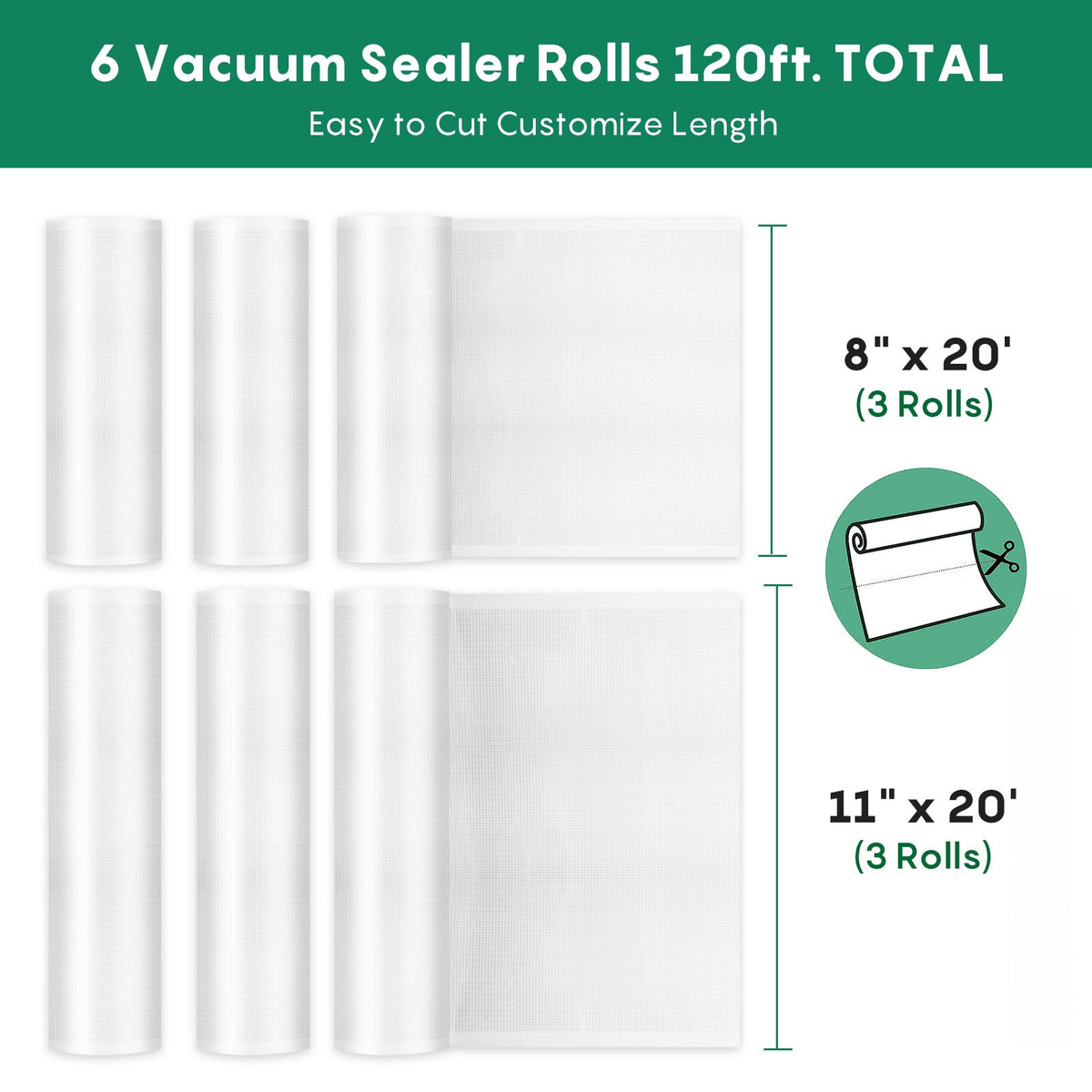
For a flat heat-seal bag, width runs across the opening; length runs from the opening toward the sealed bottom. A roll label is different: 8 inches × 20 feet describes the roll’s width and total available length, not one finished bag.
Do not treat the advertised dimensions as a promise that an equally wide food will fit. The film must wrap around the food’s thickness, and factory seams occupy some space. Check whether the supplier quotes outside or usable dimensions. If that detail is absent, measure a sample’s usable interior rather than assuming.
| Format | Listed size | What it lets you choose | Fit check |
|---|---|---|---|
| Precut bag | 6 × 10 inches | A smaller fixed-width, fixed-length pouch | Check the food’s thickness and remaining opening space; do not fill to the top. |
| Precut bag | 8 × 12 inches | A wider and longer fixed pouch | Measure the actual portion; a “quart” label is not a guaranteed meat weight or piece count. |
| Replacement roll | 8 inches × 20 feet | Custom length within an 8-inch roll width | Allow for the first end seal and the final open end. |
| Replacement roll | 11 inches × 20 feet | A wider custom-length pouch | Confirm that the machine accepts the width before cutting. |
These dimensions are listed for FRESKO precut vacuum sealer bags and FRESKO replacement bag rolls. Check the selected variant and current package contents. A roll included with a machine may have a different total length from a replacement roll.
Measure the food as you will actually pack it

- Choose the portion first. Decide what you want to open together. Measure that portion, not the entire grocery-store package.
- Arrange it in its intended position. Two pieces side by side need more width; stacking them increases thickness. Neither arrangement has the same fit as measuring one piece alone.
- Measure length, width, and height. Include the thickest point and any irregular edge. A ruler viewed from above misses the material needed to wrap around the sides.
- Check a compatible bag or roll. The food should slide inside without stretching the film tight. The mouth must flatten without pulling the contents toward the machine. For a roll, include material for the bottom seal before evaluating the finished pouch.
- Measure the empty opening space after loading. Apply your machine’s allowance, then check that the mouth reaches its required position. If it does not, use a longer pouch or a smaller portion.
Try one package before cutting ten identical lengths. Once the fit works, note the portion arrangement and finished bag dimensions. A useful note is “two thin fillets, side by side,” not simply “fish.” Keep the measuring area clean and avoid carrying raw-food residue onto the roll, ruler, or machine controls.
Leave sealing space—not just the width of the seal line
The empty section above the food lets the bag flatten and reach the machine’s loading position. It is not the same thing as the narrow strip of plastic that becomes the heat seal. A machine advertising a 5 mm seal does not mean you should leave only 5 mm above the food.
For the FRESKO New V8: the US manual, printed pages 5–6 and 11, requires at least 4 inches between the food and the bag opening. Measure that allowance toward the open end after loading. It is not an instruction to add 4 inches to every side.
Other models can differ. For example, FoodSaver’s VS2100 instructions specify at least 3 inches between the contents and open end. Follow the instructions for your exact machine, not whichever number uses less plastic.
Keep this empty section free of food, grease, crumbs, and moisture. Extra length cannot make a dirty or wrinkled opening ready to seal. Recheck placement rather than pulling a too-short pouch taut.
Match the bag to the shape, not a fixed serving count
A food chart is most useful when it tells you what to measure. Chicken breasts, steaks, and loaves vary too much for a universal “four pieces per quart bag” rule.
| Food shape | Measure this | If the first bag does not fit |
|---|---|---|
| Flat fillets or thin cuts | Total footprint in the chosen arrangement | Separate portions or try a wider compatible bag. |
| A thick roast or bulky cut | Height as well as width and length | Reassess width; a longer narrow pouch will not solve every fit problem. |
| A long cut or loaf | Full length plus required opening space | Consider custom roll length, provided the width fits. |
| A frozen portion of soup or sauce | The actual frozen block, including its thickness | Choose a smaller freezing shape before making the next batch. |
Size alone does not protect delicate bread from compression or stop sharp bones from puncturing film. Those foods also need appropriate preparation and controls. For an external sealer, do not assume extra headspace makes free-flowing liquid safe to vacuum; the New V8 manual recommends freezing liquids in portions before bagging.
Precut bags, rolls, and valve bags have different fit limits
Precut bags fix both dimensions. Rolls let you change length, not the original width. If choosing between those formats is your main question, see the rolls versus precut bags comparison.
Valve bags use a different closure and evacuation system. Their zipper, valve, and any marked fill limit must remain usable; do not transfer a heat-seal allowance to them. Chamber machines also require the filled package to fit inside the chamber. Matching the printed dimensions alone does not establish machine compatibility.
Vacuum sealer bag sizing FAQs
Is an 8 × 12-inch bag always a quart?
FRESKO labels its 8 × 12-inch precut variant “Quart.” Treat that as a product size label, not a promise that a particular volume, number of chicken breasts, or weight will fit with the required sealing space.
Should I choose a larger bag when I am between sizes?
Choose the size that passes the loaded-fit check and leaves the required opening space. Slightly more material is preferable to stretching a pouch tight. Still confirm that the wider option fits the machine.
Can I fold a wide bag to fit a narrower sealer?
Do not use folding as a workaround for the machine’s width limit. Choose the specified bag width or divide the food. The opening needs the flat, even placement required by the manufacturer.
Does a larger bag require a stronger vacuum sealer?
Bag size alone is not a reason to upgrade suction power. First check approved width and material, opening placement, and seal condition. An oversized bag is not automatically a weak seal; an incompatible or poorly positioned opening is a separate problem.
Before you cut or fill the next bag
Check the portion, usable width, food thickness, machine allowance, and clean opening—in that order. Then explore vacuum sealer bags and rolls with your measurements in hand. The goal is a practical fit, not the smallest possible scrap of plastic.
Vacuum sealing does not replace proper refrigeration or freezing of perishable food. Follow the food’s handling instructions and your machine manual; changing bag size does not establish a longer safe storage time.
Partager:
Can You Reuse Vacuum Sealer Bags? A Practical Reuse Checklist