

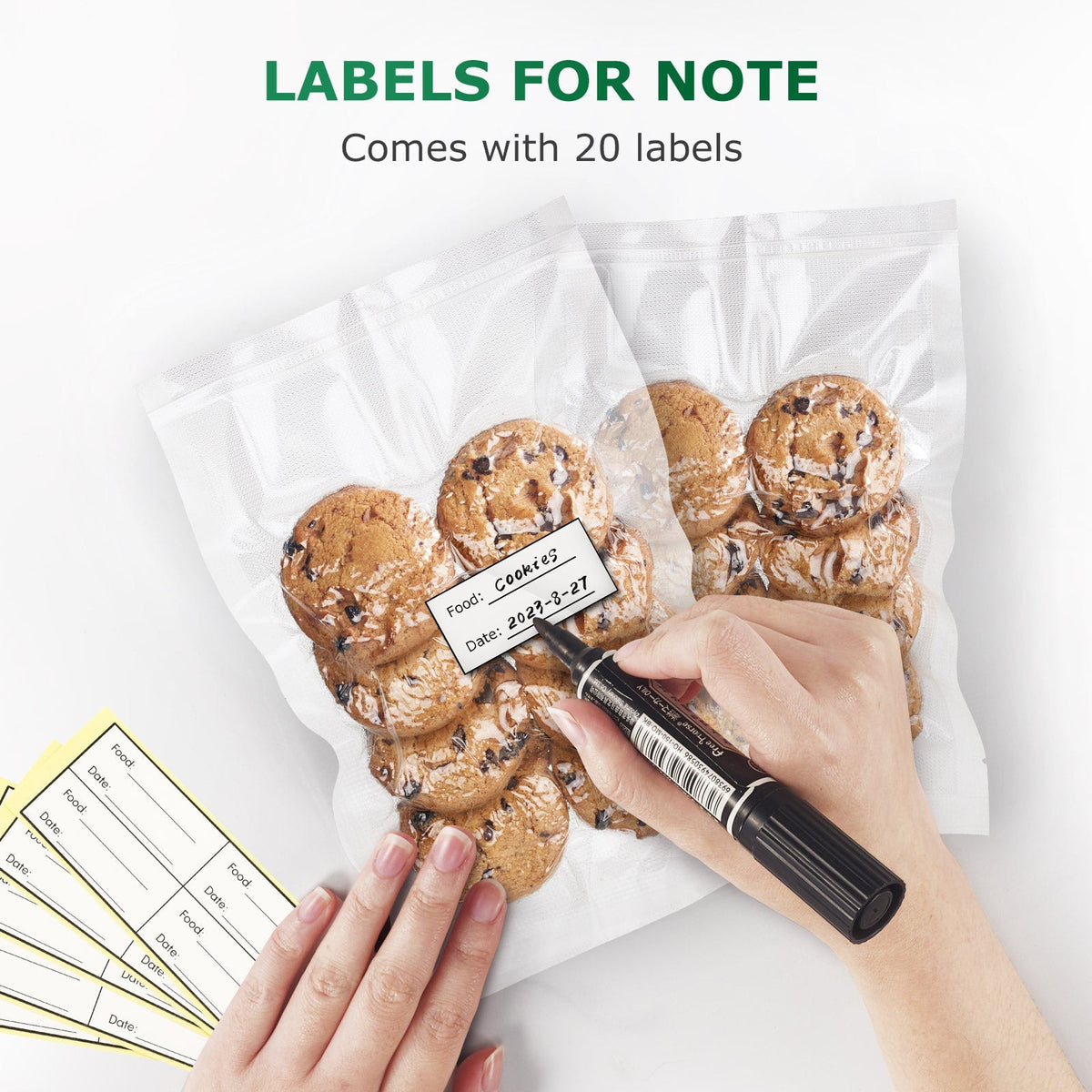
An empty vacuum bag can look ready for another round. Before you refill it, check more than whether it still holds air. The bag's instructions, previous contents, and current condition all matter. A bag that reseals successfully is not automatically clean enough for another food.
Are vacuum sealer bags reusable?
Some vacuum sealer bags are reusable, but not every bag or every use qualifies. Check the exact product's reuse and cleaning instructions, what it previously held, and whether its film and closure remain intact. Without a confirmed cleaning protocol for raw-food contact, use a fresh bag rather than repurposing one that held raw meat, poultry, or seafood.
Jump to: Reuse decision table · Bag types · Five-step checklist · FRESKO product notes · FAQs
Reuse, check first, or replace?
Use this as a conservative household decision guide, not permission to reuse packaging labeled for single use. Start with the instructions supplied with your particular bags.
| What you know about the bag | Decision | What to check |
|---|---|---|
| Reusable product; previously held bread or plain dry pantry food | Potential reuse candidate | Follow its cleaning directions, dry completely, and inspect before refilling. |
| Raw meat, poultry, seafood, or raw-food juices | Fresh bag is the conservative choice | Do not infer a suitable cleaning protocol from the word “reusable.” |
| Moist food, oil, sauce, or marinade | Product-specific decision | Can the approved method clean the seams, zipper, and valve? If residue remains, replace it. |
| Sous vide, microwaving, or other heating | Check before another use | An approved cooking use does not by itself establish reuse after cooking. |
| Puncture, torn closure, separated layers, or repeated air leaks | Replace | Cleaning cannot repair physical damage. |
| Unknown contents or missing product instructions | Do not reuse for food yet | Identify the product and its history; otherwise choose new packaging. |
There is a reason for these boundaries. USDA explains that single-use food packaging can retain bacteria and cause cross-contamination when reused. That warning does not make all purpose-designed reusable bags single-use; it does mean ordinary food-contact packaging should not be promoted into a reusable product without evidence.
Heat-seal bags and reusable valve bags need different checks
Open-ended heat-seal bags and rolls
These bags close with a heated seam. Opening and resealing usually consumes some bag length, so a previously used bag must still leave the clear sealing space required by your machine. A textured surface helps certain machines remove air; texture, thickness, or a BPA-free label alone does not prove a bag is reusable.
Manufacturer rules can be restrictive. FoodSaver's Bags & Rolls guidance allows washing and reuse after specified foods, but says to discard those bags after raw meat, fish, eggs, unpasteurized cheese, or greasy foods. These are instructions for that bag family, not a certification for FRESKO or every other brand.
Zipper bags with a vacuum valve
A reusable valve bag opens at a zipper instead of requiring a new heat seam each time. Its closure and valve need attention as well as the bag walls. Food trapped in either area can interfere with the seal. Do not cut off the zipper, heat-seal over it, or dismantle a valve unless that product's instructions allow it.
Even one brand can publish different care rules for different ranges. FoodSaver's separately labeled Reusable Vacuum Zipper Bags have their own hand-washing instructions. Use the directions matching the bag in your hand, not whichever search result sounds most convenient.
Five checks before a bag gets a second use

- Identify the bag and its last contents. Keep the packaging or a photo of the product name and care directions. Separate known reuse candidates from bags awaiting disposal. If you cannot remember what was inside, do not guess.
- Reject damage before cleaning. Look along the corners, seams, and closure. Stop if there is a hole, split, loose component, or damaged film. A fresh seam at the mouth will not fix a puncture farther down the bag.
- Use the approved washing method. Where hand-washing is permitted, follow the specified detergent, water-temperature, and valve instructions. A quick wipe is not a substitute for that method. Do not improvise with boiling water, bleach, a dishwasher, or a stiff cleaning tool.
- Dry fully and inspect again. Check the inside corners and closure before storing or refilling. If residue or an objectionable odor remains, retire the bag from food use. A normal smell, however, cannot prove that a bag is microbiologically safe.
- Refill, close correctly, and check the package. Stay within its fill limit and keep the closure clean. Follow the machine's sealing procedure. If air returns, check for closure problems or damage rather than repeatedly running the pump and assuming the problem is solved.
Keep food safety separate from bag performance. Perishable food still needs cold storage even when vacuum-packed. Repacking food also does not reset its storage history or make spoiled food safe.
What this means for FRESKO bags
The current FRESKO precut vacuum sealer bags listing describes that product as reusable. That does not establish a universal wash cycle, a fixed number of reuses, or permission to reuse every FRESKO roll, machine-supplied bag, and accessory after every food. Check the exact package and its care instructions.
The FRESKO HV9 handheld vacuum sealer set includes reusable valve bags. Its US manual, edition 20260715-HV9-US-A1, specifically instructs users to remove the bag valve and thoroughly clean the inside after storing moist or wet items before reuse. It also identifies food debris around the zipper or valve as a possible cause of air returning.
Follow that manual's component diagram; do not apply its removable-valve procedure to an unrelated bag. The cited instructions do not establish a bag-dishwasher program or a raw-protein-specific cleaning protocol. If those details are missing from your package, ask FRESKO product support with the bag name or set model and a photo. Meanwhile, use fresh packaging for uncertain cases.
How many times can you reuse vacuum sealer bags?
There is no reliable universal “two or three times” rule. The answer depends on the actual product and its condition, not simply whether it is thick or embossed. For example, ZWILLING's Fresh & Save guidance bases replacement on wear, damaged closures, and inability to maintain the seal rather than one fixed reuse count.
Make reuse selective: keep a few identified, clean, dry bags that suit your routine instead of a mixed drawer of questionable packaging. If repeated trimming leaves a heat-seal bag too short, switch to a fresh one. Our vacuum sealer bag size guide explains how to allow room for the food and sealing area.
Frequently asked questions
Can vacuum seal bags be reused after freezing?
Freezing is not the deciding factor. Check the bag's reuse permission, previous food, and condition after opening. A freezer-safe label alone does not authorize cleaning and reuse.
Can vacuum sealer bags be reused for meat?
For a bag that already touched raw meat, use a fresh one unless the exact reusable product has an applicable manufacturer cleaning protocol you can follow. Do not transfer another brand's permission to your bags.
Can I put reusable vacuum bags in the dishwasher?
Only when the exact bag instructions say so. “Reusable” does not mean dishwasher-safe, and care directions for a glass container do not apply to its companion valve bags.
Can I reuse a bag after sous vide?
Do not assume so. Confirm both the original cooking use and subsequent reuse are allowed for that product, and consider what it held. If that information is unavailable, choose a new bag.
Does a good vacuum prove the bag is safe?
No. It tells you something about the closure, not whether contaminants remain. Good reuse decisions require both an appropriate cleaning process and an undamaged bag.
The useful rule: reuse by documented permission and known history, not by appearance alone. When either is uncertain, a fresh bag is the simpler choice.
Share:
Can You Vacuum Seal Bread? Keep Loaves and Slices from Flattening