

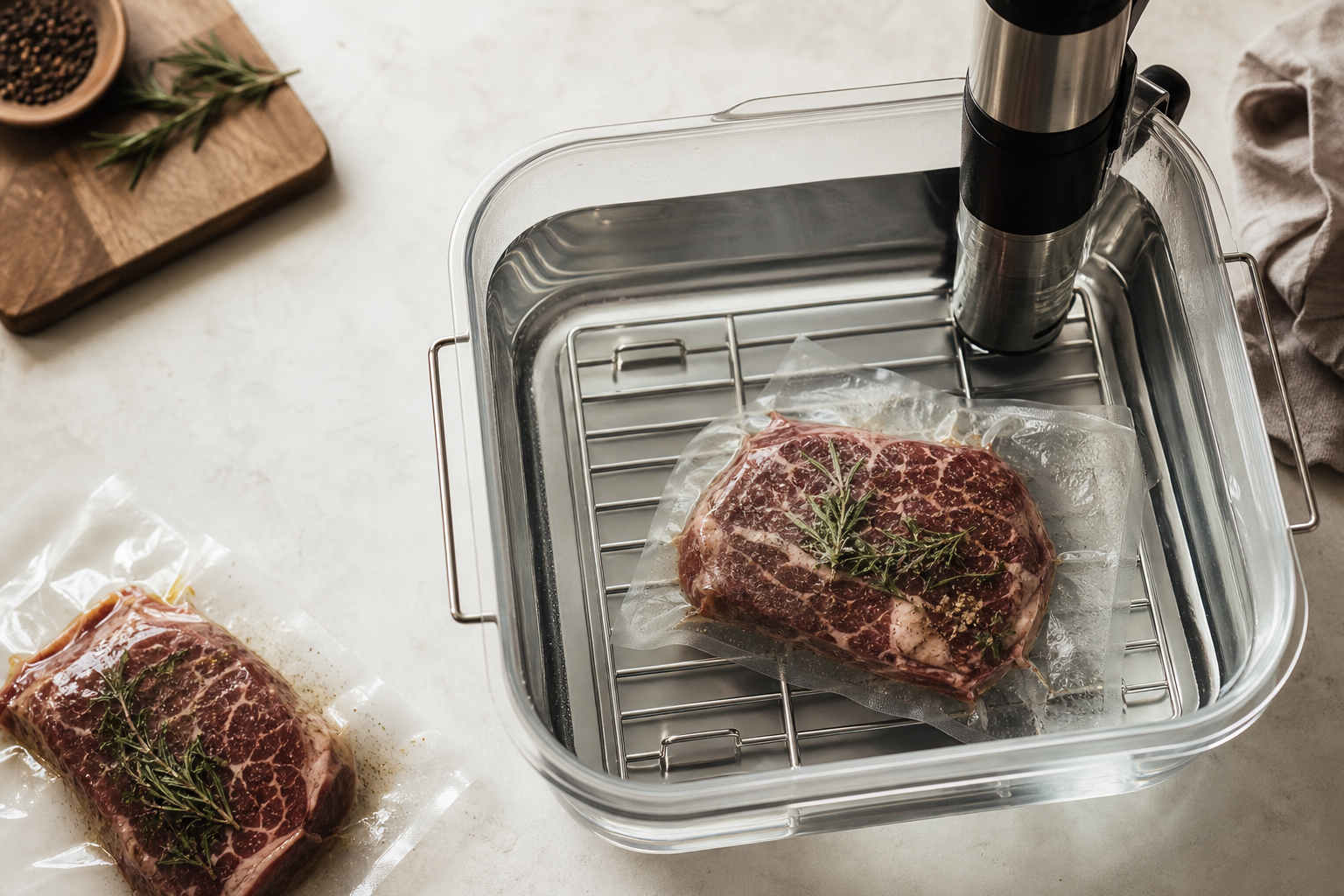

Vous avez le circulateur à immersion, le morceau de viande choisi, et maintenant vous vous retrouvez devant un mur de scelleuses sous vide – ou une douzaine d'onglets de navigateur en présentant – à essayer de déterminer celle qui est réellement conçue pour des heures de cuisson au bain-marie plutôt que de simplement refermer des restes de chips. Toutes les scelleuses ne sont pas adaptées à cette tâche. Certaines ont du mal avec les marinades, d'autres ne peuvent pas maintenir un joint étanche pendant une cuisson prolongée, et d'autres encore n'ont tout simplement pas été conçues pour la cuisson sous vide.
Voici ce qui compte vraiment lorsque vous choisissez une scelleuse sous vide pour cuisson sous vide, et quels modèles sont les plus performants.
Faut-il utiliser une scelleuse sous vide pour la cuisson sous vide ?
Réponse courte : pas strictement, mais cela fait une réelle différence. Vous pouvez vous débrouiller avec la méthode de déplacement de l'eau – en plongeant un sac à fermeture éclair dans l'eau jusqu'à ce que la pression expulse l'air – pour une cuisson rapide et individuelle. Mais pour les cuissons plus longues, la préparation de repas en grande quantité, ou tout ce qui implique une marinade, un scellage sous vide approprié élimine l'air plus complètement et maintient les aliments en contact direct et uniforme avec l'eau pendant toute la durée de la cuisson. Nous couvrons tous les détails dans Faut-il une scelleuse sous vide pour la cuisson sous vide ? si vous hésitez encore sur la méthode qui convient à votre routine.
Si vous optez pour la cuisson sous vide, la machine que vous choisissez est plus importante que la plupart des gens ne le pensent.
Ce qu'il faut rechercher dans une scelleuse sous vide pour la cuisson sous vide
Toutes les fonctionnalités importantes pour le rangement dans le garde-manger ne le sont pas pour la cuisson sous vide, et vice-versa. Avant de comparer les modèles, il est utile de savoir ce qu'il faut vraiment vérifier :
- Une véritable étanchéité. Recherchez la technologie de double soudure thermique – une seule bande de scellage est plus sujette aux points faibles qui peuvent céder après des heures de cuisson prolongée.
- Contrôle du scellage des liquides. Les marinades et les morceaux juteux nécessitent une machine capable de suspendre ou de modérer l'aspiration, et non un simple tirage rapide et agressif qui entraîne le liquide dans la bande de scellage.
- Sacs résistants à la chaleur et de qualité alimentaire. Les sacs sont tout aussi importants que la machine – ils doivent résister aux températures sous vide prolongées sans laisser échapper de substances dans les aliments.
- Ligne de scellage constante, à chaque fois. La détection automatique du sac réduit les risques de scellage de travers ou incomplet qui laisserait entrer l'eau.
- Une capacité suffisante pour votre mode de cuisson réel. Un seul steak et un lot de six poitrines de poulet ont des besoins très différents en matière de manipulation des sacs.
Scelleuses sous vide pour la cuisson sous vide, par type et par budget
Plutôt que de chercher un seul « meilleur » modèle, il est plus utile de réfléchir à la catégorie de scelleuse qui correspond réellement à vos habitudes culinaires – le bon choix pour une personne qui prépare ses repas chaque semaine n'est pas le même que pour quelqu'un qui cuisine sous vide deux fois par an.

Scelleuses externes d'entrée de gamme
Ce sont des machines à mode unique : vous placez le sac, la machine aspire et scelle en une seule passe. Elles sont peu coûteuses et conviennent aux coupes de viande ou aux légumes de base, mais elles ont tendance à avoir des difficultés avec les marinades et les sacs contenant beaucoup de liquide car il n'y a aucun moyen de suspendre l'aspiration avant que le liquide n'atteigne la bande de scellage. Un choix raisonnable si vous débutez avec la cuisson sous vide et que vous ne savez pas encore à quelle fréquence vous l'utiliserez – le FRESKO AutoMax V2 est un exemple dans cette catégorie, avec une technologie de double soudure thermique pour au moins maintenir un scellage de base fiable.

Scelleuses de milieu de gamme avec modes réglables
Ce niveau est celui où la cuisson sous vide en tire réellement parti. Recherchez une machine avec des modes distincts "scellage uniquement" et "aspiration et scellage" – ce contrôle vous permet de manipuler les marinades sans dégâts, car vous pouvez fermer la majeure partie du sac avant d'aspirer le reste. Les coupe-sacs intégrés sont également courants à ce niveau, ce qui est plus important qu'il n'y paraît : des sacs de taille correcte évitent les poches d'air piégées qui causent une cuisson inégale. Plusieurs marques proposent cet ensemble de fonctionnalités dans la fourchette de 80 à 130 $, y compris les modèles Fresko AutoMax V6 et V8-New, ainsi que des options comparables d'autres fabricants – il est utile de comparer la force de scellage et la flexibilité des modes entre plusieurs avant de prendre une décision.

Scelleuses à chambre
Les scelleuses sous vide à chambre immergent le sac entier dans une chambre scellée et éliminent l'air en abaissant la pression ambiante, plutôt que d'aspirer l'air par l'ouverture du sac. Cela signifie qu'elles gèrent les liquides et les marinades de manière native sans aucun risque de colmatage – c'est vraiment la meilleure option si vous scellez régulièrement des soupes, des saumures ou tout ce qui est humide. Elles coûtent beaucoup plus cher et occupent plus d'espace sur le comptoir, c'est pourquoi la plupart des cuisiniers amateurs qui font occasionnellement de la cuisson sous vide ignorent entièrement ce niveau et se fient plutôt au contrôle des modes d'une bonne scelleuse externe.
Ce qui compte vraiment plus que la marque
À tous ces niveaux, les caractéristiques qui font la plus grande différence pour la cuisson sous vide sont spécifiquement : une double soudure véritablement hermétique, une forme de contrôle de la vitesse d'aspiration pour les liquides, et des sacs conçus pour une exposition prolongée à la chaleur. Une scelleuse à 70 $ avec les bons sacs et une technique soignée sera plus performante qu'une scelleuse à 150 $ associée à des sacs génériques et fins et un scellage bâclé.

Meilleurs sacs de scellage sous vide pour cuisson sous vide
La machine ne fait que la moitié du travail – le sac doit également tenir le coup. Quelle que soit la marque que vous achetez, recherchez des sacs de scellage sous vide pour cuisson sous vide qui sont explicitement sans BPA et conçus pour résister à une chaleur de bain-marie prolongée, généralement à au moins 90°C. Les sacs de rangement génériques réaffectés à cette tâche sont plus souvent la cause de défaillance que la machine elle-même. Les sacs prédécoupés sont plus rapides pour les portions standard, tandis que les sacs en rouleau vous permettent de personnaliser la taille pour les coupes de forme irrégulière – nous abordons plus en détail le dimensionnement dans comment choisir la bonne taille de sac de scellage sous vide. Les sacs Fresko sont une option qui répond à cette spécification si vous utilisez déjà l'une de leurs machines, bien que tout sac répondant aux mêmes critères de chaleur et sans BPA fonctionnera.
Tableau comparatif
| Niveau | Prix typique | Force sous vide | Attention à |
|---|---|---|---|
| Externe d'entrée de gamme | 50 $ – 80 $ | Scellage de base simple et fiable | Pas de contrôle des liquides, mode unique |
| Milieu de gamme avec modes réglables | 80 $ – 130 $ | Le mode « scellage uniquement » gère les marinades ; inclut souvent un coupe-sac intégré | Toujours pas entièrement étanche aux liquides sous forte aspiration |
| Scelleuse à chambre | 200 $ et plus | Gère les liquides et les saumures nativement, aucun risque de colmatage | Encombrant, plus cher, excessif pour une utilisation occasionnelle |
La gamme de Fresko couvre les deux premiers niveaux – l'AutoMax V2 d'entrée de gamme, et l'AutoMax V6 et la V8-New dans le niveau intermédiaire – si vous souhaitez un point de départ pour vos comparaisons.
FAQ
Quelle est la différence entre une scelleuse sous vide normale et une conçue pour la cuisson sous vide ? N'importe quelle scelleuse sous vide peut techniquement sceller un sac pour la cuisson sous vide, mais les modèles avec des modes de scellage réglables gèrent bien mieux les marinades et les liquides, et les modèles avec une technologie de double scellage thermique sont moins susceptibles de développer un scellage faible lors d'une cuisson de plusieurs heures.
Puis-je utiliser n'importe quel sac de scellage sous vide pour la cuisson sous vide, ou ai-je besoin de sacs spéciaux ? Utilisez des sacs explicitement étiquetés sans BPA et conçus pour des températures de bain-marie, généralement jusqu'à au moins 90°C. Les sacs de rangement fins et génériques ne sont pas conçus pour une chaleur prolongée et sont plus susceptibles de céder lors d'une longue cuisson.
Une scelleuse sous vide plus chère en vaut-elle la peine si je ne fais de la cuisson sous vide qu'occasionnellement ? Pas nécessairement. Si vous cuisinez des portions individuelles de temps en temps, un modèle d'entrée de gamme avec un scellage solide est généralement suffisant. Les fonctionnalités de niveau supérieur – plusieurs modes, coupe-sacs intégrés, plus grande capacité – sont rentables lorsque vous cuisinez souvent ou en grandes quantités.
Les scelleuses sous vide fonctionnent-elles avec les marinades liquides sans fuir dans la machine ? Cela dépend du modèle. Une machine avec un mode "Scellage uniquement" dédié vous permet de fermer partiellement le sac avant de passer à l'aspiration, ce qui maintient le liquide éloigné de la bande de scellage et évite le colmatage.
Combien de temps les sacs sous vide scellés sous vide peuvent-ils rester au réfrigérateur avant la cuisson ? Traitez-les comme n'importe quel aliment cru ou mariné – conservez-les au réfrigérateur en dessous de 4°C et cuisinez-les dans les 1 à 2 jours, sauf si vous les congelez pour un stockage plus long.
La bonne scelleuse élimine la plupart des incertitudes de la cuisson sous vide — une fois le sac hermétique et entièrement immergé, le bain-marie fait le reste. Adaptez le niveau à la fréquence de votre cuisson sous vide avant de l'adapter à une marque particulière ; c'est la décision qui vous fera économiser de l'argent de toute façon.
Partager:
7 erreurs courantes de mise sous vide en cuisson sous vide qui gâchent votre plat (Guide 2026)
Comment mettre sous vide des aliments pour la cuisson sous vide : Un guide complet