

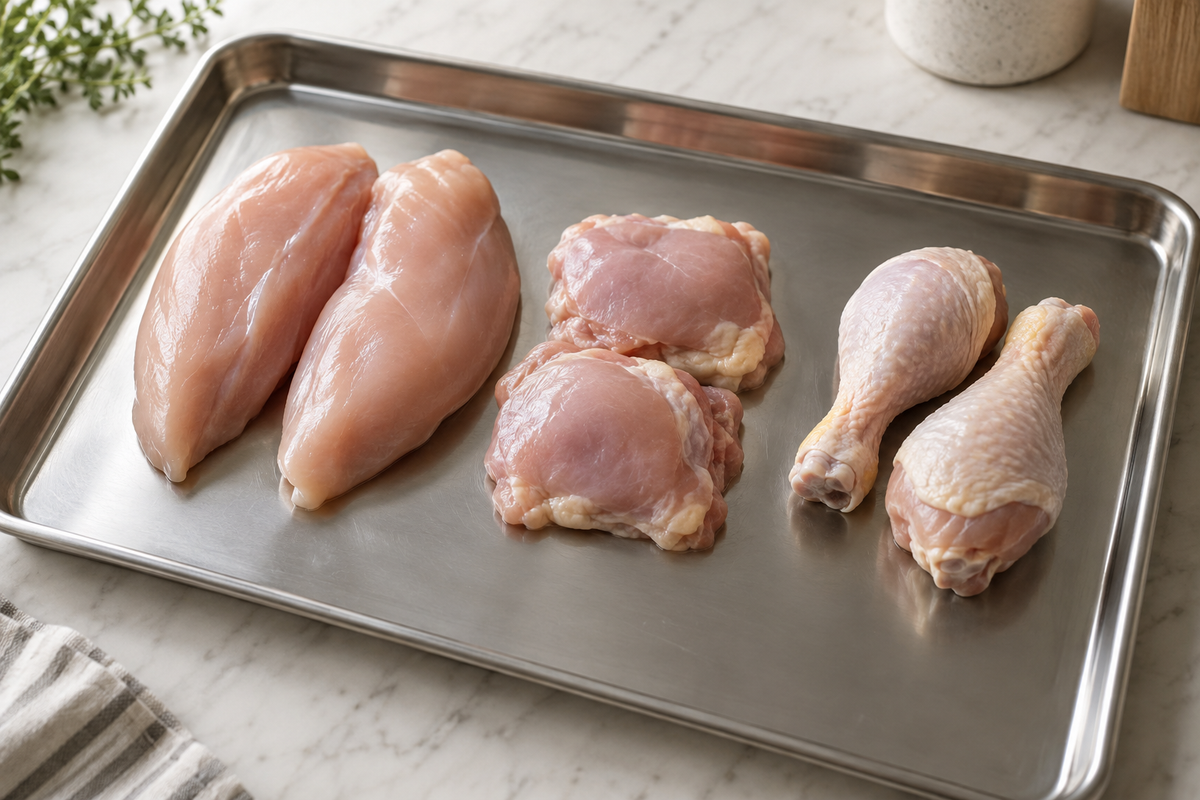
Quick answer: To vacuum seal chicken for the freezer, keep it cold, divide it into meal-size portions, and keep raw juices out of the bag's sealing area. If needed, firm the portions in the freezer before sealing. Inspect each seam, label raw or cooked contents and the date, then freeze at 0°F (-18°C) or below.
A family pack of chicken is only a bargain if the portions fit your week. Packing eight breasts into one frozen block saves a bag today but creates a problem when you need two tomorrow. A little planning before sealing makes the freezer easier to use and helps you avoid reopening more food than you need.
This is a chicken-preparation workflow, not a ranking of the best machines. If you already own a compatible vacuum sealer, focus on portion shape, juice control, and labels before considering a different model.
Before opening the chicken: set up a clean packing station
Have freezer-compatible vacuum bags, a tray, labels, and a marker ready. Place the machine away from the raw-food work area so juices are less likely to reach its controls. Write labels before handling the chicken, or wash your hands before touching the marker again.
Keep raw chicken refrigerated at 40°F (4°C) or below while you prepare the workspace. Work with one manageable batch and return the rest to the refrigerator. Do not rinse raw poultry; splashing can spread contamination. Wash hands with soap and water, keep raw food separate from ready-to-eat ingredients, and clean food-contact surfaces after use. See FoodSafety.gov's four food-safety steps.
Vacuum sealing does not make raw chicken sterile or restart its refrigerator clock. According to the federal cold-storage chart, fresh chicken normally belongs in the refrigerator for only one to two days before cooking or freezing. Plan a freezer batch early in that window rather than using packaging to postpone the decision.
Choose portions around how you cook
| Chicken type | Practical packing choice | What to check |
|---|---|---|
| Boneless breasts | A meal-size number arranged beside one another | Avoid folding a large breast over the bag opening |
| Boneless thighs | Small groups in a mostly even layer | Keep folds of meat away from the sealing area |
| Drumsticks or bone-in pieces | Arrange pieces without sharp ends pressing against the bag | Inspect for possible puncture points before and after sealing |
| Cooked shredded chicken | The amount needed for one salad, soup, or family meal | Cool safely before packing; mark the bag “cooked” |
| Chicken with marinade | A cold portion with liquid controlled before external-suction sealing | Do not let free-flowing marinade enter the machine |
The goal is a portion you can identify and use without opening the neighboring bag. Keep similar cuts together when they need different cooking times. A bag of mixed breasts and drumsticks may be compact, but it is less helpful when your recipe only calls for boneless pieces.
For bone-in chicken, do not force a sharp point into stretched plastic. Reposition the pieces or choose a suitable package. Any protective pad must be specifically approved for contact with food and the intended use; a machine's included bags do not automatically include a bone guard.
How to vacuum seal chicken without drawing juices into the seal
1. Match the bag to the portion
Use bags compatible with your machine and intended for freezer storage. Leave the clean space above the food required by the instructions. A cramped bag encourages juices or meat to reach the opening; an unnecessarily large one wastes material. For help choosing a shape, consult the vacuum sealer bag size guide.
2. Keep the sealing area clean
Fold the rim outward before loading, then unfold it without dragging it through juices. Arrange the chicken below the seal zone. If the inside of the opening is contaminated, replace or correct the package according to the manufacturer's instructions rather than trying to seal through liquid.
3. Control moisture before starting the cycle
With an external-suction machine, very juicy portions can be firmed in the freezer on a clean, rimmed, freezer-safe tray before bagging. Keep the tray protected from contamination. Check the actual condition instead of relying on one fixed pre-freezing time: piece thickness, starting temperature, and freezer load differ.
For a free-flowing marinade, freeze the liquid solid with the portion before external-suction sealing unless the model's instructions approve another approach. A “moist” mode does not turn an external-suction sealer into a chamber machine. Never let the promise of a stronger vacuum override liquid-control precautions.
4. Seal using the instructions for your exact model
Position the opening correctly and run the appropriate cycle. If juice approaches the intake, stop using the model's approved control and address the liquid before continuing. Allow the specified interval between cycles, and clean any collection area according to the manual. Do not put the electrical unit in water.
For example, the official FRESKO New V8 vacuum sealer page lists automatic moisture detection, a bag-mouth clamp, and a removable drip tray. Those features can support a packing routine, but they are not a reason to draw raw chicken liquid into the machine or skip cleanup.

5. Inspect the seam and freeze promptly
Look for a continuous seal without wrinkles or trapped food. Check around bone ends and corners for punctures. A package that loses its tight fit needs inspection and, if necessary, repackaging; repeatedly running the vacuum cycle does not fix a hole.
Freeze packages in one layer before stacking them. The USDA freezing guide recommends rapid freezing and stacking only after packages are frozen solid. For the broader packaging routine, see our freezer-burn prevention checklist.
What to write on a vacuum-sealed chicken bag
A useful label answers four questions: what is it, is it raw or cooked, how much is inside, and when was it frozen? Add the preparation date if it differs from the freezing date. Note a marinade or allergen when someone else may cook the meal.
Example: “Raw boneless chicken thighs · 4 pieces · packed/frozen Sept 29 · lemon marinade.” This is an organizational example, not a freshness guarantee. Keep older portions accessible and add new ones behind them.
US freezer guidance gives chicken pieces a nine-month quality window at 0°F or below; a whole chicken has a one-year quality recommendation. These are quality guidelines for correctly handled food, not a special extension created by vacuum sealing. Do not replace them with an unsupported claim that home-packed chicken lasts several times longer.
For raw versus cooked refrigerator limits, use the vacuum-sealed meat storage guide. Freezing preserves the condition of food going in; it does not correct earlier temperature abuse.
Thaw and cook with the same care
Plan refrigerator thawing on a tray that catches leaks, and follow any package instructions about opening or removing wrapping. Do not thaw chicken on the counter. USDA also permits cold-water or microwave thawing under specific conditions, followed by immediate cooking; its safe-defrosting guide explains those methods.
Cook chicken to 165°F (74°C), checked with a food thermometer in the appropriate thickest area away from bone. Color and clear-looking juices are not substitutes for measurement. See safe minimum internal temperatures. Reheat cooked leftovers to 165°F as well.
Common packing questions
Can I vacuum seal cooked chicken?
Yes, provided it was cooked and cooled safely. Keep it separate from raw chicken, package manageable portions, and identify it clearly. Do not seal a steaming batch and leave it on the counter to cool.
Can I vacuum seal chicken that is already frozen?
Yes, if it has remained safely frozen and the pieces fit without damaging the bag. Keep the seal zone clean and dry. Repackaging does not reset the original freezing date.
Which vacuum sealer is best for chicken?
For this task, prioritize bag compatibility, a dependable seal, clear moisture-handling instructions, and an accessible cleanup area. A specific model cannot compensate for an overfilled bag or unsafe handling. Browse vacuum sealer bags to match the portions you actually prepare.
The takeaway: cold chicken, usable portions, a clean seam, and an informative label make the system work. Pack for your next meal, not merely for the tightest possible bag.
Share:
Vacuum Sealing Meat with Bones: How to Reduce Bag Punctures