

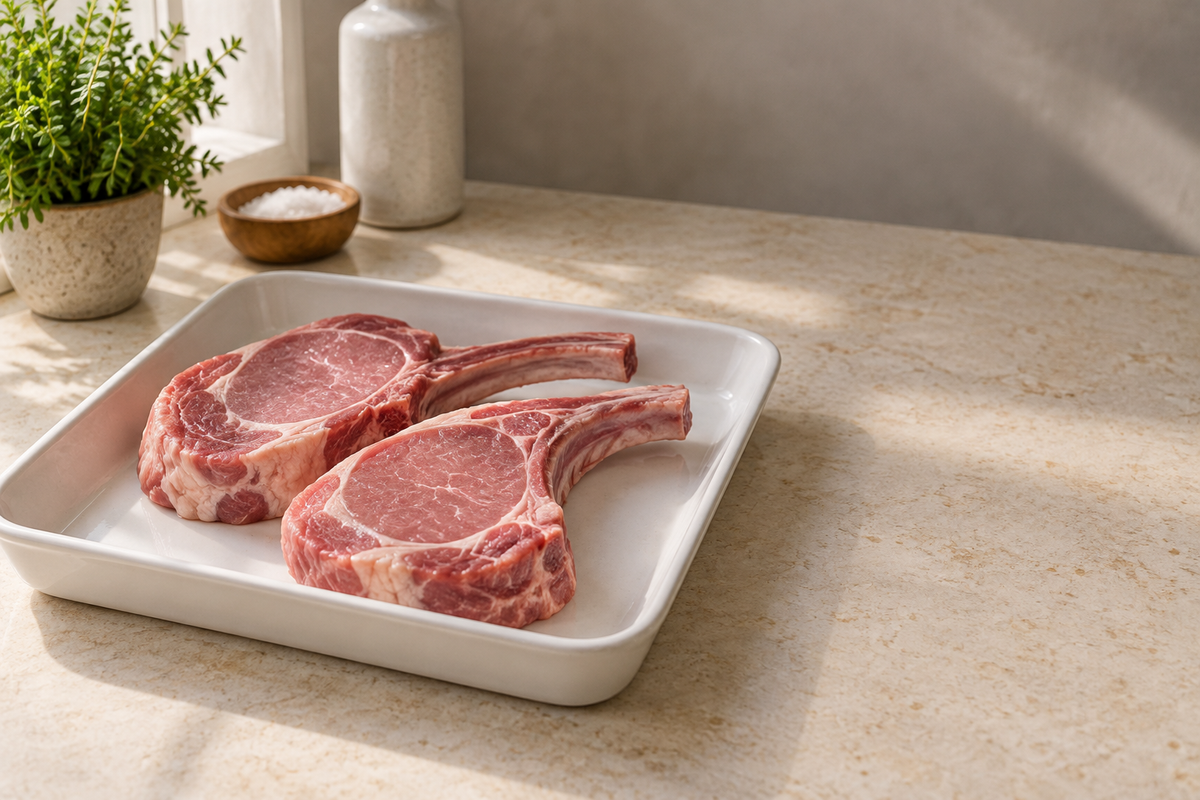
Quick answer: Vacuum sealing meat with bones takes more than a tight-looking bag. Check exposed bone tips, choose a compatible bag that fits without stretching, and use a purpose-made bone guard only as its instructions permit. Keep the sealing area clean, inspect the finished package, and maintain proper refrigeration or freezing.
A rib bone can turn a neat freezer portion into a loose bag. The frustrating part is that the seam may look perfectly straight: the leak is somewhere else, where a hard edge presses against the film. Before changing machine settings or blaming the seal bar, work out which part of the package needs attention.
This guide focuses on puncture prevention before cold storage. It is not a cooking recipe, a promise that a package cannot leak, or permission to heat a protective pad inside a bag.
Why bone-in meat can puncture a vacuum bag
As air leaves the package, flexible film draws closer to the food. An exposed bone tip or a rough cut edge becomes a concentrated contact point. A bag can also be damaged later when a rigid frozen portion is pushed against another package. The aim is to manage that contact, not simply pull a stronger vacuum.
Two problems deserve separate checks. A puncture is damage in the bag wall. A seam leak is an incomplete seal, potentially associated with a fold, moisture, food residue, or an incompatible bag. A bone guard addresses local contact with the film; it cannot correct a dirty sealing area.
| What you notice | Possible explanation | What to examine |
|---|---|---|
| A tiny tear close to a bone | A concentrated contact point has damaged the film. | The bone's position, the bag's fit, and any permitted protective guard. |
| A wrinkle crosses the sealed edge | The seam may not have closed evenly. | Bag alignment and whether the mouth was clean and flat. |
| A package looks tight, then becomes loose | Air may be entering through the wall or seam. | The whole package rather than only the seal line. |
| A bag tears after being moved in the freezer | A rigid edge may have pressed against the package. | How frozen portions are arranged and handled. |
A plastic bone-protection pad is not multilayer bag film
The FRESKO design discussed here is a separate plastic puncture-protection pad. Its purpose is to sit between a sharp contact point and the bag wall, helping reduce the chance of that point piercing the bag during vacuum packaging. It is not a description of how many layers the bag itself contains.
That distinction matters when choosing supplies. Bag construction, machine compatibility, and a separate protective accessory are different specifications. A product description mentioning puncture-resistant film does not automatically mean a bone guard is included. Likewise, a pad does not turn an unsuitable bag into the right bag for your machine.
Use a purpose-made accessory with confirmed food-contact and storage instructions. Do not improvise with a piece of household plastic, assume a retail absorbent pad serves the same purpose, or copy another brand's placement diagram. If the package does not explain how to position the supplied pad, check with FRESKO before using it.
Which FRESKO packages include the protective pad?
FRESKO has confirmed the pad for the specific boxed precut-bag packaging identified in its packaging guidance. This is not a claim that every size, count, or regional bag variant includes it. Vacuum bag rolls and the bags supplied with vacuum sealers do not include this pad.
| Package type | Pad inclusion | Before ordering or using |
|---|---|---|
| The specifically confirmed boxed precut-bag package | Included for that confirmed packaging. | Match the exact package and selected variant with FRESKO; do not infer a quantity. |
| Vacuum bag rolls | Not included. | Do not treat a roll purchase as including a bone-protection accessory. |
| Bags supplied with a vacuum sealer | Not included. | Do not assume a machine bundle contains the pad. |
| Other precut-bag variants or packaging | Not established by this confirmation. | Ask about that specific pack rather than extrapolating from a similar box. |
For the bag range, see FRESKO precut vacuum sealer bags. Verify the contents of the selected package before relying on an included pad. The broader vacuum sealer bags collection is a selection guide, not an accessory-inclusion guarantee.
A practical workflow for vacuum sealing bone-in meat
1. Inspect the cut before choosing the bag
Keep the meat on a clean tray and look for exposed tips and rough cut surfaces. Do not drag your fingers across sharp bone. If the cut has loose fragments or an awkward projecting edge, ask your butcher to assess it rather than attempting an unfamiliar bone-cutting job at home.
2. Give the portion enough room
Choose compatible freezer packaging with room for the meat and the sealing margin required by the machine's instructions. A bag that only just fits can leave little flexibility around a projecting bone. Splitting a large purchase into meal-size portions may be more practical than forcing several irregular cuts into one package. Consult the vacuum sealer bag size guide for the separate sizing decision.
3. Protect the contact point as instructed
If your confirmed package includes a suitable protective pad, follow its placement directions at the sharp contact point. Keep it out of the sealing area. Do not add an unverified folding pattern, adhesive, or extra layers. If the required directions are missing, pause and request them through FRESKO product support.
4. Align the mouth and run the appropriate cycle
Keep juices and food away from the seam and follow the controls for your exact model. A bag-positioning feature helps with alignment; it does not shield a bone elsewhere in the package. The FRESKO New V8 vacuum sealer is a separate equipment option, not evidence that its supplied bags contain protective pads. Find model-specific instructions under FRESKO product manuals.
5. Check the wall and seam before storage
Inspect for visible tears, folds through the seal, residue, and sections of film stretched tightly over an exposed tip. A completed machine cycle is not proof that the entire package is leak-free. Avoid squeezing the bone against the film to test it. If you find damage, use fresh suitable packaging and correct the contact problem.
What if the bag loses its vacuum?
Start with the food's temperature history, then inspect the package. A loose bag alone does not tell you whether the food is safe. Resealing cannot reverse unsafe storage, and smell or appearance cannot reliably rule out harmful bacteria.
If properly handled meat remains frozen and its packaging tears in the freezer, USDA advises overwrapping or rewrapping it. A repaired package still needs cold storage. Maintain the freezer at 0°F (-18°C) or below and the refrigerator at 40°F (4°C) or below. See USDA's freezing and food-safety guidance.
For repeated failures, note where each leak appears. Tears at the same bone contact point call for a different packing arrangement or verified protection. Repeated seam problems call for checking bag compatibility, cleanliness, and the machine instructions. Changing both at once makes the cause harder to identify.
Common questions about bone guards and vacuum bags
Can I use the plastic pad for sous vide cooking?
Do not assume so. Permission to heat a bag does not establish permission to heat an accessory inside it. This guide does not authorize the pad for sous vide, boiling, or microwaving. Obtain instructions for the pad itself before using it outside its confirmed purpose.
Can I reuse the pad or a bag that held raw meat?
Do not infer a cleaning or reuse procedure from the item's appearance. Follow explicit instructions for that accessory and packaging. If reuse is not established, this guide does not recommend it.
Does adding another seal prevent bone punctures?
An additional seam, when permitted by the machine instructions, does not protect a different part of the bag wall from a sharp bone. Address the location of the fault. Good alignment and local puncture protection perform different jobs.
Before the bag goes into the freezer: confirm the portion fits, the bone contact is managed, the seam is clear, and the package is undamaged. A few deliberate checks are more useful than assuming any bag or accessory is puncture-proof.
Share:
What Is Freezer Burn? Signs, Causes and Food Quality
How to Vacuum Seal Chicken for the Freezer: Portions, Juices, and Labels