

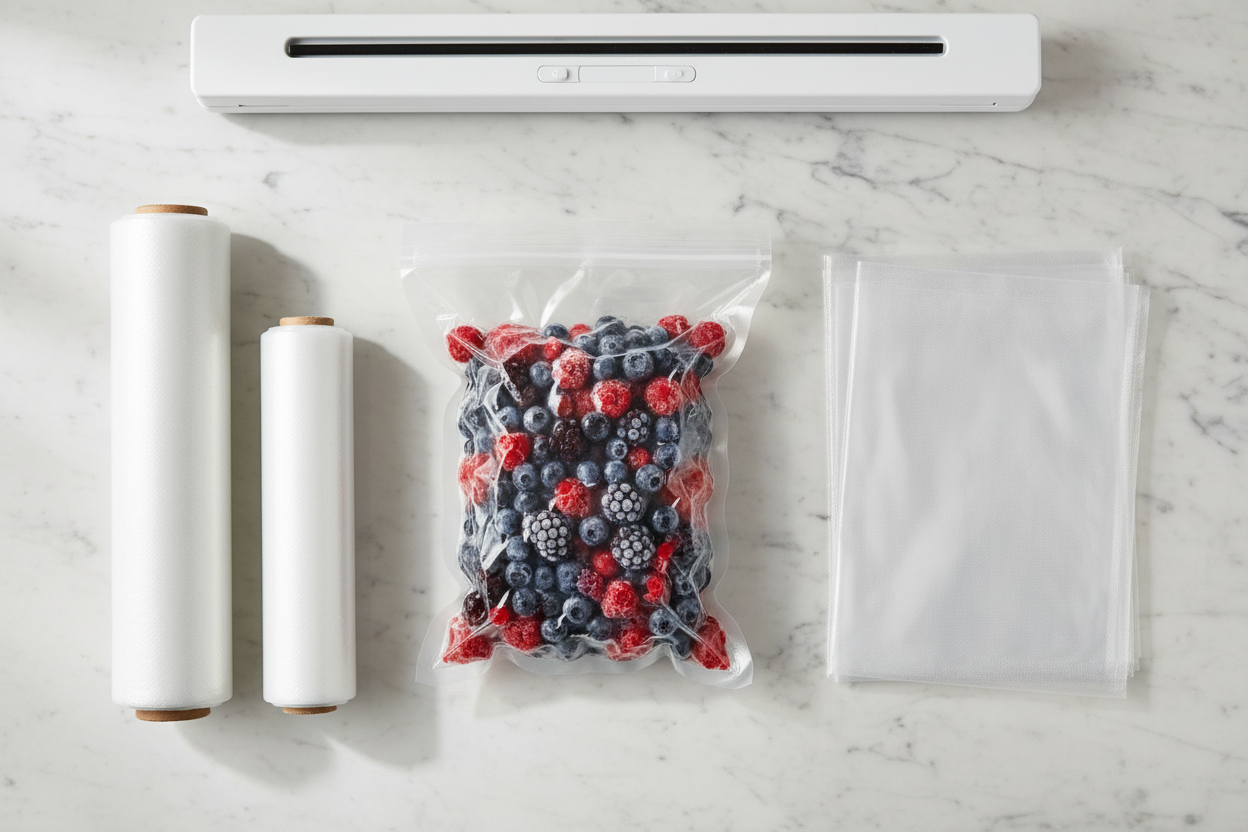
 Search "best vacuum sealer" and you'll get hundreds of nearly identical roundups, most of them ranking machines against each other without ever explaining why one spec matters more than another. That's the real problem: most buying guides tell you what to buy, not how to think about the decision.
This guide does the opposite. Instead of a ranked list, you'll learn the handful of factors that actually determine whether a vacuum sealer earns its place on your counter — or ends up in a drawer after three uses. By the end, you'll be able to look at any machine's spec sheet and know exactly what you're looking at.
Is a Vacuum Sealer Worth It?
Before getting into specs, it's worth answering the question a lot of shoppers are really asking: is a vacuum sealer worth it, or is this another kitchen gadget that sounds useful but rarely gets used?
The honest answer depends on how you already handle food storage. A vacuum sealer earns its keep when at least one of these is true for your household:
- You buy meat, fish, or produce in bulk and freeze the extra
- You meal-prep and want food to last through the week without quality loss
- You've thrown away freezer-burned food in the last few months
- You sous-vide, or want to start
- You're trying to cut down on single-use plastic bags and food waste generally
If none of those apply — say, you live alone and cook meal-by-meal from small grocery runs — a vacuum sealer is a lower-priority purchase. But for households doing any kind of bulk buying or meal prep, the math tends to work out quickly: food that would otherwise freezer-burn or spoil gets used instead of thrown away, and that adds up faster than most people expect.
The Core Factors That Actually Matter

1. Sealing Strength and Consistency
This is the single most important spec, and the one most roundups gloss over. A vacuum sealer's entire job is to pull air out and create an airtight seal — if it can't do that reliably, nothing else about the machine matters.
Look for a machine with a stated vacuum pressure or suction rating, and check whether it seals consistently across different bag thicknesses. A sealer that works perfectly on thin bags but struggles with thicker, textured "commercial-grade" bags will frustrate you the first time you try to seal something bulky, like a roast or a rack of ribs.

2. Dry Mode vs. Moist Mode
Anything with liquid content — marinated meat, soups, berries, sauces — behaves differently under vacuum than dry goods like rice or coffee. Without a dedicated moist mode, liquid gets pulled into the sealing strip mid-cycle, which weakens the seal or stops the machine from sealing at all.
If you plan to seal anything beyond dry pantry staples, a dry/moist mode switch isn't optional — it's a baseline requirement.
3. Bag and Roll Compatibility
Some machines only work with proprietary, brand-specific bags. Others accept universal embossed/textured vacuum bags and rolls from any manufacturer. This matters more than it seems: proprietary bag systems can quietly become the most expensive part of owning the machine, since you're locked into buying replacement bags from one source indefinitely.
Before buying, check whether the machine accepts standard textured rolls, and whether it can cut and seal rolls to custom lengths — that flexibility saves money and reduces waste over time.
4. Pulse or Manual Vacuum Control
Delicate items — bread, berries, chips, baked goods — get crushed under full vacuum pressure. A pulse function (manual, start-stop control over suction) lets you pull air out gradually and stop before the food is damaged. If you plan to seal anything soft or fragile, this feature moves from "nice to have" to essential.
5. Footprint and Storage
Countertop space is finite, and a vacuum sealer that's a hassle to pull out and put away tends to get used less over time — even if it performs well. Consider:
- Whether it stores upright or needs to lie flat
- Whether the bag roll storage is built in or separate
- How heavy it is if you plan to store it in a cabinet rather than leave it out
A machine that lives in the way of daily kitchen work usually gets used for a few weeks and then abandoned, no matter how good the seal quality is.
6. Noise Level
This is rarely mentioned in spec sheets but matters in daily use, especially for anyone sealing food in the evening or in an open-plan kitchen. If noise level is listed, check it. If it isn't, look at customer reviews specifically for mentions of loudness — it's one of the most common post-purchase complaints across the category.
7. Ease of Cleaning
Liquid and food particles inevitably get pulled toward the sealing strip, even with a moist mode. A removable, dishwasher-safe drip tray or catch tray makes a meaningful difference in how often the machine actually gets used, since nobody wants to hand-scrub a sticky sealing channel after every session.
8. Certifications and Warranty
Look for basic safety certifications (UL, ETL, or CE depending on your region) and a warranty of at least one year. Vacuum sealers have moving mechanical parts and a heating element for the seal — a longer warranty is generally a signal that the manufacturer expects the unit to hold up under regular use.
External vs. Chamber Vacuum Sealers

Most home buying guides only cover external (out-of-chamber) sealers, but it's worth knowing the difference:
External sealers pull air out through the open end of the bag while it sits outside the machine. They're compact, affordable, and cover the vast majority of home use cases — this is what "best food vacuum sealer" roundups are almost always referring to.
Chamber sealers place the entire bag inside a sealed chamber and vacuum the air out of the whole enclosed space. They're significantly more powerful and can seal liquids without a moist mode, but they're bulkier, pricier, and generally built for high-volume or commercial use.
For nearly all home kitchens, an external sealer with a solid moist mode and pulse function covers everything a chamber sealer does, at a fraction of the cost and counter space.

Common Mistakes When Buying a Vacuum Sealer
Buying based on price alone. The cheapest machines on the market often cut corners on sealing consistency, which is the one spec that can't be compromised without undermining the entire point of the purchase.
Ignoring bag costs long-term. A lower upfront price on a machine that requires proprietary bags can end up costing more over a year of regular use than a slightly pricier machine that accepts universal rolls.
Overlooking accessories. Features like a built-in bag cutter, roll storage, or a wide sealing strip for bulky items aren't essential for everyone, but they matter a lot if you're sealing large cuts of meat or bulk produce regularly.
Assuming "best rated" means "best for you." A machine can be genuinely excellent for high-volume commercial sealing and still be the wrong choice for someone sealing a few bags of vegetables a week. Match the machine to your actual usage pattern, not just its review score.
Bringing It Together
A vacuum sealer earns its place in the kitchen when it seals reliably, handles both wet and dry foods, and is easy enough to use that it doesn't end up buried in a cabinet after the first month. Everything else — bag storage, extra accessories, sleek design — is secondary to those fundamentals.
If you're comparing specific models side by side, our Best Vacuum Sealers 2026 buying guide walks through how current options stack up against these criteria. And if freezer storage specifically is your main use case, our freezer burn prevention guide covers how proper sealing fits into a broader food storage routine.

FAQ Section (for on-page FAQ schema)
What is the best food vacuum sealer for home use? The best food vacuum sealer for most households is a compact external sealer with both dry and moist modes, a pulse function for delicate foods, and compatibility with universal vacuum bags and rolls. The "best" model ultimately depends on how often you seal, what types of food you're sealing most, and how much counter or storage space you have available.
Is a vacuum sealer worth it for a small household? Yes, if you buy food in bulk, meal-prep, or freeze leftovers regularly. If you shop and cook in small quantities day-to-day, the benefit is smaller, since there's less excess food that needs long-term storage.
What's the difference between a vacuum sealer and a regular freezer bag? Regular freezer bags trap air inside, which speeds up freezer burn and ice crystal formation. A vacuum sealer removes that air before sealing, which slows oxidation and helps food retain texture and flavor over a longer storage period.
Do vacuum sealers work on liquids? External vacuum sealers can seal liquids if they have a dedicated moist mode, which slows the vacuum process to avoid pulling liquid into the sealing strip. Without a moist mode, liquid-heavy foods are difficult to seal cleanly.
How long does vacuum-sealed food actually last? It varies by food type and storage method (fridge, freezer, or pantry), but vacuum-sealed food generally lasts significantly longer than food stored in regular bags or containers, since removing air slows the oxidation and freezer burn that cause food to degrade.
Share:
World Cup Flavors: A Global Grilling Tour You Can Marinate in Minutes
Can You Reuse Vacuum Sealer Bags? What You Need to Know