

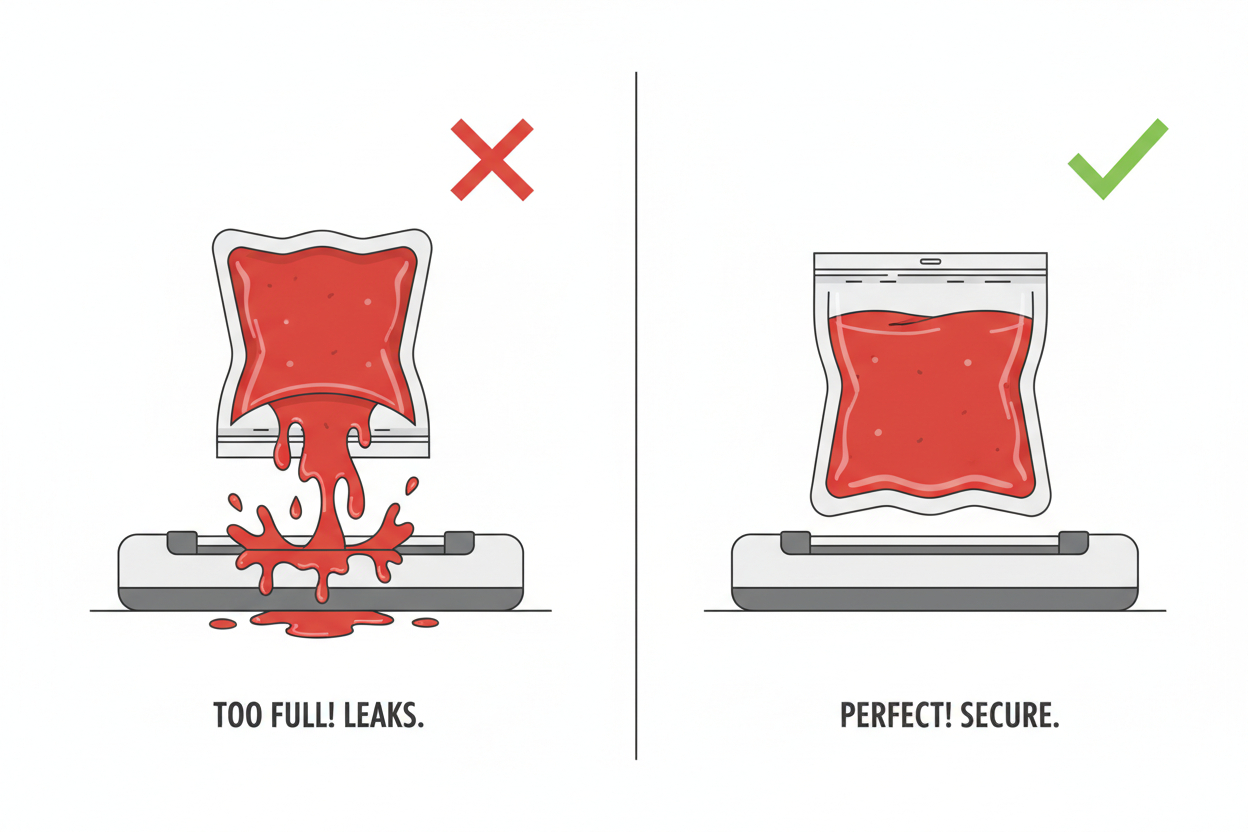

Si vous avez déjà essayé de mettre sous vide un sac de soupe pour le voir aspiré directement dans votre machine, vous n'êtes pas seul. La mise sous vide des liquides est l'une des frustrations les plus courantes pour les cuisiniers amateurs — mais une fois que vous maîtrisez la bonne technique, c'est l'un des outils les plus puissants de votre cuisine.
Que vous essayiez de préparer des soupes pour la semaine, de conserver un lot de bouillon maison, de stocker des protéines marinées, ou de sceller des sauces fraîches avant qu'elles ne se gâtent, savoir comment utiliser correctement une machine sous vide avec des liquides peut vous faire gagner des heures et réduire considérablement le gaspillage alimentaire.
Dans ce guide, nous vous expliquerons précisément ce que signifie la mise sous vide des liquides, comment cela fonctionne, quand c'est pertinent, quels aliments conviennent le mieux, et — surtout — comment le faire sans faire de dégâts ni abîmer votre machine.
Réponse Rapide
La mise sous vide des liquides est possible, mais elle nécessite l'une des deux techniques suivantes : la méthode de congélation préalable (congeler le liquide avant de le sceller) ou la méthode de la ligne de scellage (laisser suffisamment d'espace et incliner la machine pour que le liquide n'atteigne pas la pompe). L'approche de congélation préalable est plus fiable et est la méthode que nous recommandons pour la plupart des soupes, bouillons et sauces. Correctement réalisée, la mise sous vide des liquides les conserve 3 à 5 fois plus longtemps au congélateur que les liquides stockés dans des récipients standard.
Qu'est-ce que la mise sous vide, et pourquoi est-ce délicat avec les liquides ?
La mise sous vide est une méthode de conservation des aliments qui retire l'air d'un sac de stockage avant de le sceller hermétiquement par la chaleur. Sans oxygène, les micro-organismes qui causent la détérioration des aliments — moisissures, bactéries et levures — ralentissent considérablement. Résultat : les aliments restent frais beaucoup plus longtemps, qu'ils soient conservés au réfrigérateur, au congélateur ou au garde-manger.
La plupart des gens apprennent à utiliser une machine sous vide en commençant par des aliments secs — viandes, fromages, noix et légumes. Ceux-ci sont indulgents. Les liquides sont différents.
L'aspiration qui retire l'air d'un sac ne fait pas de distinction entre l'air et le liquide. Si votre sac est trop plein, ou si vous n'utilisez pas la bonne technique, cette aspiration entraînera le liquide directement dans le mécanisme de scellage de la machine — le bouchant, l'endommageant ou créant une fuite qui ruine complètement le scellage.
C'est le désordre que la plupart des gens essaient d'éviter. Et avec la bonne approche, c'est totalement évitable.
Comment la mise sous vide fonctionne-t-elle avec les liquides ?
Élimine l'oxygène
La pompe à vide aspire l'air du sac scellé à travers un petit canal. Pour les liquides, le défi est que les molécules de liquide peuvent être aspirées à travers ce canal en même temps que l'air si le sac est trop rempli ou mal positionné.
Réduit la perte d'humidité
Une fois scellés, les sacs sous vide créent une barrière hermétique qui empêche l'évaporation. Votre soupe conserve toute son humidité et sa saveur, contrairement aux récipients ouverts qui peuvent se dessécher ou développer une pellicule.
Ralentit l'oxydation
L'oxydation — le même processus qui fait brunir une pomme coupée — dégrade la couleur, la saveur et la valeur nutritionnelle des aliments. En éliminant l'oxygène, la mise sous vide préserve la fraîcheur de votre bouillon, sauce ou marinade pendant des semaines ou des mois supplémentaires.
Aide à prévenir les brûlures de congélation
La brûlure de congélation se produit lorsque l'humidité à la surface des aliments s'évapore dans l'environnement sec du congélateur. Les sacs sous vide éliminent la poche d'air qui en est la cause, conservant le goût des soupes et des sauces aussi frais que le jour où vous les avez préparées.
Les deux méthodes pour mettre sous vide des liquides

Méthode 1 : La méthode de congélation préalable (recommandée)
C'est l'approche la plus infaillible, et c'est celle que nous utilisons le plus chez Fresko.
- Refroidissez complètement votre liquide. N'essayez jamais de mettre sous vide un liquide chaud ou même tiède. Laissez les soupes, bouillons et sauces atteindre la température ambiante, puis réfrigérez jusqu'à ce qu'ils soient froids.
- Pré-portionnez dans des sacs ou des récipients. Décidez de la quantité que vous souhaitez dans chaque sac — les portions individuelles conviennent bien pour la préparation des repas.
- Congelez jusqu'à ce que ce soit solide. Versez le liquide dans le sac sous vide (en laissant au moins 7-8 cm d'espace vide), posez-le à plat sur une plaque à pâtisserie et congelez jusqu'à ce qu'il soit complètement solide. Cela prend généralement 4 à 6 heures ou toute une nuit.
- Mettez sous vide le bloc congelé. Une fois congelé, le liquide ne sera pas aspiré dans la machine. Passez-le dans votre machine sous vide normalement.
- Étiquetez et stockez. Écrivez le contenu et la date sur chaque sac. Empilez à plat dans le congélateur.
Conseil de pro : L'utilisation d'un bac à glaçons en silicone ou d'un moule à muffins pour pré-congeler les portions vous donne des blocs nets et empilables qui se glissent parfaitement dans les sacs sous vide standard.

Méthode 2 : La méthode de la ligne de scellage / d'inclinaison (pour les petites quantités)
Si vous devez sceller un liquide sans le congeler au préalable — par exemple, une marinade que vous utilisez le jour même ou une sauce allant directement au réfrigérateur — la méthode d'inclinaison fonctionne bien pour les petites quantités.
- Remplissez le sac au maximum d'un tiers. Laissez un espace généreux.
- Repliez le haut du sac vers l'extérieur avant de le placer dans la machine. Cela maintient la zone de scellage intérieure propre et sèche.
- Inclinez la machine de sorte que l'extrémité ouverte du sac soit élevée au-dessus du niveau du liquide. La gravité maintient le liquide éloigné de la barre de scellage.
- Commencez le processus de vide lentement. De nombreuses machines sous vide ont un mode "humide" ou "doux" — utilisez-le. Arrêtez l'aspiration manuellement juste avant que le liquide n'atteigne la ligne de scellage.
- Scellez immédiatement. Appuyez sur le bouton de scellage pour fermer le sac.
Cette méthode demande de la pratique et convient mieux aux liquides de faible volume. Pour toute quantité supérieure à une ou deux tasses, congelez d'abord.
Avantages de la mise sous vide des liquides
1. Fraîcheur considérablement prolongée
Le bouillon maison conservé dans un récipient ouvert dure 4 à 5 jours au réfrigérateur. Mis sous vide et congelé, il peut durer 2 à 3 ans sans perte significative de qualité. C'est une différence significative pour quiconque cuisine en grande quantité.
2. Meilleure préservation des saveurs
Le scellement hermétique maintient les composés aromatiques volatils — ceux qui donnent de la profondeur à votre bouillon et de l'éclat à votre sauce tomate — enfermés dans le sac au lieu de s'évaporer dans votre réfrigérateur.
3. Fini les brûlures de congélation
Les soupes et les sauces sont particulièrement vulnérables aux brûlures de congélation dans les sacs de congélation standard. Les sacs sous vide éliminent complètement l'espace d'air, préservant la texture et le goût.
4. Meilleur contrôle des portions
Sceller les liquides en portions individuelles ou familiales signifie que vous ne décongelez que ce dont vous avez besoin. Plus besoin de décongeler une marmite entière de chili quand vous ne voulez qu'un bol.
5. Moins de gaspillage alimentaire
Selon les estimations de l'USDA, les ménages américains gaspillent environ 30 à 40 % de leurs denrées alimentaires — une grande partie étant des liquides et des repas cuisinés qui se gâtent avant d'être consommés. La mise sous vide vous permet de prolonger la durée de vie de tout ce que vous cuisinez, de sorte que moins de choses finissent à la poubelle.
Limitations de la mise sous vide des liquides
Il est important de savoir ce que la mise sous vide ne peut pas faire :
- Elle ne tue pas les bactéries. La mise sous vide ralentit la croissance bactérienne en éliminant l'oxygène, mais elle ne stérilise pas les aliments. Ne mettez jamais sous vide des liquides qui ont déjà tourné ou qui ont été laissés à température ambiante pendant plus de deux heures.
- Elle ne remplace pas la réfrigération ou la congélation. Les liquides mis sous vide doivent toujours être conservés au froid. La plupart des soupes et bouillons scellés doivent être congelés pour un stockage à long terme ; les liquides scellés et réfrigérés ont toujours une durée de conservation de 1 à 2 semaines.
- Certains liquides nécessitent une préparation spéciale. Les liquides riches en matières grasses comme les soupes à la crème peuvent développer des saveurs désagréables s'ils sont mal congelés. Laissez-les refroidir complètement avant de les sceller et envisagez d'ajouter des stabilisants comme une petite quantité de fécule de maïs si le réchauffage est une préoccupation.
- La qualité du sac affecte les résultats. Les sacs minces ou de mauvaise qualité sont plus sujets aux perforations et aux défaillances du scellage. Les sacs plus épais et gaufrés conçus pour les machines sous vide fonctionnent nettement mieux, en particulier pour les liquides avec des morceaux ou des os.
- Les liquides gazeux ne peuvent pas être mis sous vide. La différence de pression entraînera l'échappement du gaz carbonique, rendant le processus inefficace et potentiellement dangereux pour la machine.
Meilleurs aliments à mettre sous vide avec la méthode liquide
| Aliment / Liquide | Convient à la mise sous vide ? | Notes |
|---|---|---|
| Bouillon de poulet ou de bœuf | ✅ Oui | Congeler d'abord ; portionner en portions de 1 à 2 tasses |
| Soupe à base de tomates | ✅ Oui | Congeler d'abord ; laisser 7-8 cm d'espace pour l'expansion |
| Soupe à la crème | ✅ Oui (avec précaution) | Refroidir complètement ; peut se séparer légèrement au réchauffage |
| Chili avec haricots | ✅ Oui | Congeler en portions plates ; excellent pour la préparation des repas |
| Marinades (viande crue) | ✅ Oui | La méthode d'inclinaison fonctionne ; utiliser le jour même ou congeler |
| Sauce à pâtes | ✅ Oui | Congeler d'abord ; excellent pour la cuisson par lots |
| Smoothies / jus | ✅ Oui | Congeler d'abord dans des bacs à glaçons |
| Vin (pour la cuisine) | ✅ Oui | Méthode de la ligne de scellage ; conserver au réfrigérateur jusqu'à 2 semaines |
| Boissons gazeuses | ❌ Non | Incompatibilité de pression ; endommage la machine |
| Œufs crus (entiers) | ❌ Non | La coquille présente un risque de perforation ; casser et congeler plutôt |
| Liquide chaud (au-dessus de 38 °C) | ❌ Non | Doit refroidir à température ambiante avant de sceller |
| Lait de vache | ⚠️ Avec précaution | Courte durée de vie au réfrigérateur ; congeler immédiatement après scellage |
Erreurs courantes lors de la mise sous vide de liquides

Erreur n°1 : Trop remplir le sac
C'est la raison la plus fréquente pour laquelle le liquide est aspiré dans la machine à emballer sous vide. En règle générale, ne remplissez jamais un sac plus qu'à moitié lorsque vous travaillez avec des liquides, et laissez toujours un minimum de 7,5 cm entre le liquide et l'extrémité ouverte du sac. L'aspiration est puissante — elle attirera le liquide vers la barre de scellage plus rapidement que vous ne l'imaginez.
Erreur n°2 : Essayer de sceller un liquide tiède ou chaud
Les liquides chauds créent de la vapeur, que la pompe à vide aspire avec l'air — entraînant avec elle des gouttelettes de liquide. Laissez toujours les soupes et les sauces refroidir à température ambiante, puis réfrigérez-les avant d'essayer de les sceller. Cette étape simple prévient la majorité des incidents d'endommagement de la machine.
Erreur n°3 : Oublier l'étape de congélation pour les grands volumes
Beaucoup de gens essaient la méthode d'inclinaison sur un sac de soupe plein et finissent par faire un gâchis. Pour toute quantité de liquide supérieure à une ou deux tasses, la méthode de congélation préalable est simplement le choix le plus sûr et le plus fiable. Oui, cela ajoute quelques heures. Mais cela garantit également un scellage propre et hermétique à chaque fois.
Erreur n°4 : Utiliser des sacs de mauvaise qualité
Tous les sacs sous vide ne sont pas égaux. Les sacs génériques ou de marques inconnues ont souvent des parois plus fines et des canaux de gaufrage plus faibles, ce qui signifie que la machine ne peut pas générer un vide complet — et le scellage est plus susceptible de céder dans le congélateur avec le temps. Cela est d'autant plus important avec les liquides, où un scellage défaillant signifie une fuite.
Erreur n°5 : Oublier d'étiqueter
Les soupes scellées sous vide se ressemblent toutes après quelques semaines au congélateur. Écrivez toujours le contenu et la date sur le sac avec un marqueur permanent avant de le ranger. Cela prend cinq secondes et évite beaucoup de repas mystérieux.
Conseils d'experts de Fresko
Chez Fresko, nous avons passé des années à travailler avec des cuisiniers amateurs, des préparateurs de repas et des cuisines professionnelles pour comprendre ce qui fait fonctionner la mise sous vide dans le monde réel — pas seulement en théorie.
Voici ce que nous avons constaté :
La méthode de congélation préalable vaut presque toujours l'étape supplémentaire. Nous savons que cela demande de la planification, mais les résultats parlent d'eux-mêmes : des machines plus propres, de meilleurs scellages et des soupes qui ont le même goût trois mois plus tard que le jour où vous les avez préparées.
Les moules en silicone sont vos meilleurs amis. Portionner le liquide dans des bacs à glaçons en silicone ou des moules à muffins avant de congeler vous donne des blocs de taille parfaite qui s'insèrent parfaitement dans les sacs. Une seule préparation de bouillon peut remplir six à huit sacs individuels en environ dix minutes de préparation.
Effectuez toujours un test de scellage sur chaque lot. Avant d'empiler les sacs dans le congélateur, appuyez doucement sur chaque sac scellé pour vous assurer que le vide est maintenu. Si vous sentez une légère résistance ou entendez de l'air s'échapper, resceller avant de congeler.
Pour un stockage à long terme (plus de 3 mois), doublez le sac pour tout ce qui contient beaucoup de liquide. Un deuxième sac offre une protection contre les perforations dues à l'empilage au congélateur. Cela facilite également l'empilage à plat des sacs, ce qui maximise l'espace de congélation.
Datez vos sacs sur deux côtés. Lorsque les sacs sont empilés, vous ne pouvez voir qu'un seul côté. Écrire la date des deux côtés vous permet de toujours la lire, quelle que soit la position du sac.
Outils recommandés
Obtenir des résultats toujours excellents avec la mise sous vide de liquides repose sur deux choses : une machine de qualité et des sacs de qualité.
Pour la machine, recherchez une machine à emballer sous vide avec une vitesse d'aspiration réglable, un mode aliments humides ou délicats, et un plateau d'égouttement ou un collecteur de liquide interne. Ces caractéristiques ne sont pas facultatives lorsque vous scellez régulièrement des soupes et des sauces — ce sont elles qui protègent votre machine à long terme.
Pour les sacs, choisissez des sacs épais, gaufrés, sans BPA et compatibles avec votre scelleuse. Le gaufrage crée les canaux qui permettent d'évacuer l'air uniformément — sans cela, l'aspirateur ne peut pas aspirer l'air sur toute la longueur du sac.
Le scelleur sous vide Fresko est conçu précisément pour ces cas d'utilisation. Il comprend un mode dédié aux aliments humides, un bac d'égouttement amovible pour un nettoyage facile et une pression de scellage constante qui fonctionne aussi bien pour les coupes de viande sèches que pour les soupes riches en liquide. Associé aux sacs de stockage sous vide gaufrés Fresko, c'est la configuration la plus propre et la plus fiable que nous ayons trouvée pour la mise sous vide de liquides à la maison.
Questions fréquemment posées
Peut-on mettre de la soupe sous vide ?
Oui, mais il faut utiliser la bonne méthode. L'approche de congélation préalable (congeler la soupe avant de la mettre sous vide) est la plus fiable. Pour de plus petites quantités de liquide, la méthode d'inclinaison fonctionne également. N'essayez jamais de mettre sous vide de la soupe chaude ou tiède.
Combien de temps une soupe sous vide se conserve-t-elle au congélateur ?
Une soupe sous vide conservée au congélateur dure généralement 2 à 3 ans sans perte significative de qualité. Comparez cela à 3 à 6 mois pour une soupe dans un sac à fermeture éclair standard. Au réfrigérateur, une soupe scellée dure 1 à 2 semaines.
Une machine à emballer sous vide ordinaire peut-elle gérer les liquides ?
La plupart des scelleuses sous vide standard peuvent gérer les liquides si vous utilisez la technique correcte. L'astuce est de soit congeler le liquide d'abord, soit d'utiliser la méthode d'inclinaison/ligne de scellage et d'arrêter l'aspiration avant que le liquide n'atteigne la barre de scellage. Les scelleuses avec un mode pour aliments humides facilitent cela.
Comment mettre du bouillon sous vide sans faire de dégâts ?
Congelez-le d'abord. Versez le bouillon refroidi dans des sacs sous vide (ne remplissez pas plus qu'à moitié), placez-les à plat sur une plaque de cuisson, congelez-les jusqu'à ce qu'ils soient solides pendant la nuit, puis passez-les dans votre scelleuse sous vide. C'est la méthode la plus propre et la plus infaillible.
Pourquoi du liquide a-t-il été aspiré dans ma machine à emballer sous vide ?
Cela se produit généralement lorsque le sac est trop rempli, que le liquide est trop chaud ou que la vitesse d'aspiration est trop élevée. Essayez de congeler le liquide d'abord, de réduire le niveau de remplissage ou d'utiliser le mode doux/humide de votre machine.
Peut-on mettre une marinade sous vide ?
Oui. La mise sous vide de la viande dans une marinade accélère en fait la macération — le vide ouvre les pores de la viande et attire la marinade plus rapidement. Utilisez la méthode d'inclinaison pour les marinades non congelées et gardez le sac rempli au tiers au maximum.
Est-il sûr de mettre des liquides sous vide ?
Oui, tant que vous respectez les règles de base de sécurité alimentaire : refroidissez le liquide avant de le sceller, conservez les sacs scellés au réfrigérateur ou au congélateur, et ne scellez jamais des liquides qui sont déjà périmés. La mise sous vide ralentit la croissance bactérienne mais ne stérilise pas les aliments.
Peut-on mettre des smoothies ou des jus sous vide ?
Oui — utilisez la méthode de congélation préalable. Versez votre smoothie dans un sac, congelez-le à plat, puis scellez-le. Décongelez-le au réfrigérateur pendant la nuit ou passez le sac scellé sous l'eau froide pour une option rapide.
Conclusion
Apprendre à mettre les liquides sous vide est l'un des meilleurs investissements que vous puissiez faire dans votre organisation de cuisine. Une fois que vous aurez maîtrisé la méthode de congélation préalable — et compris quand la méthode d'inclinaison s'applique — vous ne reviendrez jamais à jeter la moitié d'une casserole de soupe dans un récipient en espérant le meilleur.
Les points clés à retenir : toujours refroidir votre liquide avant de le sceller, congeler d'abord pour toute quantité supérieure à une tasse, laisser beaucoup d'espace libre, utiliser des sacs de qualité et tout étiqueter.
Mettre sous vide soupes, bouillons, marinades et sauces est tout à fait réalisable à la maison. Avec la bonne technique et les bons outils, vous obtiendrez des résultats hermétiques et sans dégâts à chaque fois — et un congélateur rempli de mois de repas prêts à consommer.
Prêt à commencer ? Explorez le scelleur sous vide Fresko et notre gamme complète de sacs de stockage sous vide compatibles pour trouver la configuration adaptée à votre cuisine.
Guides connexes qui pourraient vous être utiles :
- Comment utiliser un scelleur sous vide : Le guide complet du débutant
- Combien de temps la viande sous vide se conserve-t-elle ? Tableau de conservation
- Avantages de la mise sous vide des aliments
- Les scelleuses sous vide en valent-elles la peine ? Une analyse honnête des coûts et des économies
Partager:
Les meilleures machines sous vide pour la maison en 2026 — Et pourquoi le Prime Day est le moment idéal pour les acheter
Comment la mise sous vide aide à garder les aliments frais plus longtemps : un guide pratique pour les cuisines de tous les jours