

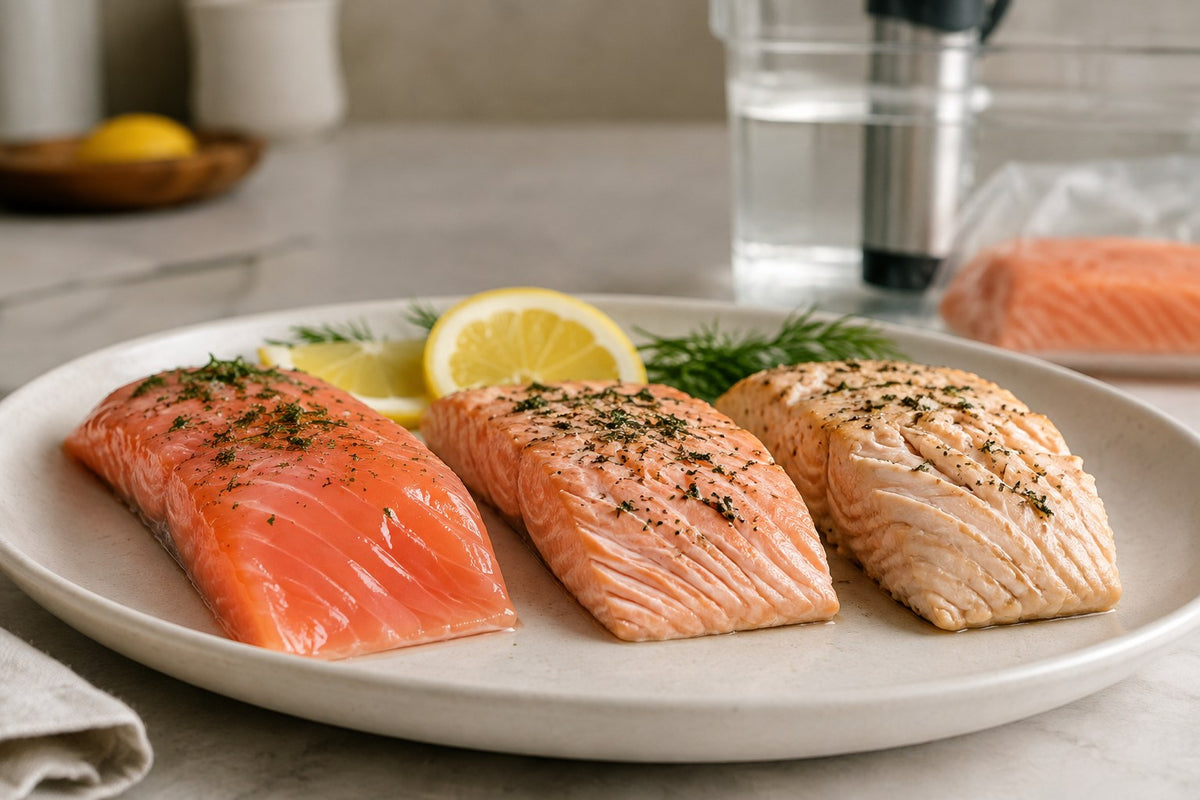

The best sous vide salmon temperature depends on the texture you want. At the low end, salmon stays jewel-like and almost sashimi-soft. A few degrees higher, the flakes become more defined while the center remains moist. This guide helps you choose a temperature, estimate cooking time by thickness, dry-brine the fish, bag it without crushing it, and finish it cleanly.
Quick answer: For a moist, gently flaky result, many cooks prefer 120–130°F (49–54°C) for about 30–45 minutes for a thawed 1-inch fillet. Lower temperatures produce a silkier, more translucent texture. The USDA consumer safety recommendation for fish is 145°F (63°C); cooking below that is a culinary texture choice and may not be suitable for higher-risk diners.
Sous vide salmon temperature chart
| Water-bath temperature | Expected texture | Best for |
|---|---|---|
| 105°F / 41°C | Very soft, cool-looking center, sashimi-like | Experienced low-temperature diners who specifically want a raw-like texture |
| 110°F / 43°C | Silky, buttery, and delicate | A barely set center |
| 115°F / 46°C | Translucent and tender; beginning to separate | Silky salmon with a little flake |
| 120°F / 49°C | Very moist, tender, and softly flaky | A balanced restaurant-style texture |
| 125°F / 52°C | Moist with clearer, firmer flakes | A familiar medium texture |
| 130°F / 54°C | Firm, moist, and fully flaky | Diners who prefer a more conventionally cooked bite |
| 145°F / 63°C | Opaque and firm | The USDA-recommended consumer safety endpoint |
Important: A controlled water bath makes temperature precise, but precision is not the same as pasteurization. This chart describes texture; it does not replace official food-safety guidance. The USDA safe temperature chart lists 145°F for fish, and the FDA seafood safety guidance recommends the same endpoint. Pregnant people, young children, older adults, and anyone with a weakened immune system should choose thoroughly cooked fish or follow medical advice.
How long to sous vide salmon
Thickness matters more than weight. These practical ranges are for thawed portions placed in a fully preheated bath. Begin timing once the bag is submerged.
| Thickness at the thickest point | Suggested time | Notes |
|---|---|---|
| About 3/4 inch | 30–35 minutes | Ideal for thinner tail portions; handle gently after cooking. |
| About 1 inch | 35–45 minutes | A reliable range for most individually portioned fillets. |
| About 1 1/2 inches | 45–60 minutes | Allow extra time for the center to reach the bath temperature. |
Avoid leaving salmon in the bath for hours. Unlike a tough cut of meat, fish contains little connective tissue that needs extended cooking. Excess time can make the surface unusually soft or chalky. For the cleanest comparison, use portions of similar thickness and cook them in one layer.
Should you dry-brine salmon first?
A short dry brine improves seasoning and helps the fish retain a firmer surface. Pat two 5–6 ounce portions dry, sprinkle both sides evenly with about 1/2 teaspoon kosher salt total, and refrigerate uncovered for 20–30 minutes. Pat away any moisture that beads on the surface before bagging.
Thirty minutes is enough for weeknight cooking. If you are sensitive to salt, use less and season after cooking. Avoid strongly acidic marinades in the sous vide bag: lemon juice or vinegar can change the fish's texture before heat does. Add fresh lemon when serving instead.

How to bag salmon without damaging it
Salmon is delicate, so the goal is close bag contact without squeezing out moisture or deforming the fillet.
- Choose even portions. Cut fillets into 5–6 ounce pieces and remove pin bones with clean tweezers.
- Keep the sealing area dry. Leave 2–3 inches of clean bag above the fish so the seal forms without oil or moisture in the seam.
- Arrange in a single layer. Do not stack portions. If two fillets share a wide bag, leave space between them.
- Add fat sparingly. A teaspoon of olive oil or a thin pat of butter is enough to prevent adjacent surfaces from sticking. Too much oil can mute seasoning.
- Use a gentle vacuum. Stop the vacuum as soon as the bag hugs the fish, then seal. If your machine has pulse or moist mode, this is a good time to use it.
A zipper bag and water-displacement method can work for a short cook, but a heat-sealed food-grade bag is neater and less likely to admit water. See our complete guide to vacuum sealing food for sous vide, or review when a vacuum sealer is worth using for sous vide.
Sous vide salmon recipe: step by step
Yield: 2 servings | Prep: 10 minutes plus optional 30-minute brine | Cook: 30–60 minutes
Ingredients
- Two center-cut salmon fillets, 5–6 ounces each, about 1 inch thick
- Kosher salt and freshly ground black pepper
- 1 teaspoon olive oil or a thin pat of butter, optional
- 1 tablespoon high-heat cooking oil, if searing
- Lemon wedges and fresh herbs, for serving
Equipment
- Immersion circulator and water-safe container
- Food-grade sous vide bags and a vacuum sealer
- Paper towels, tongs or a fish spatula, and an optional heavy skillet
Instructions
- Preheat the bath. Set the circulator to the temperature that matches your preferred texture. For a moist, softly flaky starting point, try 120°F; for a firmer flake, use 125–130°F.
- Prepare the fish. Check for pin bones. Dry-brine for 20–30 minutes if desired, then pat the surface dry and add pepper.
- Seal gently. Place the portions skin-side down in one layer with optional oil or butter. Vacuum only until the bag conforms to the fish, then create a complete seal.
- Cook by thickness. Lower the bag into the preheated water, confirm it is fully submerged, and cook for 35–45 minutes for a 1-inch fillet.
- Remove carefully. Cut open the bag and support the fish from underneath. Sous vide salmon—especially at 105–120°F—is fragile.
- Dry thoroughly. Blot all sides with paper towels. A dry surface browns faster and lets you keep the center at the chosen temperature.
- Finish and serve. Serve as-is for the purest texture comparison, or sear using the method below. Add lemon only after cooking.
How to sear sous vide salmon without overcooking it
For skin-on fillets, heat a thin film of high-heat oil in a heavy skillet until shimmering. Place the fish skin-side down, press very gently for the first few seconds to maintain contact, and cook for about 60–90 seconds until crisp. Flip for only 10–15 seconds, then transfer immediately to a plate.
Skinless fillets need even less time. You can skip the sear, use a brief torch finish, or kiss one presentation side in a hot pan. The fish is already cooked; the finishing step is only for color, aroma, and crispness.
Common problems and quick fixes
| Problem | Likely cause | Fix next time |
|---|---|---|
| White albumin on the surface | Natural proteins were pushed out during cooking | Use a short dry brine, avoid aggressive vacuum pressure, and try a slightly lower temperature. |
| Fish turns mushy | Cooked too long or handled while very warm | Stay within the thickness-based window and support it from below. |
| Watery, pale sear | The surface was not dry or the pan was not hot | Blot thoroughly and preheat the skillet before adding fish. |
| Bag floats | Trapped air or steam | Reseal if needed and use a sous vide rack or food-safe weight to keep it submerged. |
| Broken seal | Moisture or oil reached the seal line | Keep the top of the bag clean and dry; make a second seal for extra security. |
Food-safety and storage notes
Buy refrigerated fish last during grocery shopping, keep it cold, and thaw frozen salmon in the refrigerator—not on the counter. Cook fresh or thawed fish promptly. Do not vacuum seal raw fish and leave it in the refrigerator for extended storage; reduced-oxygen packaging changes the food-safety risks. If the salmon will not be cooked soon, freeze it according to the fish supplier's and bag manufacturer's directions.
After cooking, serve immediately for the best texture. If you intentionally cook, chill, and store salmon for later, use a validated time-and-temperature process and rapid ice-bath chilling rather than improvising. When in doubt, follow the 145°F consumer endpoint and current government guidance.
Frequently asked questions
What is the best sous vide temperature for salmon?
There is no single best temperature, but 120–125°F is a useful starting range for moist salmon that still flakes. Choose 110–115°F for a silkier center or 130°F for a firmer texture. USDA guidance recommends 145°F for consumer food safety.
Can you sous vide frozen salmon?
Yes, if the fish was frozen and packaged appropriately, but it needs additional time to thaw and heat through. For predictable results, thaw in the refrigerator, rebag if necessary, and use the thickness chart above. Never cook fish in retail packaging unless it is explicitly rated for sous vide temperatures.
Do you need to vacuum seal fish for sous vide?
No. Water displacement with a sturdy food-grade zipper bag can work for a short cook. A vacuum sealer makes submersion and leak prevention easier, but use gentle pressure so the salmon is not compressed.
Should salmon skin face up or down in the bag?
Either orientation cooks evenly, but skin-side down makes the portion easier to support and keeps the presentation surface from rubbing against the bag seam.
Can I put lemon slices in the sous vide bag?
It is better to add lemon after cooking. Acid can change the salmon's surface texture, and the white pith of a lemon slice can add bitterness during a warm bath.
Choose your texture, then protect it
The practical sweet spot for many home cooks is 120–130°F, a 35–45 minute cook for a 1-inch fillet, and a fast skin-side sear. The temperature creates the texture; careful brining, bagging, drying, and finishing preserve it. For supplies, browse Fresko vacuum sealer bags and the Fresko vacuum sealer collection. Then try the technique in our existing sous vide salmon with creamed spinach soup recipe.
Partager:
Une crème de potiron aux saveurs festives
12 Immersion Blender Recipes for Soups, Sauces, and More